


Sponsored by Glaukos
To watch the full webcast on Eyetube, please visit this page.
Delivering effective glaucoma care today entails more than clinical skill—it requires coordination, communication, and a shift in mindset across disciplines. On a recent webinar, Iqbal Ike K. Ahmed, MD, FRCSC; John Berdahl, MD; Savak “Sev” Teymoorian, MD; and Mitch Ibach, OD, FAAO, discussed where interventional glaucoma is headed and how ophthalmologists and optometrists can align to provide earlier, more sustainable treatment options for patients.
What does interventional mean in glaucoma care today?
Dr. Ike Ahmed: Far too many often assume the least interventional option is the same as the least risky option, but that is not the case when dealing with a progressive condition. Reframing what it means to think about the right timing for each tool in our toolbox is of the utmost importance to help shake up the traditional paradigm.
Dr. Berdahl: Being interventional is not just about performing procedures. It is about making informed decisions on behalf of patients—balancing risk and benefit instead of avoiding action for fear of harm. Intervention means acting at the right time, with the right tools, for better long-term outcomes.
Dr. Teymoorian: To me, being interventional means switching from a "play not to lose" mindset to a "play to win" approach. As guardians of our patients’ vision, we now have the technology to intervene earlier and with more insight than ever before.
Dr. Ibach: Interventional glaucoma shifts the burden from patient-led to provider-led care, which I think involves a highly collaborative approach. Eye care providers take more responsibility for disease control, whether that is achieved with laser therapy, procedural pharmaceuticals, or Micro-invasive Glaucoma Surgery (MIGS). It is about implementing predictable, evidence-based solutions rather than relying solely on patients’ adherence to their prescribed therapies.
How do clinicians find time to increase procedural care? What is the role of optometry in interventional care?
Dr. Berdahl: Team-based care is essential. Dr. Ibach and I are uniquely positioned to answer this question from our perspective, as we work side by side every day. He and our other optometrist run the clinic while I focus on the OR. This model is collaborative, not siloed, and it provides me with more surgical bandwidth without compromising patient care.
Dr. Teymoorian: The key is finding a balance—that is where communication and education from external or internal providers is beneficial. If optometrists know when to refer patients and what to expect, the OR pipeline can become more efficient.
Dr. Ibach: Optometrists play a key role in early disease detection and long-term management (Figure 1). They want their patients to return because there is pride in the continuity of care and earning the trust of each individual. But the better optometrists and ophthalmologists collaborate—and the clearer the expectations—the more effective the handoffs become in interventional glaucoma care.
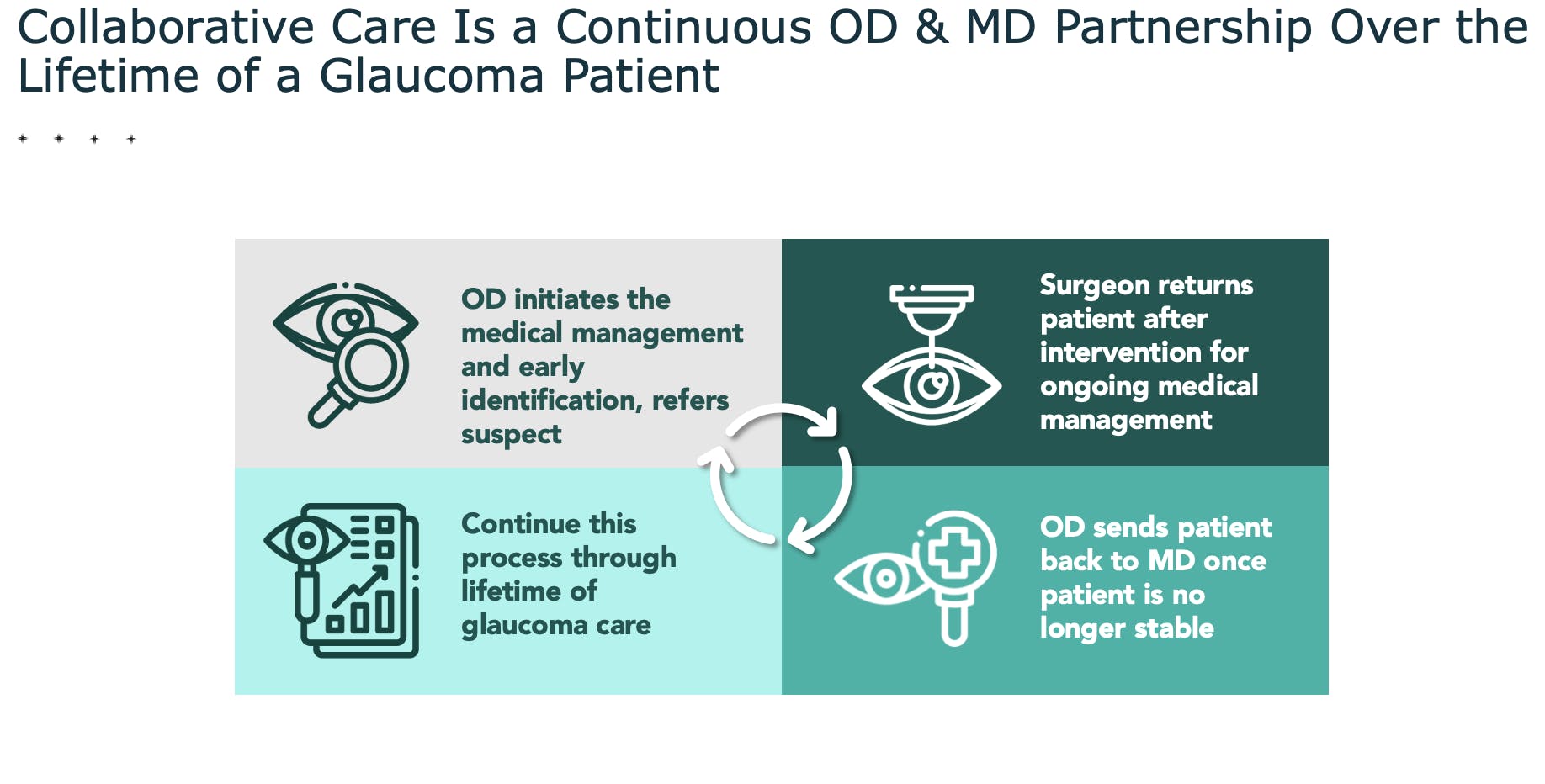
Dr. Ike Ahmed: The demand continues to grow beyond what we see with our aging population. We see this as more interventions come on board just as we start with cataract surgery too. I think the conversation is really important and the reality is that you just can't do it yourself.
Can you share a real-world example of collaborative interventional glaucoma care?
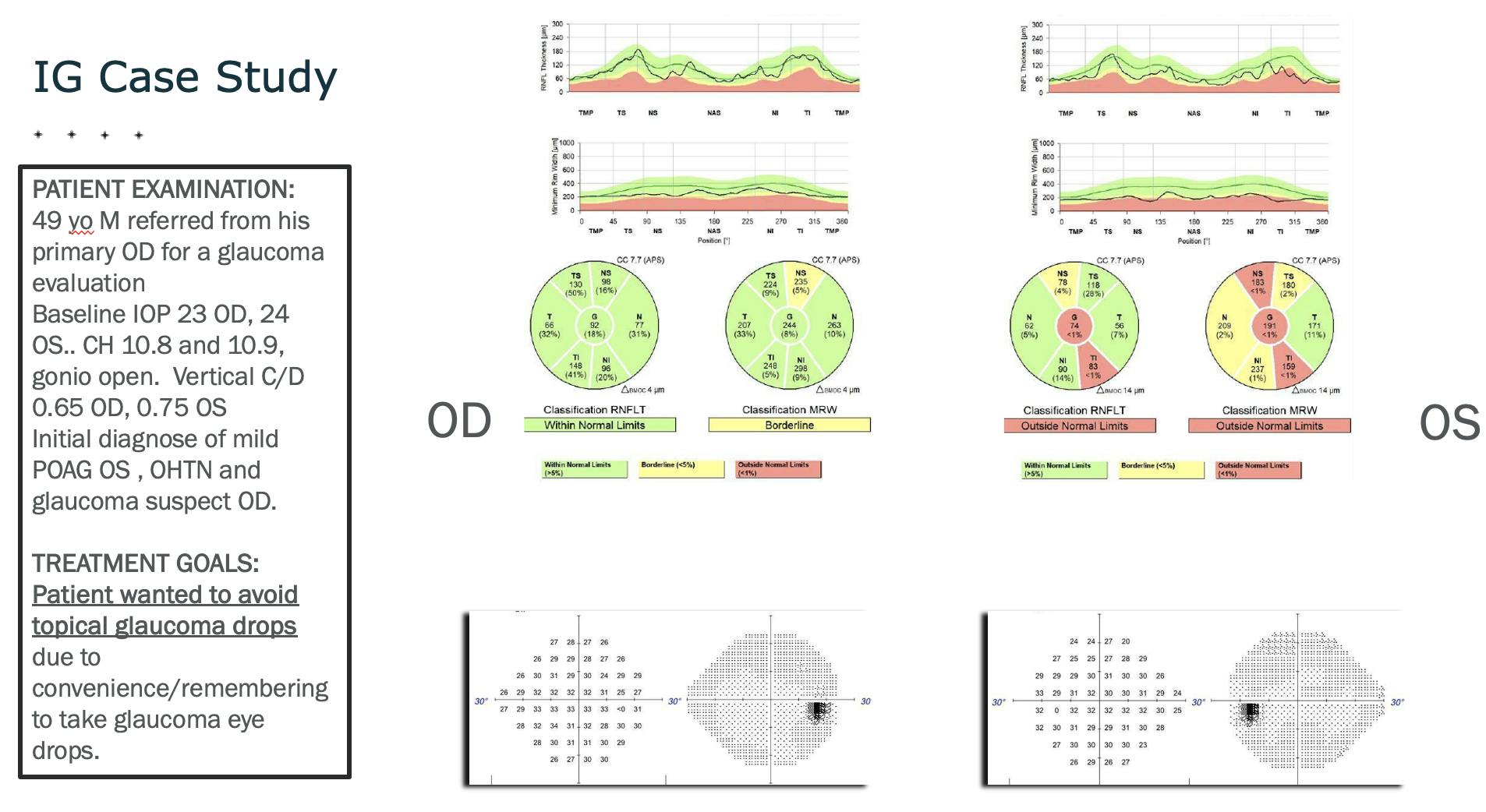
Dr. Ibach: We had a 49-year-old patient referred to us from his primary optometrist for ocular hypertension (Figure 2). Ultimately, we opted for a selective laser trabeculoplasty, which Dr. Berdahl performed, rather than beginning drops, based on the patient’s goals and our shared clinical judgment. Over time, the patient cycled between our care and his primary optometrist, and, as his treatment requirements evolved, we introduced iDose TR (travoprost intracameral implant) 75 mcg and adjusted his therapy accordingly. Overall, this patient has responded well to a combination of drops and procedures.
How do you educate and engage your referral network?
Dr. Berdahl: We host annual educational events focused on glaucoma, specifically how to manage glaucoma in this day and age, which have been helpful. We also offer mini fellowships so that optometrists can see this interventional, collaborative care firsthand.
Dr. Teymoorian: At the end of the day, it is all about giving patients the best experience possible. My advice is to work with one optometrist at a time. This way, conversations are more streamlined and centered around how to manage glaucoma, both from a general perspective and from a case-by-case basis.
Dr. Ibach: It is important to emphasize outcomes over procedures. Referring providers should initiate the discussion without immediately locking patients into a specific treatment. For example, it is helpful to say, “You may benefit from a laser or procedural pharmaceutical approach,” not, “You’ll get this specific implant.”
Dr. Ike Ahmed: It's always about communication. I think the more communication we have the better. When I make a decision, whether it's an IOL choice or it's a glaucoma choice, I always communicate that to everyone involved. Not just their primary eye care provider, but also to their primary care provider or family physician, who the patient may decide to go to and if they have a question to ask about that.
What’s the most important factor in successfully operationalizing interventional glaucoma in your practices?
Dr. Teymoorian: It truly begins with the physician mindset. If an eye care provider does not believe in interventional glaucoma, then the logistics will not matter. Once everyone is on board, adjustments in scheduling, staffing, and patient flow can support intervening earlier and more efficiently.
Dr. Ibach: In our practice, simplifying protocols and building systems that support faster implementation of interventional techniques has been instrumental. The focus is on setting our team up for success however we can.
Dr. Berdahl: Sometimes the best thing we can do for patients is getting out of our comfort zone and explore the field’s emerging treatment options. Change takes champions, and it often takes converting skeptics by referencing real-world and published data that demonstrates the benefits of interventional glaucoma procedures. I do not villainize drops because there is certainly a role for them; however, interventional procedures are quickly becoming the primary therapeutic preference in glaucoma care.


