


A 2006 Mayo Clinic survey identified the seven key traits of the model doctor: confident, empathetic, humane, personal, forthright, respectful, and thorough.1-3 We glaucoma doctors must possess these characteristics and more.
We usually observe patients with this disease for many years, and a supportive doctor-patient relationship is key to optimal management. We deal with the challenge of treating patients diagnosed with the number-one cause of irreversible vision loss in the world. When they hear a diagnosis of glaucoma, they immediately think, “I’m going blind.” That fear leads to compulsive attention by some to their treatment regimen and to denial in others. Medical adherence is a perpetual problem.
Our field is one in which patients’ understanding of their disease is essential to improving outcomes. For that reason, we must embrace the philosophy that patients’ education and a positive doctor-patient relationship make a real difference in saving sight. To adjust to their needs, we must be chameleons.
THE CHAMELEON
Each patient has unique needs. On any given day, I find myself switching among various roles (Table). My patients demand that I be an educator, advocate, counselor, negotiator, communications specialist, cheerleader, and salesperson. I could add chef to that list after marinating eyes with various combinations of drops to obtain optimal results.
Although it is our role to diagnose and manage glaucoma, it is essential that we glaucoma doctors empower patients. We must let them know that what they do on a daily basis is more important than what we do during their office visits.
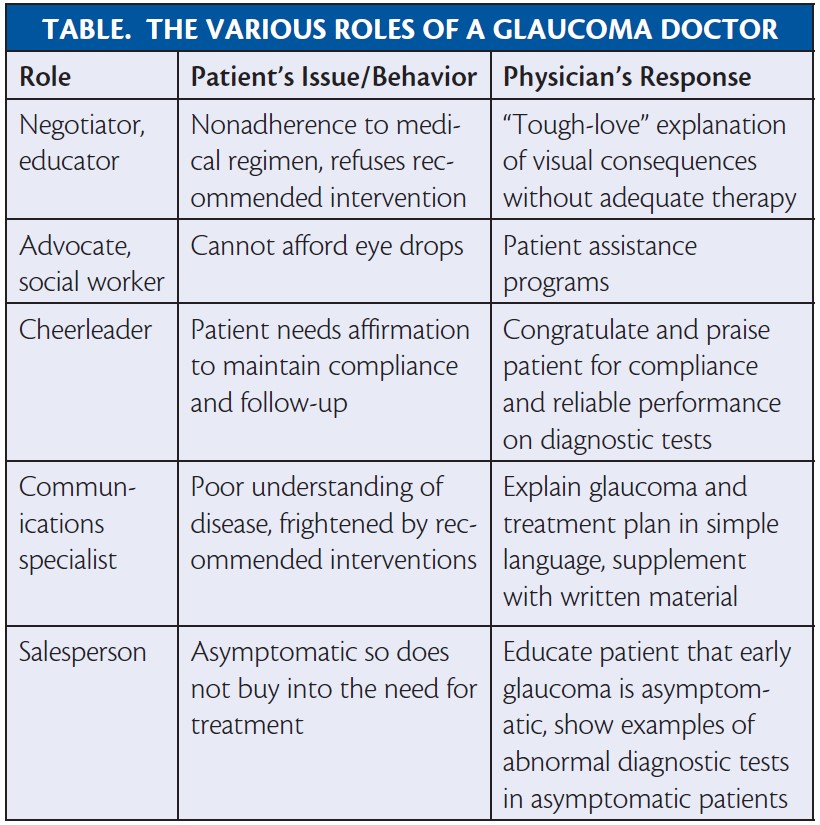
We must be attentive. We listen in order to discern an individual patient’s concern and then do our best to address it, because what we think is the main issue may not be what worries the patient. Unless we bridge that disconnect, we cannot deliver effective care.
COMMUNITY
Colleagues in other ophthalmic subspecialties may not understand why we devote ourselves to such an “unglamorous” field. To me, the best characteristic of glaucoma doctors is our sense of community, our view that we are all in this together. Is it collective masochism or collegiality?
My colleagues’ devotion to patient care and innovation motivates me to persevere in a challenging medical environment where our patients depend on us to advocate for them so that they can maintain access to their medications and to us, their doctors. This incredible generosity of spirit and commitment to the education of our patients and peers, to innovation, and to technology move the entire profession forward. n
Eydie Miller-Ellis, MD, is a professor of clinical ophthalmology and the director of the Glaucoma Service at the Scheie Eye Institute of the University of Pennsylvania Health System in Philadelphia. Dr. Miller-Ellis may be reached at (215) 662-8188; eydie.miller-ellis@uphs.upenn.edu.
1. Hitti M. 7 Key traits of the ideal doctor. WebMD Health News. http://www.webmd.com/news/20060309/7-key-traits-of-ideal-doctor. Published March 9, 2006 Accessed July 7, 2015.
2. Bendapudi N M, Berry LL, Frey KA, et al. Patients’ perspectives on ideal physician behaviors. Mayo Clin Proc. 2006;81(3):338-344.
3. Li JT. The quality of caring. Mayo Clin Proc. 2006;81(3):294-296.
