


Laser treatment can play a key role in the management of primary angle-closure glaucoma (PACG). The choice of laser therapy usually depends on the mechanism responsible for the anatomic configuration predisposing a patient to PACG. This review summarizes the indications for performing a laser peripheral iridotomy (LPI), iridoplasty, and endoscopic cyclophotocoagulation (ECP).
LASER PERIPHERAL IRIDOTOMY
LPI is the primary laser surgery for the treatment of PACG. Traditionally, a pupillary block mechanism has been thought to cause approximately 90% of cases of PACG, but recent data have suggested that a large proportion is related to plateau iris anatomy.1,2 LPI is still considered as a first-line treatment in these situations, however, because there is usually a component of pupillary block even when a plateau iris exists. Also, a plateau iris cannot truly be diagnosed until after an LPI is performed.
The indication for performing an LPI is an occludable angle for 180º (two quadrants) or more on gonioscopy. An angle is occludable if the examiner can observe only the anterior trabecular meshwork or less without indentation. Gonioscopy should be performed under dark conditions to prevent miosis of the pupil, and the height and intensity of the slit-lamp beam should be minimized so that no light enters the pupil. If necessary, the examiner can slightly tilt the goniolens in order to peer over a high lens vault.
LPI should not be performed on eyes with more than 180º of peripheral anterior synechiae (PAS). The reason is that the remaining trabecular meshwork may not be able to accommodate the inflammation induced by the LPI, and the IOP may spike as a result.
Recent studies have suggested that the LPI should be in the horizontal position to help avoid postoperative visual disturbances such as photopsias.3 Also, creating a sufficiently large iridotomy can be important for ensuring opening of the angle.4 Figure 1 presents a patient whose angle was occludable even in the presence of a patent LPI. After enlargement of the LPI, it is clear that the angle has opened substantially (Figure 2).
IRIDOPLASTY
The use of argon laser iridoplasty for angle closure is controversial. There is a paucity of prospective research evaluating the safety and efficacy of this procedure. A recent study from Beijing compared LPI alone versus LPI plus argon laser iridoplasty for the treatment of primary angle closure and PACG.5 One year postoperatively, there were no significant differences between the two groups in terms of IOP reduction, corneal endothelial cell counts, or overall complication rates. There was a possible prevention of 1 clock hour of PAS in the combined laser group compared to the LPI-only group. Ritch et al have shown an improvement in the angle architecture after iridoplasty.6 This procedure may be particularly helpful in cases of plateau iris with a persistent narrow angle despite LPI.
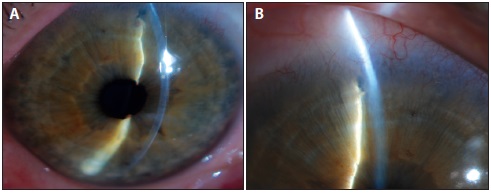
Figure. 1. A 38-year-old man with microphthalmia has persistent occludable angles after LPI. At the slit lamp, the peripheral anterior chamber is shallow (A) but deepens after the LPI is enlarged (B).
A prospective study of the long-term effects of iridoplasty versus observation in post-LPI eyes that are still occludable would help guide clinicians. Until iridoplasty is clearly demonstrated to be of clinical benefit to patients with occludable angles after LPI, I will avoid using this procedure.
ENDOSCOPIC CYCLOPHOTOCOAGULATION
Endoscopic cyclophotocoagulation (ECP) may have particular advantages in the treatment of PACG aside from the IOP-lowering effects of ciliary body destruction and suppressed aqueous production. Some surgeons have advocated a form of ECP, known as endocycloplasty, to improve the angle architecture, thus enhancing aqueous outflow.7 With endocycloplasty, laser energy is directed at the posterior portion of the ciliary process to cause shrinkage and concurrent retraction of the process and iris root posteriorly. Endocycloplasty has been used primarily as an adjunct with phacoemulsification cataract extraction and may be indicated for plateau iris if ciliary processes are directed anteriorly.
When most of the angle is closed by PAS, however, it may not be prudent to use ECP, because there is usually a substantial amount of inflammatory debris that may have difficulty exiting the anterior chamber and cause an IOP spike.
LENS REMOVAL: THE ULTIMATE THERAPY?
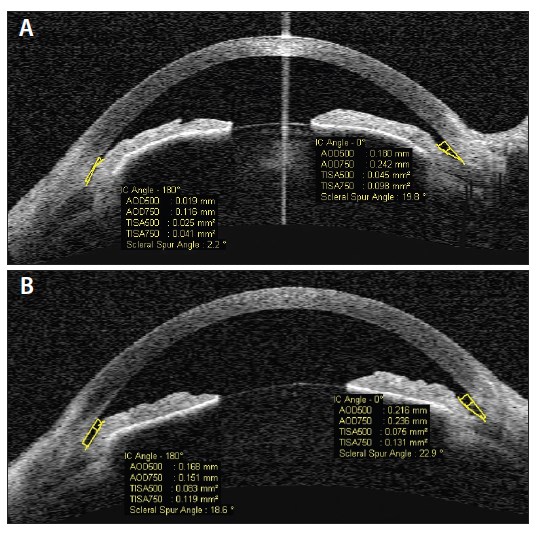
Figure 2. Shown here is the same patient described in Figure 1. Anterior segment optical coherence tomography prior to enlargement of the LPI (A) and after enlargement (B). The angle has widened significantly.
Ultimately, the most effective treatment for patients with ACG—and perhaps even a cure in many cases—is to remove the lens, whether cataractous or clear. Studies from Hong Kong have demonstrated a significant reduction in IOP and the number of glaucoma medications in PACG cases.8,9 Clear lens extraction has also been shown to be effective in treating PACG.10
CONCLUSION
Laser treatment has been a mainstay for PACG, and LPI remains the first-line approach to most cases. If the angle remains occludable and/or if the IOP is still uncontrolled, however, iridoplasty or ECP may be a reasonable adjunctive procedure to help improve angle anatomy. n
Shan Lin, MD, is a professor of clinical ophthalmology and director of the Glaucoma Service, Department of Ophthalmology, University of California, San Francisco. Dr. Lin may be reached at (415) 514-0952; lins@vision.ucsf.edu.
1. Kumar G, Bali SJ, Panda A, et al Prevalence of plateau iris configuration in primary angle closure glaucoma using ultrasound biomicroscopy in the Indian population. Indian J Ophthalmol. 2012;60(3):175-178.
2. He M, Friedman DS, Ge J, et al. Laser peripheral iridotomy in eyes with narrow drainage angles: ultrasound biomicroscopy outcomes. The Liwan Eye Study. Ophthalmology. 2007;114(8):1513-1519.
3. Vera V, Naqi A, Belovay GW, et al. Dysphotopsia after temporal versus superior laser peripheral iridotomy: a prospective randomized paired eye trial. Am J Ophthalmol. 2014;157(5):929-935.
4. Bochmann F, Johnson Z, Atta HR, Azuara-Blanco A. Increasing the size of the a small peripheral iridotomy widens the anterior chamber angle: an ultrasound biomicroscopy study. Klin Monbl Augenheilkd. 2008;225(5):349-352.
5. Sun X, Liang YB, Wang NL, et al. Laser peripheral iridotomy with and without iridoplasty for primary angle-closure glaucoma: 1-year results of a randomized pilot study. Am J Ophthalmol. 2010;150(1):68-73.
6. Ritch R, Tham CC, Lam DS. Argon laser peripheral iridoplasty (ALPI): an update. Surv Ophthalmol. 2007;52(3):279-288.
7. Tam DY. Treating glaucoma: in defense of ECP. Review of Ophthalmology. March 2013. http://bit.ly/1xd1Ls2.
8. Tham CC, Kwong YY, Leung DY, et al. Phacoemulsification versus combined phacotrabeculectomy in medically controlled chronic angle closure glaucoma with cataract. Ophthalmology. 2008;115(12):2167-2173.e2.
9. Tham CC, Kwong YY, Leung DY, et al. Phacoemulsification versus combined phacotrabeculectomy in medically uncontrolled chronic angle closure glaucoma with cataracts. Ophthalmology. 2009;116(4):725-731.e1-3.
10. Barbosa DT, Levinson AL, Lin SC. Clear lens extraction in angle-closure glaucoma patients. Int J Ophthalmol. 2013;6(3):406-408.
