


The goal of glaucoma treatment is to prevent vision loss. Because visual acuity is not affected until late in the disease, visual field testing is how eye care specialists monitor a patient’s visual function. This article discusses how to recognize visual field progression in glaucoma.
THE BASICS
The first requirement is a good baseline. On the Humphrey Field Analyzer (HFA; Carl Zeiss Meditec), this means obtaining two fields in a fairly short time frame.1,2 Some recommend performing three fields in the first year to establish a baseline. Two to three visual field tests done in a short period of time at diagnosis will also identify patients whose glaucoma may be progressing rapidly and who therefore need aggressive treatment. The second requirement is that the field be reliable.
Many clinicians immediately look at pattern defects while ignoring that some glaucoma causes diffuse loss.1 Not all generalized depression is due to cataract.
Probably the most important basic point is that a field with apparent worsening has to be repeated. In the Ocular Hypertension Treatment Study (OHTS), 86% of visual field abnormalities detected during follow-up were not confirmed on repeat testing.3 Sound clinical judgment is a necessity. For instance, if a patient has advanced disease, elevated IOP, and a disc hemorrhage, there is no need for a repeat field. In a patient with a worsening visual field but otherwise stable glaucoma, a repeat visual field test is paramount, especially if the eye care provider is considering a major change in management.
LONG-TERM FLUCTUATION
How do practitioners determine if the patient before them has a worsening visual field? The first thing to ascertain is whether or not any change is outside the bounds of expected long-term fluctuation. According to Chauhan et al,4 it takes three fields per year to detect a real change of 4 dB in mean deviation over 2 years. Outside a research setting, this is far more often than most practitioners obtain visual fields.5 What is a busy clinician to do?
A loss of 1 dB per year is considered a moderate rate of disease progression. Any significant worsening (at least 1 dB) of pattern standard deviation in a reliable field may therefore indicate a need to repeat the visual field to confirm progression. In Figure 1, the patient’s most recent visual field is down 2.5 dB from the best baseline. Looking at the upper portion of the figure shows that, although the visual field has fluctuated, the trend line is flat.
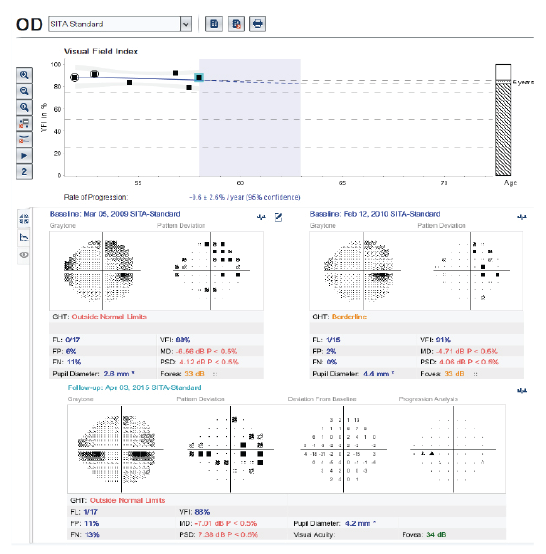
Figure 1. Visual field test of a patient with long-term fluctuation but no real progression. The top image displays the visual field index (VFI), a global measure of visual function.
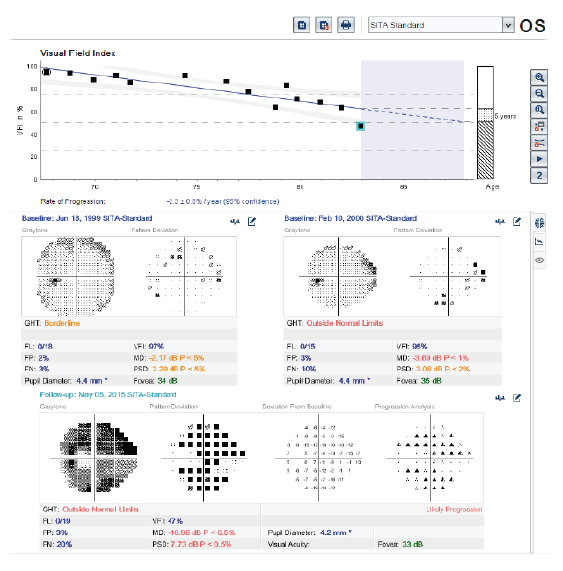
Figure 2. The VFI of a patient whose glaucoma is progressing over the course of many years.
DETECTING PROGRESSION
In a glaucoma suspect or a patient with early glaucoma, detecting change from normal to abnormal may actually be easier than detecting progression in an eye with an existing scotoma. The change from “within normal limits” to “borderline” on the Glaucoma Hemifield Test means that, at most, there is only a 3% chance that the field is normal.1 Combined with a pattern standard deviation that has a P value of less than 1% and point clusters (preferably 3) in the abnormal range, the field can be interpreted as abnormal. The test needs to be repeated, as previously mentioned, but if the result is confirmed, the practitioner can be reasonably certain that a change has occurred.
In a patient with an existing scotoma on the visual field, progression usually manifests as deepening or extension of that defect.1 The HFA’s Glaucoma Progression Analysis software offers guidance. Triangles that are open, half filled, or black call attention to areas that may be worsening. The statistical analysis also indicates whether the field has “possible” or “likely” progression.
A recent addition to the HFA is the VFI. Based on work by Bengtsson and Heijl,6 it represents a percentage of visual function and is highly weighted toward the central visual field. Like mean deviation, the VFI provides a useful measure of overall visual field performance and is less sensitive to cataractous changes. The slope of the change in the first five fields is a good predictor of future progression (Figure 2).7 A problem with the VFI, however, is that it is less predictable for advanced disease, as when the mean deviation reaches the range of -20 dB.1
CONCLUSION
No change in management should be made on the basis of the visual field alone. As radiologists say, “clinical correlation recommended.” Has the patient’s IOP been rising? Is the field change consistent with the optic nerve on examination or imaging? Could a cataract be causing a generalized depression of the overall field? Was the correct refraction used? Was the correct eye tested? (This has happened to me [WB] where the HFA showed a scotoma in the “nasal” field corresponding to the actual blind spot!)
Clinicians must take all factors into account, including the patient’s age, general health, medications being used, adherence to medical therapy, etc. Putting all of the data together will enable them to decide the best strategy for managing each patient. n

William H. Bray, MD, is an assistant professor of clinical ophthalmology at the University of Missouri in Columbia, Missouri. He acknowledged no financial interest in the product or company mentioned herein. Dr. Bray may be reached at (573) 882-1028; braywh@health.missouri.edu.

Steven R. Sarkisian Jr, MD, is the glaucoma fellowship director at the Dean McGee Eye Institute, and he is a clinical professor at the University of Oklahoma College of Medicine in Oklahoma City. He acknowledged no financial interest in the product or company mentioned herein. Dr. Sarkisian may be reached at (405) 271-1093; steven-sarkisian@dmei.org.
1. Nouri-Mahdavi K, Nassiri N, Giangiacomo A, Caprioli J. Detection of visual field progression in glaucoma with standard achromatic perimetry: a review and practical implications. Graefes Arch Clin Exp Ophthalmol. 2011;249:1593-1616.
2. Mayer H, Weitzman M, Caprioli J. Automated perimetry in glaucoma. In: Walsh TJ, ed. Visual Fields: Examination and Interpretation. New York: Oxford UP; 2011:146.
3. Keltner JL, Johnson, CA, Quigg JM, et al. Confirmation of visual field abnormalities in the Ocular Hypertension Treatment Study. Arch Ophthalmol. 2000;118:1187-1194.
4. Chauhan BC, Garway-Heath DF, Goni FJ, et al. Practical recommendations for measuring rates of visual field change in glaucoma. Br J Ophthalmol. 2008;92:569-573.
5. Friedman DS, Nordstrom B, Mazaffari E, Quigley HA. Glaucoma management among individuals enrolled in a single comprehensive insurance plan. Ophthalmology. 2005;112:1500-1504.
6. Bengtsson B, Heijl A. A visual field index for calculation of glaucoma rate of progression. Am J Ophthalmol. 2008;145:343-353.
7. Bengtsson B, Patella VM, Heijl A. Prediction of glaucomatous visual field loss by extrapolation of linear trends. Arch Ophthalmol. 2009;127:1610-1615.
