


Open-angle glaucoma is a chronic condition marked by structural changes to the optic nerve and retinal nerve fiber layer (RNFL) with associated losses of visual function. The goal of glaucoma management is to reduce the rate of progression to the extent necessary to prevent visual disability during the patient’s lifetime. To achieve this goal, physicians must detect and quantify glaucomatous progression.
For a host of reasons, assessing progression is difficult, partially because of the variability inherent in all measurement devices and the varying ways that the disease can progress.1 Evaluations of the optic disc and the RNFL are crucial to diagnosing glaucoma, but for monitoring the condition, visual fields historically have been considered to be the more important tool.
HISTORICAL PERSPECTIVE
The introduction of time-domain optical coherence tomography (TD-OCT) more than 15 years ago advanced the detection of RNFL loss but was not helpful for detecting or quantifying glaucomatous progression. One problem was the technology’s inability to register serial images and the low numbers of retinal A-scans that TD-OCT could provide. In addition, data analysis applications were more limited than with perimetry. Guided Progression Analysis with the Humphrey Field Analyzer perimeter (Carl Zeiss Meditec) offered sophisticated progression analysis methods that were not available on TD-OCT.
Introduced in 2006, spectral domain OCT (SD-OCT) produced more than 50 times as much imaging data as TD-OCT, providing a significant step-function improvement in image and data quality. An important advance was SD-OCT’s ability to register (overlay) OCT images that were taken over time, improving users’ ability to identify progressive loss.
OCT has continued to evolve, with speedier acquisition times (limiting motion artifacts), improved segmentation algorithms, better registration and image quality, incorporation of eye tracking, and improved data analysis. As a result, physicians use SD-OCT images to reliably detect and quantify progression. Although most OCT devices use both RNFL thickness and optic disc measurements (rim area and cup volume) to identify results that fall outside normal ranges, OCT primarily relies upon RNFL analysis to detect and quantify progression.1 Importantly, progression analysis is not dependent upon the use of a normative database.
PATIENTS WHO BENEFIT
Monitoring for progression is useful in two populations: patients with glaucomatous damage and glaucoma suspects, who by definition do not have proven glaucomatous damage. In glaucoma patients, clinicians look for deepening or expansion of existing areas of damage and also for the development of newly damaged areas. In glaucoma suspects, practitioners look for change to occur from presumably normal baseline findings. In both situations, the task is as much to look for a statistically significant change from baseline and subsequent tests as it is to look for measurements that depart from normal limits.
WHAT TO LOOK FOR
Just as in perimetry, typical glaucoma patients can lose one-third of their average RNFL thickness before falling below normal limits on OCT. On Cirrus SD-OCT (Carl Zeiss Meditec), the statistically normal range for average RNFL thickness (the green zone) covers a range of 32 µm, from 107 to 75 µm.2 For context, patients having mean RNFL thicknesses of 60 µm are at high risk of already having visual disability, leaving physicians little room to maneuver once measurements have fallen below the green zone.
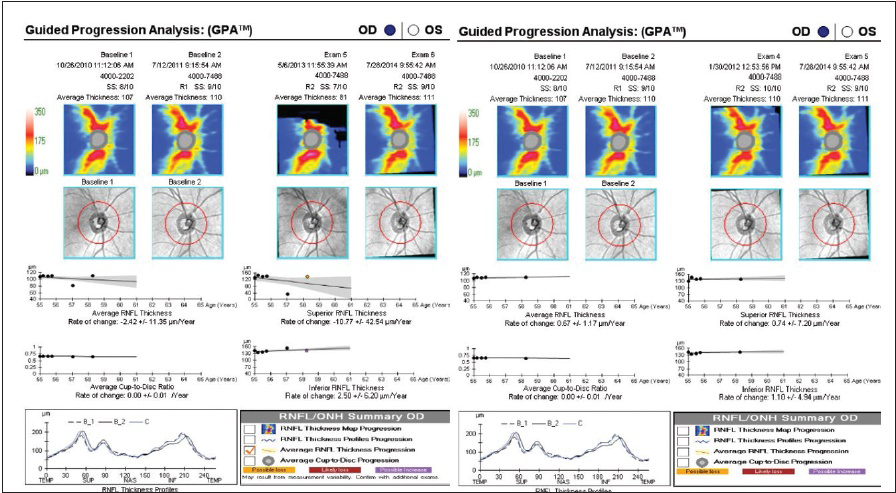
Figure 1. Guided Progression Analysis for the right eye. Examination 5, dated May 6, 2013, is not an acceptable image, as seen by the missing data on the top. When the analysis took place, it appears that the disease became significantly worse (A). Another image shows marked improvement and demonstrates that progression did not occur (B). If image A is removed from the data set, the trend line for average and superior RNFL thickness will be flat and no longer show a significant loss of tissue.
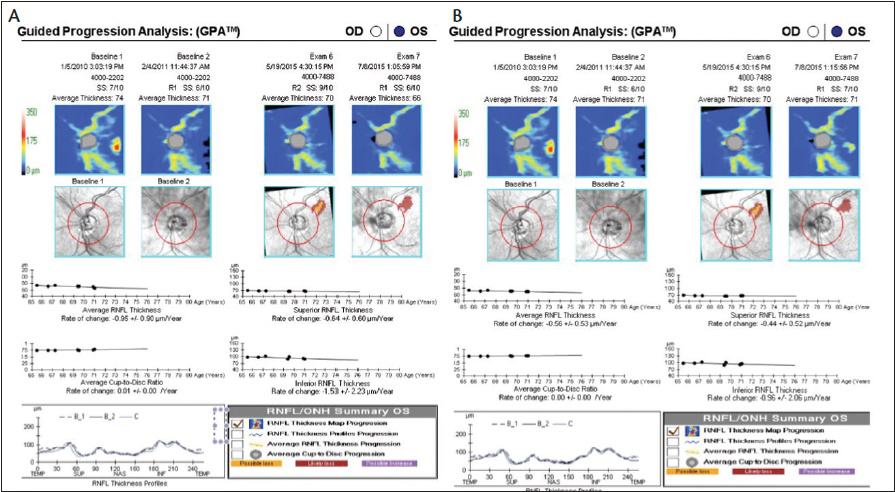
Figure 2. Guided Progression Analysis for the left eye. Examination 7, dated July 8, 2015, has a signal strength of six and an average RNFL thickness of 66 μm (A). When the examination was repeated on the same day, a better signal strength was achieved (7/10), and the average thickness improved to 71 μm (B).
On Cirrus, a statistically significant decrease in average RNFL thickness is 5 µm.2,3 The value 5 µm was chosen because decreases of this magnitude have been found to occur less than 2.5% of the time due to random measurement variability.2 For this reason, one method of detecting developing disease in glaucoma suspects is to look for confirmed decreases of 5 µm or more in average RNFL thickness. Changes of this magnitude that are confirmed on a second test have been reported to randomly occur less than 1% of the time.4 A recent study showed that lead time may be gained when using OCT to detect glaucoma conversion in glaucoma suspects versus the Humphrey perimeter.5
Progression is evaluated with OCT by either event or trend analysis. Event analysis on the Cirrus printout is color coded to display changes in RNFL thickness when at least 20 contiguous pixels show statistically significant change.1 This approach allows localized change to be detected. Another way to evaluate progression with OCT is to measure its rate by watching the average rate of change per year provided.6 Still, OCT is useful for only early to moderate stages of glaucomatous damage; a floor effect for RNFL measurements is present in patients who have more than moderate damage. A measurement with the Cirrus OCT will never go below approximately 50 µm.7
PEARLS FOR USING OCT
The clinician needs to ensure that only acceptable images are included in data sets for analyzing progression. The technician may have recognized a poor image, and another image may have been taken. Often, however, the first image was not deleted. When Guided Progression Analysis takes place, the device defaults to the first image taken on any given day, which may lead to an erroneous progression alert. It is therefore important to delete substandard images, even if there is no good second image for that visit (Figure 1). Also, RNFL thickness measurements correlate with signal strength for all OCT devices. For the Cirrus OCT, only images with a signal strength of seven or greater should be used. Disease may appear to have progressed when a scan with reduced signal strength is included and compared to better images (Figure 2).
Weigh in on this Topic Now!
Do you currently use OCT to monitor progression in patients with early to moderate stages of glaucoma?
Answer at https://www.surveymonkey.com/r/SYG6PR2.
CONCLUSION
SD-OCT allows detection of multiple steps of statistically significant change, even while patients have normal RNFL thicknesses. When properly used, the technology can complement perimetric assessment, as clinicians manage patients with glaucoma over time. n
The author would like to thank V. Michael Patella, OD, for his input on this article.

Murray Fingeret, OD, is the chief of the Optometry Section, Department of Veterans Affairs, New York Harbor Healthcare System, Brooklyn, New York. He is a consultant to Carl Zeiss Meditec and has received research support from Canon, Carl Zeiss Meditec, Heidelberg Engineering, and Topcon. Dr. Fingeret may be reached at murrayf@optonline.net.
1. Leung CK. Diagnosing glaucoma progression with optical coherence tomography. Curr Opin Ophthalmol. 2014;25(2):104-111.
2. Leung CK, Cheung CY, Weinreb RN, et al. Retinal nerve fiber layer imaging with spectral-domain optical coherence tomography: a variability and diagnostic performance study. Ophthalmology. 2009;116:1257-1263.
3. Mwanza J, Chang R, Budenz D, et al. Reproducibility of peripapillary retinal nerve fiber layer thickness and optic nerve head parameters measured with Cirrus HD-OCT in glaucomatous eyes. Invest Ophthalmol Vis Sci. 2010;51(11): 5724-5730.
4. Feuer WJ, Durbin MK. Performance of confirmation as a strategy to retain acceptable specificity and sensitivity when monitoring glaucoma over multiple visits. Poster presented at: ARVO Annual Meeting; May 3-7, 2009; Fort Lauderdale, FL.
5. Kuang TM, Zhang C, Zangwill LN, et al. Estimating the lead time gained by optical coherence tomography in detecting glaucoma before development of visual field defects [published online ahead of print July 18, 2015]. Ophthalmology. doi:10.1016/j.ophtha.2015.06.015.
6. Kouros NM, Caprioli J. Measuring rates of structural and functional change in glaucoma. Br J Ophthalmol. 2015:99:893-898.
7. Leung CK, Liu S, Weinreb RN, et al. Evaluation of retinal nerve fiber layer progression in glaucoma: a prospective analysis with neuroretinal rim and visual field progression. Ophthalmology. 2011;118:1551-1557.
