


Glaucoma is a slow and progressive degenerative disease that is often diagnosed after patients have sustained damage to the optic nerve and/or visual field defects. The discovery of a noninvasive diagnostic biomarker for glaucoma could allow clinicians to identify and initiate treatment of susceptible individuals before they experience substantial vision loss.
GOALS
The goal is to use a biomarker in a simple clinical test that is not overly expensive but that is specific and sensitive for the disease. Ideally, the biomarker would serve one of three purposes:
• identify individuals in the general population of patients who are at greatest risk of developing glaucoma and who should see an eye care specialist immediately
• differentiate between patients at high risk of glaucomatous progression who thus require frequent monitoring, drug treatment, and intervention versus those who need less frequent follow-up
• indicate which glaucoma patients will respond to a specific medication or treatment successfully, moderately successfully, or not at all
Molecular markers of susceptibility may be the most important, because clinical tests such as visual fields and optic nerve examinations are not specifically designed to capture an individual’s susceptibility to the disease of interest such as glaucoma. Clinical characteristics are the subject of clinical tests, which determine the presence or the absence of the disease but are not necessarily designed to determine susceptibility.
Research to establish disease susceptibility biomarkers may depend on nonhuman models. These models typically have a short lifespan so that investigators can capture important aspects of the disease in reduced time and at lower expense to arrive at a discovery.
DISCOVERY AND VALIDATION
We used a proteomic approach (Omics) to identify a protein termed cochlin that was differentially expressed in the human glaucomatous trabecular meshwork (TM) tissue1 and subsequently also observed within the TM of mice naturally genetically susceptible to developing glaucoma (the DBA/2J mouse strain).2 The function of the protein was unknown at the time of discovery in 2005. Nonglaucomatous control eyes lacked the protein, but it was present in portions of the glaucomatous TM1,3 before the segmental blockage of aqueous humor outflow became an established term.4 Parallel segmental TM blockage and cochlin deposits in DBA/2J mice also occur in humans (Figure 1). Drawing an analogy from von Willbrand factor A,5 a protein associated with hemodynamic systems, we were able to establish that the main function of cochlin in the aqueous humor dynamics is to act as a solution state mechanosensor.6 Cochlin also works in tandem with membrane mechanosensitive transducers.7 The protein, therefore, facilitates the movement of TM cells in response to mechanical forces such as shear stress.
A systemic biomarker carried in body fluids is easily accessed for detection. One potential problem is that it could be a marker for stress associated with multiple organs and not be sensitive. Alternatively, the biomarker may be altered by a variety of conditions in different organs. Cochlin has been detected in the retina and the optic nerve in very low quantities but not in the blood or urine. The levels of cochlin in the retina or the optic nerve have not been studied by any other group in a systematic fashion. Thus, we do not know whether this level of cochlin relates to the disease or provides insight into a person’s susceptibility to disease progression. The importance of cochlin in glaucoma, however, has also been suggested by an independent group.8 Moreover, a commercial enterprise, Sylentis in Spain, has filed an independent patent with cochlin as a potential glaucoma treatment target.
The Omics discovery approach has also identified a potential susceptibility marker as possibly one of the long-chain phosphatidylcholines in total phospholipids as a potential susceptibility marker.9 Our independent analyses using a different methodological approach corroborated this finding in local TM tissue.10 This biomarker, however, has not received wide attention as of yet. Another problem is that a lack of suitable reagents make lipid biomarker detection more complicated in clinical settings.
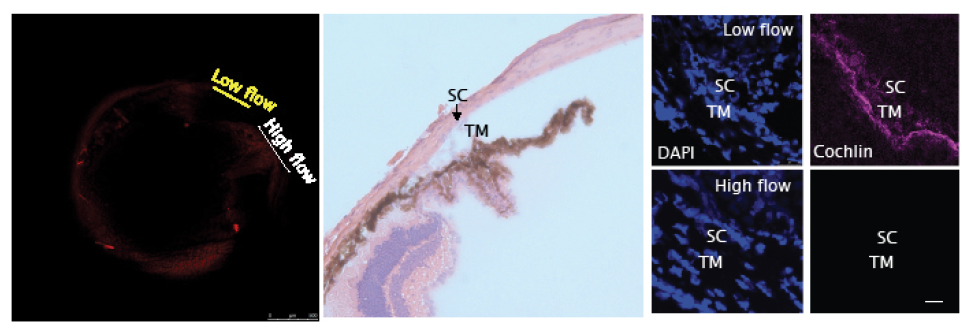
Figure 1. Segmental blockage of aqueous humor outflow and segmental cochlin deposits in DBA/J2 mice. The Qtracker 655 (Thermo Fisher Scientific) demonstrates, as in human TM, regions of high and low flow (A). A histologic hematoxylin-eosin (H&E) stained section showing the TM region and Schlemm canal in DBA/J2 mice (B). The TM region in higher magnification (bar = 20 μm) shows cellularity with DAPI staining and specific staining for cochlin. Prominent cochlin deposition has been observed in the regions of low flow (C).
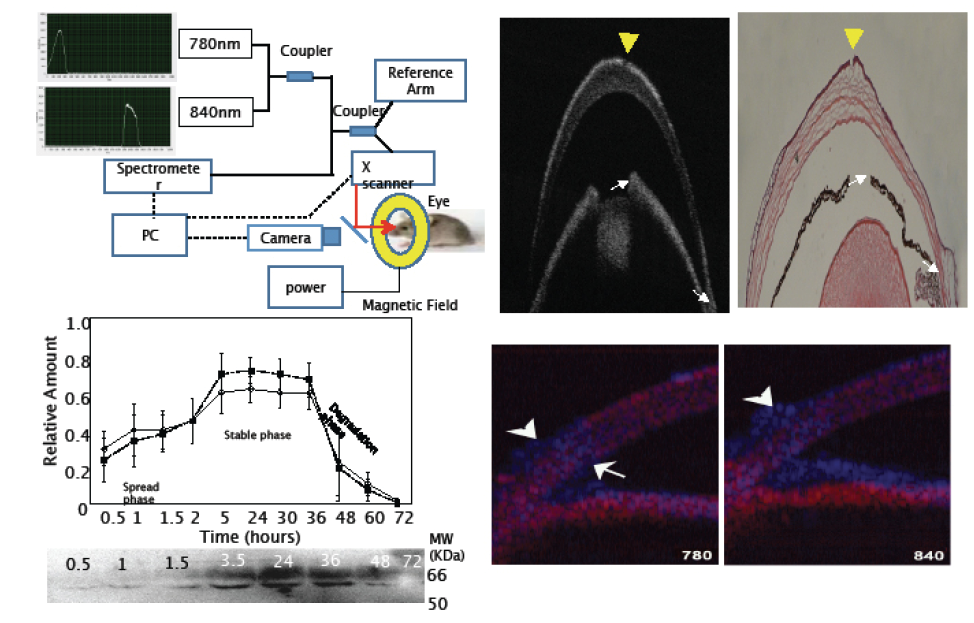
Figure 2. A schematic diagram of the authors’ customized optical coherence tomography (OCT) device (A). The OCT (B) and H&E (C) images, with landmarks indicated by arrows. Relative amount (signal) determination using near infrared (NIR) dye (solid line; diamonds) and anticochlin couple magnetic beads (dashed line; solid squares). The spread, stable, and degradation phases in the time span (in hours postinjection) have been shown. Offline Western analyses at each point have been shown below for indicated time interval (in hours). Stable phase is achieved 3.5 hours after antibody injection and stays for 24 hours (D). The 780-nm (E) and 840-nm (F) superimposition of before (red) and after (blue) antibody injection. The injected region shows local edema (arrowhead). Arrow indicates TM region. Adapted with permission from Wang et al.11
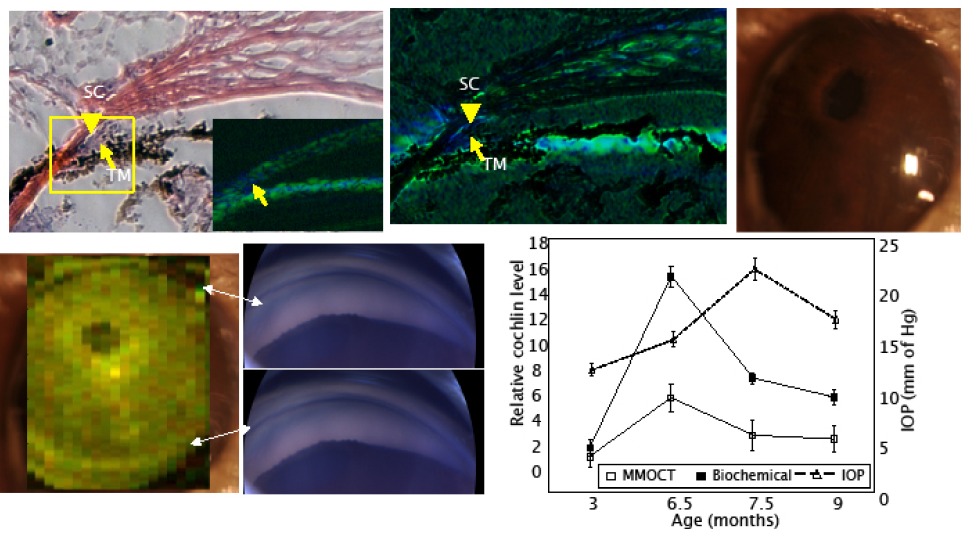
Figure 3. Anatomic image (H&E stain), arrow, and arrowhead show TM and Schlemm canal. In situ: superimposed image of 780 nm (blue; before) and 840 nm (green; after IR dye injection) (A). Superimposed, spectroscopic OCT and anatomic image with TM region (arrow; blue) after injection; arrowhead indicates region of Schlemm canal (B). Representative anatomic image for identification of the location of regions from OCT images (C). Representative superimposition of anatomic image and one generated from OCT image analyses (D). A special microscope generated this image of the TM region in the anterior chamber for the identification of the TM region in the software-generated three-dimensional OCT image stack (E). Representative estimation of cochlin in mice at 3 to 9 months of age with indicated IOP using magnetomotive OCT approach and endpoint biochemical (Western blot) analyses. Mean ± standard deviation from animals (n = 10) (F). Adapted with permission from Wang et al.11
DETECTION SYSTEM FOR LONGITUDINAL FOLLOW-UP
Our group has investigated glaucoma susceptibility and has developed detection devices and techniques pertaining to cochlin. We studied the DBA/2J mouse strain, which spontaneously develops elevated IOP and subsequently glaucoma. We have found that approximately 25% of mice in a cohort lacking pigmentary dispersion and anterior segment anomalies developed glaucoma. We built a device in collaboration with our colleague, Jianhua (Jay) Wang, MD, PhD, at the Bascom Palmer Eye Institute, that combines features of spectroscopic and magnetomotive disturbance of optical coherence in a single OCT device.11,12 We used antibodies to cochlin that lack the Fc antibody region conjugated with an NIR dye that absorbs at 780 nm or magnetic particles of various sizes from 5 to about 750 nm. Our device has two different laser beams for spectroscopic OCT function (780 and 840 nm; Figure 2A). The NIR-bound antibody negatively affects the signal when bound to antigen, and the signal disappearance before and after injection correlates with the amount of antigen when integrated for 360º across the TM. The magnetic particle-bound antibody performs a similar function when the magnet-off minus magnet-on signals are integrated (Figures 2 and 3 A-E). These measurements in live mouse eyes were validated with offline endpoint measurements in enucleated eyes, and they established that cochlin peak accumulation precedes IOP elevation (Figure 3F). In DBA/2J, spontaneous elevation of IOP occurs after elevation of cochlin levels.13 It may be argued that the long-term detection of a biomarker should be established in different model systems with close attention to allometry to assess its usefulness in humans.
MECHANISTIC DETAILS OF THE BIOMARKER
The evaluation of animal models that develop spontaneous IOP elevation and glaucoma from an early age will allow testing of the utility of cochlin as a susceptibility biomarker. One of the aberrations in glaucoma is increased diurnal fluctuation in IOP.14 This relates directly to mechanosensing-mechanotransduction and IOP homeostasis. A parallel can be drawn to vascular homeostasis and mechanosensing.15,16 We found cochlin to be a solution phase mechanosensing molecule, which works in tandem with cell membrane-based pressure transducers.6
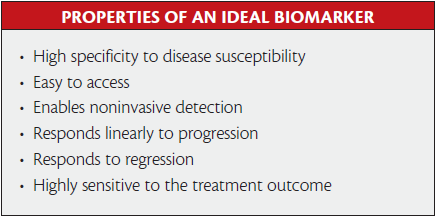
Establishing the mechanistic details of the biomarker, beyond diagnosis and prognosis, opens new avenues to therapeutic intervention (see Properties of an Ideal Biomarker). Elevated cochlin expression could become a warning sign that patients require glaucoma treatment. Additional studies with one or more spontaneous IOP elevation models can establish whether cochlin could serve as a preclinical warning sign.
CONCLUSION
We identified cochlin in the glaucomatous TM using an Omics approach. Our recent work permits the periodic, longitudinal, long-term, in vivo detection of cochlin with minimal invasiveness along with the measurement of other clinical ocular parameters. In mice, we have used 780-nm NIR dyes as well as 780-nm and 840-nm laser wavelengths for OCT. In humans, 1,230- to 1,500-nm wavelength lasers may be appropriate. It is important to note that reagents such as NIR dyes are readily available in this wavelength range.
Omics approaches and independent investigations have opened up the possibility of using nonprotein entities such as lipids as potential biomarkers for disease. In the future, the availability of reagents and longitudinal in vivo follow-up will establish the suitability of specific biomarkers for susceptibility, disease progression, or predictors of interventional outcome. Mechanistic investigation of their generation, degradation, and biological role will open new avenues for therapeutic intervention. Research has now identified two potential biomarkers, cochlin and a variant of a long acyl chain phosphatidylcholine (PC 22:6/22:6).9,10 Both can be tested for noninvasively or minimally invasively. Tests encompassing a large population and across many ethnicities will validate these biomarkers in 5 to 10 years for simple, inexpensive tests to determine patients’ susceptibility to glaucoma and/or the efficacy of glaucoma treatment. n
This research was supported by NIH grant EY016112 and an unrestricted grant from RPB to University of Miami.

Sanjoy K. Bhattacharya, M Tech, PhD, is a professor of ophthalmology, neuroscience, biochemistry, and molecular biology at the University of Miami in Florida. He acknowledged no financial interest in the product or companies mentioned herein. Dr. Bhattacharya may be reached at sbhattacharya@med.miami.edu.

Richard K. Lee, MD, PhD, is an associate professor of ophthalmology, cell biology, and neuroscience at the University of Miami in Florida. He acknowledged no financial interest in the product or companies mentioned herein. Dr. Lee may be reached at rlee@med.miami.edu.
1. Bhattacharya SK, Rockwood EJ, Smith SD, et al. Proteomics reveal cochlin deposits associated with glaucomatous trabecular meshwork. J Biol Chem. 2005;280(7):6080-6084.
2. Bhattacharya SK, Annangudi SP, Salomon RG, et al. Cochlin deposits in the trabecular meshwork of the glaucomatous DBA/2J mouse. Exp Eye Res. 2005;80(5):741-744.
3. Vranka JA, Bradley JM, Yang YF, et al. Mapping molecular differences and extracellular matrix gene expression in segmental outflow pathways of the human ocular trabecular meshwork. PLoS One. 2015;10:e0122483.
4. Stamer WD, Acott TS. Current understanding of conventional outflow dysfunction in glaucoma. Curr Opin Ophthalmol. 2012;23:135-143.
5. Stockschlaeder M, Schneppenheim R, Budde U. Update on von Willebrand factor multimers: focus on high-molecular-weight multimers and their role in hemostasis. Blood Coagul Fibrinolysis. 2014;25:206-216.
6. Goel M, Sienkiewicz AE, Picciani R, et al. Cochlin, intraocular pressure regulation and mechanosensing. PLoS One. 2012;7(4):e34309.
7. Goel M, Sienkiewicz AE, Picciani R, et al. Cochlin induced TREK-1 co-expression and annexin A2 secretion: role in trabecular meshwork cell elongation and motility. PLoS One. 2011;6:e23070.
8. Peral A, Loma P, Mediero A, et al. Effect of several siRNA in the treatment of ocular hypertension and glaucoma. Invest Ophthalmol Vis Sci. 2007;48:4808. http://bit.ly/1V03RqA.
9. Acar N, Berdeaux O, Juaneda P, et al. Red blood cell plasmalogens and docosahexaenoic acid are independently reduced in primary open-angle glaucoma. Exp Eye Res. 2009;89(6):840-853.
10. Aribindi K, Guerra Y, Lee RK, Bhattacharya SK. Comparative phospholipid profiles of control and glaucomatous human trabecular meshwork. Invest Ophthalmol Vis Sci. 2013;54:3037-3044.
11. Wang J, Aljohani A, Carreon T, et al. In vivo quantification of cochlin in glaucomatous DBA/2J mice using optical coherence tomography. Sci Rep. 2015;5:11092.
12. Wang J, Wang MR, Jiang H, et al. Detection of magnetic particles in live DBA/2J mouse eyes using magnetomotive optical coherence tomography. Eye Contact Lens. 2010;36(6):346-351.
13. Wang H, Edwards G, Garzon C, et al. Aqueous humor phospholipids of DBA/2J and DBA/2J-Gpnmb(+)/SjJ mice. Biochimie. 2015;113:59-68.
14. Asrani S, Zeimer R, Wilensky J, et al. Large diurnal fluctuations in intraocular pressure are an independent risk factor in patients with glaucoma. J Glaucoma. 2000;9(2):134-142.
15. Kilarski WW, Samolov B, Petersson L, et al. Biomechanical regulation of blood vessel growth during tissue vascularization. Nat Med. 2009;15:657-664.
16. Deng Q, Huo Y, Luo J. Endothelial mechanosensors: the gatekeepers of vascular homeostasis and adaptation under mechanical stress. Sci China Life Sci. 2014;57:755-762.
