




The number of glaucoma patients worldwide is rising.1 Diagnosing, treating, and following up on this ever-growing population puts tremendous pressure on the health care system and glaucoma specialists. Although the majority of patients may be treated medically, a significant number of people require surgical intervention to achieve IOP control.2
AT A GLANCE
• The number of glaucoma patients who require surgical intervention is increasing, putting a tremendous burden on the health care system and glaucoma specialists.
• Recently introduced techniques such as the ultrasound ciliary plasty procedure (a high-intensity focused ultrasound cyclocoagulation) and Xen implantation are quicker than traditional filtration surgeries, and they can be performed in outpatient clinics.
• Not all patients are suitable candidates for these procedures, but in the authors’ experience, using these techniques in qualified patients can benefit both them and the health care system.
CURRENT LIMITATIONS
Our standard approach for glaucoma surgeries usually revolves around filtration procedures, either trabeculectomy or the implantation of a glaucoma drainage device. Although these surgeries remain the gold standard in terms of IOP-lowering efficacy, there are a number of problems arising from their application in high-volume clinics. These are lengthy procedures that limit the number of patients who can be fitted into a surgical theater per day. This may not be all bad, considering that each of these patients will usually need intensive postoperative care (usually four to five visits in the following weeks), and that is if no complications arise. Furthermore, these surgeries are difficult to teach.
NEW OPTIONS
These limitations have been generating a need to create surgical techniques that are easier to teach and faster to execute. If they happen to be even safer, then all the better. Recently introduced techniques such as the ultrasound ciliary plasty procedure (a high-intensity focused ultrasound [HIFU] cyclocoagulation [not FDA approved]) and the Xen45 implant (Allergan; not FDA approved) have significantly enhanced our options.
HIFU is an incisionless procedure performed under local anesthesia that usually takes less than 5 minutes. The total amount of time the patient is in the room is usually less than 15 minutes (Figure 1).
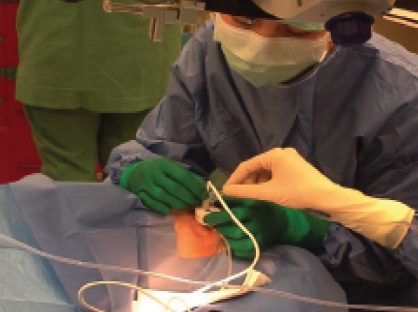
Figure 1. HIFU application over the ciliary processess under local anesthesia in an operation theater setting.
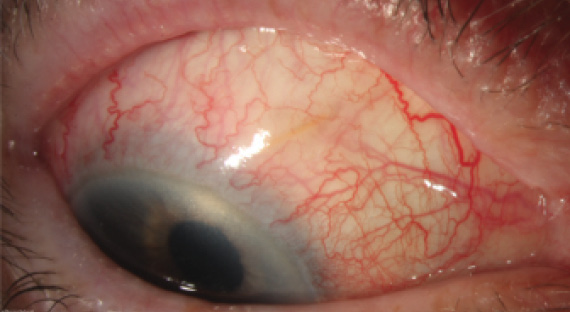
Figure 2. In situ view of the Xen implant and filtering bleb. This sutureless, minimally invasive procedure is associated with calmer postoperative eyes.
The Xen is a flexible implant placed ab interno to create a fistula to the subconjunctival space through a 1.8-mm clear corneal incision. This is smaller than a standard incision (Figure 2). Though technically more demanding than the HIFU, Xen filtering surgery is faster and less demanding than a trabeculectomy. It takes 20 to 25 minutes in the room.
MULTIPLE BENEFITS
These procedures are meant to be performed on an outpatient basis, which significantly reduces the number of scheduled hospitalizations. To give a practical example, at Universitaire Ziekenhuizen Leuven, about 10% of glaucoma surgeries were performed in the outpatient clinic. When the surgeons were at full speed with the HIFU and Xen techniques, however, that rate rose to 50%. The result has been less paperwork from doctors, fewer time-consuming tasks by nonmedical staff, and a lesser impact on patients. This has freed up the hospital OR to serve more patients each day. Furthermore, the waiting list for glaucoma surgery has significantly decreased, which has improved care delivery to patients.
POSTOPERATIVE RESULTS
We have seen similar changes in postoperative care. Because these procedures are less invasive than traditional filtration surgeries, the eye is usually calmer and in less need of critical attention. The typical patient who has undergone a HIFU cyclodestruction, for instance, is seen on day 1 and then day 30. Xen patients still need some extra supervision for bleb-related evaluation, but those are usually less time-consuming visits, because there are no sutures to be removed or adjusted. Complications are generally less frequent and milder.Symptomatic hypotony and other vision-threatening complications are uncommon. Whereas salvage procedures like needling for bleb failure are still necessary in some patients, the need for urgent reintervention is uncommon.
Watch it Now
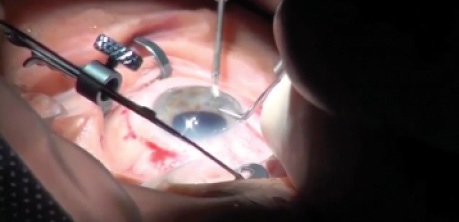
H. Burkhard Dick, MD, presents an ab interno approach to the subconjunctival space using the Xen Gel Stent in combination with laser cataract surgery.
SUBSEQUENT SURGERY
One additional (and key) benefit of these techniques is that they apparently do not interfere with subsequent surgeries like trabeculectomy does. There is no evidence that an ultrasound cycloplasty or a Xen implant will negatively affect any future filtering surgery. Because neither procedure scars the usual filtering bleb location (Xen is located superonasally), a surgical failure should not interfere with a later trabeculectomy.
PATIENT SELECTION
Patient selection is important. Although both procedures have proven effective in reducing baseline IOP by 20% to 35%, we await long-term follow-up data to validate these results over time. Patients who require a very low IOP and those at high risk of bleb failure (in the case of the Xen implant) should be screened carefully.
Not all patients are suitable candidates for these procedures, and we will, at least for the foreseeable future, continue performing traditional filtration surgery. Using these procedures for some of our patients, however, increases our capability to cope with growing surgical volume while maintaining a patient-friendly profile. n
1. Tham YC, Li X, Wong TY, et al. Global prevalence of glaucoma and projections of glaucoma burden through 2040: a systematic review and meta-analysis. Ophthalmology. 2014;121:2081-2090.
2. Lindblom B, Nordmann JP, Sellem E, et al. A multicentre, retrospective study of resource utilization and costs associated with glaucoma management in France and Sweden. Acta Ophthalmol Scand. 2006;84:74-83.
Section Editor E. Randy Craven, MD
• chief of glaucoma at King Khaled Eye Specialist Hospital, Riyadh, Saudi Arabia
• erandycraven@gmail.com
Luís Abegão Pinto, MD, PhD
• assistant professor of pharmacology and ophthalmology, University Clinic of Ophthalmology, Faculty of Medicine of Lisbon’s University, Portugal
• +351 217 805 252; abegaopinto@gmail.com
• financial interest: none acknowledged
Ingeborg Stalmans, MD, PhD
• professor of ophthalmology, Department of Ophthalmology, University Hospitals Leuven in Leuven, Belgium
• +32 16 330 461; ingeborg.stalmans@uzleuven.be
• financial disclosure: consultant to Allergan
