




The next generation of eye care-specific electronic medical record (EMR) systems is becoming increasingly relevant to clinical practice, with more predictive and intuitive user interfaces. For glaucoma practitioners, the hope is for EMRs to help guide your clinical decision making and patients’ care.1-5
Summary Screens
Because documenting disease progression in glaucoma patients and suspects requires the serial monitoring of several parameters, EMRs have an advantage over paper charts in terms of obviating time-consuming manual entry on summary sheets. With a few clicks, EMR systems can also represent relevant data points from each patient encounter in an easy-to-read, intuitive format (Figure).
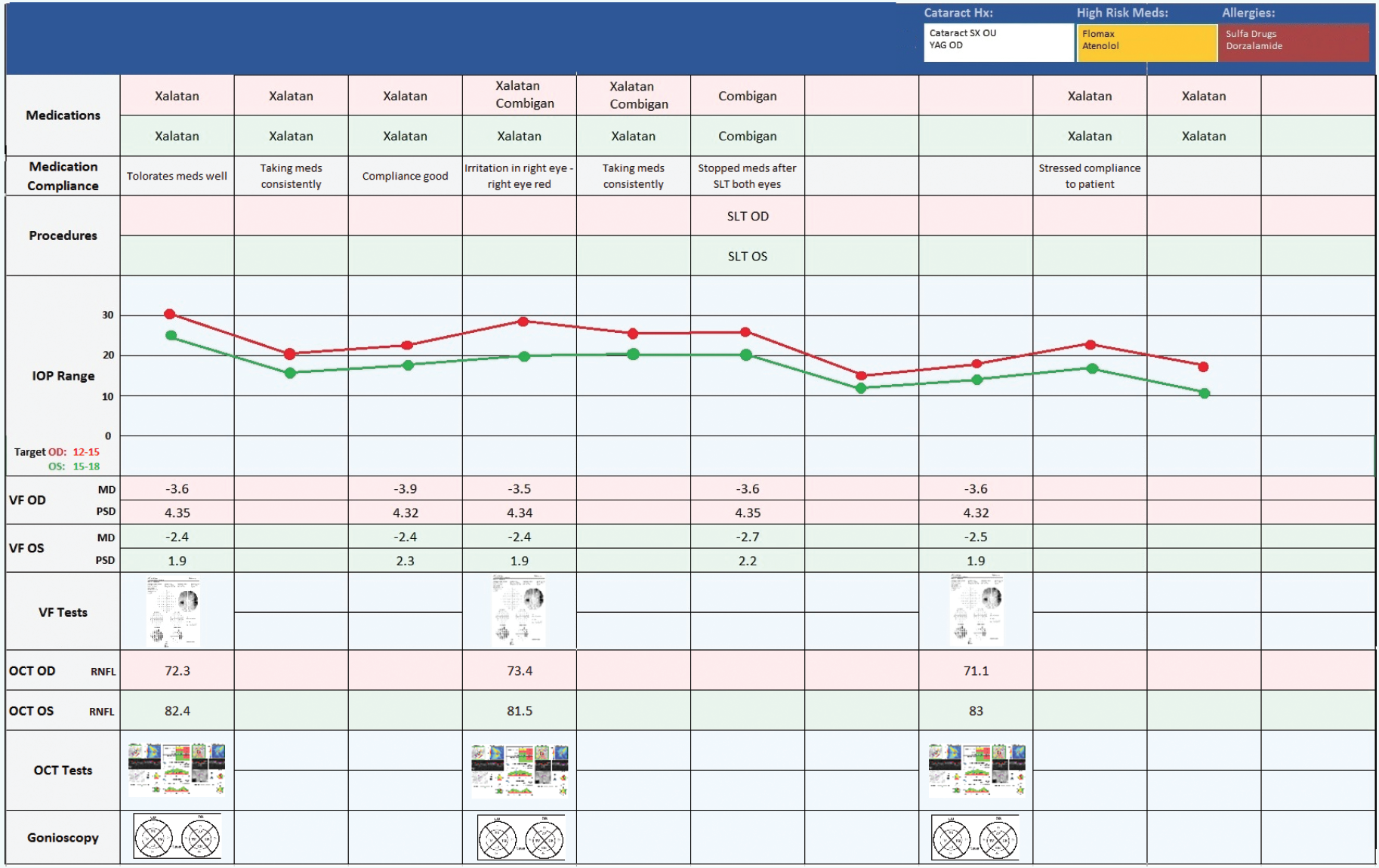
Figure. The glaucoma summary screen (Integrity EMR; Eye Care Leaders) provides a longitudinal analysis of various clinical variables in a comprehensive, intuitive snapshot. The graphs of clinical variables over time, superimposed over changes in treatment, provide an overview of disease progression and management.
Most available glaucoma diagnostic devices have network interfaces that facilitate the direct, real-time transfer of data to the EMR, increasing efficiency and ease of access. The graphs of clinical variables over time may be superimposed over changes in treatment, providing an overview of disease evolution. You can diagnose the onset of glaucoma or its progression as the analyzed indices show change, and you can actively assess the efficiency of each intervention in terms of lowering IOP and retarding visual field/ retinal nerve fiber layer loss.
Educating and Communicating With Patients
With an EMR system, you can print graphs to show patients what treatment has been done, which can facilitate communication and potentially increase adherence. The software can be programmed to send automatic messages to patients for appointments, refills, and reminders to instill eye drops. EMR platforms can “talk” to handheld devices or communicate via secure email.
Patient portals allow patients to view clinical summaries, medical charts, and educational material as well as to schedule an appointment and request a medication refill.
THE FOUNDATION OF AN EMR
An eye care-specific electronic medical records system should offer the glaucoma surgeon these 10 basics.
1. Information at your fingertips
2. Compliance with Physician Quality Reporting System and Intelligent Research in Sight reporting
3. Proper coding for office visits and diagnostic testing
4. Proper coding for office visits and diagnostic testing
5. Generation of forms, letters, orders, and prescriptions
6. Compatibility with diagnostic tools1
7. Image viewing systems
8. Drawing tool
9. Care plans: customizable blocks of text (macros) for routine follow-up and planned procedures2
10. Patient portal: education and communication
Analytics, Big Data, and Benchmarking
The smarter EMR systems now offer built-in analytics where you can use your own patients as a cohort and include variables like age, gender, and ethnicity. The cloud-based EMR system can facilitate practice benchmarking and big data analysis by aggregating information from many practices and allowing you to compare your clinical outcomes with those of your colleagues.
In addition, analysis of operational, utilization, and financial metrics provides a dynamic and real-time barometer of your practice’s health and clinical quality outcomes. This can help you determine and streamline operational, clinical, and financial processes.
Intelligent Programming and Interfaces
With the elasticity of cloud computing, it is financially feasible for EMR companies to use the growing mountain of data their systems gather to train machine-learning models. Advances in deep learning by companies like Google, Amazon, and Facebook are becoming available to EMR companies to design systems to provide automated analysis of images and correlations of data that follow no algorithm but are modeled on your own practice’s behavior. These tools can be used to find similarities among patients, much like Netflix provides recommendations for movies.
For example, the EMR can search across its database for clinical outcomes of trabeculectomies augmented with an antivascular endothelial growth factor agent versus those augmented with mitomycin C in white men younger than 30 years of age, providing a clinical benchmark for decision making. The analyses across age, ethnicity, gender, and disease profile are only the beginning, with the EMR having the capability to link outcomes to psychosocial habits as well such as smoking. The field of data science—a combination of statistics and software development—is learning to find patterns in data to understand patients’ behavior and disease progression.
The problem of the past decade has been sorting through all the data. Technology is catching up; it will start intelligently filtering the data to find the proverbial needle of meaningful information in the haystack. This is just in time. Armed with new data and the intelligence to sort through it, you will be able to offer more accurate and more personalized care.
1. Silverstone DE, Lim MC; American Academy of Ophthalmology Medical Information Technology Committee. Ensuring information integrity in the electronic health record: the crisis and the challenge. Ophthalmology. 2014;121(2):435-437.
2. Pandit R, Boland BV. Impact of digital imaging and communications in medicine workflow on the integration of patient demographics and ophthalmic test data. Ophthalmology. 2015;122(2):227-232.
3. Boland MV, Chiang MF, Lim MC, et al; American Academy of Ophthalmology Medical Information Technology Committee. Adoption of electronic health records and preparations for demonstrating meaningful use: an American Academy of Ophthalmology survey. Ophthalmology. 2013;120(8):1702-1710.
4. Kortüm KU, Müller M, Kern C, et al. Using electronic health records to build an ophthalmological data warehouse and visualize patients’ data [published online ahead of print March 29, 2017]. Am J Ophthalmol. doi:10.1016/j.ajo.2017.03.026.
5. Silverstone DE, Paek HM, Kogan Y, et al. Incorporation of clinical practice guidelines for glaucoma into an ophthalmology electronic medical record. AMIA Annu Symp Proc. 2005:1115.
Shibal Bhartiya, MD
• senior consultant, Glaucoma Services, Fortis Memorial Research Institute, Gurgaon, India
• clinical director, Medflow, Eye Care Leaders, Charlotte, North Carolina
• +91 9818700269; shibalbhartiya@gmail.com
• financial disclosure: consultant to Meflow/Eyecare Leaders
Jim Messier
• independent consultant for Eye Care Leaders, Charlotte, North Carolina
• (704) 641-0077
• financial disclosure: consultant to Meflow/Eyecare Leaders
