


1. Tell us about your background and current position.
I was born and raised in Havana, Cuba, and did a majority of my medical training there as well. After medical school, I completed a residency in family medicine, followed by a residency in ophthalmology. I then went on to pursue a fellowship in neuro-ophthalmology. In 2007, I traveled to the United States for a research fellowship in glaucoma at the University of California, San Diego. Following that experience, I returned to Cuba, where I became the Head of the Neuro-Ophthalmology Department at the Institute of Neurology and Neurosurgery.
In 2010, I moved to the United States and began working in the ophthalmic industry as the research director and chairman of the scientific board at Diopsys, where I later became chief medical officer. In 2019, I started developing my own idea for an ophthalmic innovation, and by 2020 I had left my position at Diopsys and founded a medical device company called Olleyes.
2. What was the unmet need that prompted you to develop a solution?
Generally and globally, the main factors that drove me to entrepreneurship were health care accessibility, health care costs, and a desire to help further shift the eye care paradigm from evidence-based medicine to personalized medicine.
3. DESCRIBE Olleyes as it stands today.
The initial idea I conceived of was an accessible platform for psychophysical testing, including visual acuity, visual fields, stereopsis, contrast sensitivity, and color vision assessments. When conceptualizing this idea, we first attempted to follow the trend of developing applications for smartphones and tablets. However, we quickly realized that mobile applications will never be the standard of care. Apple’s App Store contains numerous programs for visual acuity and visual field testing, but none has seen widespread use. With medical devices, all tests must be standardized, and smartphones and tablets are not ideal platforms for such standardization.
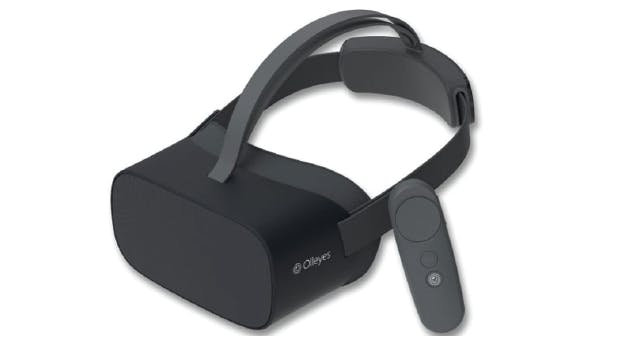
Figure. Olleyes’ VisuALL device can be used to assess visual fields, visual acuity, and color vision.
Thus, we started looking into an alternative platform that was cost-effective, modern, accessible, and mobile, and virtual reality (VR) emerged as the best solution. VR was first used in eye care in the 1980s, and a patent for VR for visual field tests had been developed. Unfortunately for the team behind that idea, VR technology was not readily available then. Times have changed in terms of VR’s availability, enabling us to follow this path.
Today, Olleyes’ VisuALL device is a multitest platform that can be used to assess visual fields (adult and pediatric), visual acuity (near and far), and color vision. Two versions of the platform are currently available: (1) the VisuALL S for office use and (2) the VisuALL H for remote patient monitoring.
4. What were the major lessons learned in conceptualizing your idea?
As previously mentioned, my initial goal was to focus on functional tests, or psychophysical evaluations, to assess visual acuity, visual fields, stereopsis, contrast sensitivity, color vision, etc. Psychophysical tests are used to determine whether a subject can detect a stimulus, identify it, differentiate between it and another stimulus, or describe the magnitude or nature of this difference. With this method, the stimulation must be consistent; however, every mobile device has a different resolution, luminosity, camera, etc. Such great variety exists across smartphones and tablets that their use would have prevented us from standardizing the stimulation, so we were required to shift to a VR-based approach.
5. Who or what is your biggest inspiration?
When I first entered the world of entrepreneurship, I naturally looked to major innovators like Steve Jobs and Bill Gates for inspiration. However, Olleyes’ pursuit was so different from theirs, especially when we began to move away from mobile devices and toward VR.
Professionally, I learned a lot from having both a medical background and experience working in the ophthalmic industry. Personally, I have always been inspired by my parents’ persistence. My mother especially taught me that, if I wanted something, I had to be persistent. I was also fortunate to have a sister who was one of the smartest and hardest-working people I’ve ever met.
6. What was your biggest challenge early in your project?
Our primary challenge early on was money, as is the case for most startups. I once heard that a company’s road to success entails nothing but peeling layers of risk. One layer of risk for us was money. Naively, in the beginning, we thought we could develop our own hardware. We soon realized that this pursuit was impossible without ample financial support, so we started outsourcing most of the work. We also peeled another layer of risk by utilizing psychophysical testing, for which the regulatory pathway is simpler.
7. What is your biggest challenge currently?
Knowledge about every aspect of the business. If I could talk to myself 20 years from now, I could learn so much about navigating the road ahead. Experience is the best teacher, and that is why having a great team who possesses a diversity of knowledge is essential.
8. How many people are employed by OLLEYES?
There are currently four employees on the Olleyes team.
9. What’s next for your project?
As it stands, the VisuALL system can be used for functional assessments of the eye, including visual field, visual acuity, and color vision testing. In time, we plan to explore the capability of evaluating the structure of the eye as well—but always with accessibility and cost-effectiveness in mind. If we build another big OCT platform or bowl visual field device, Olleyes will be just another fish in the pond. We will not be able to meaningfully disrupt or improve eye care, which is our main objective.
10. What advice can you offer to other physicians who are interested in entrepreneurship?
Go for it. A close friend who was in the middle of his neurosurgery residency once asked me, “Alberto, how was it for you, going from being a doctor to being an entrepreneur?” I said to him, “Go for it; you won’t regret it.” I don’t hesitate to give this advice because, most of the time, when someone asks a question like this, they are already craving a new challenge or a new opportunity. Entrepreneurship is certainly a dynamic pursuit, and not knowing what will happen next is the fuel that propels me through each day.


