


Glaucoma is considered a disease continuum, and glaucoma treatments exist on a continuum as well. From the medical to the surgical, this treatment continuum continues to evolve over time. More invasive procedures have entered the pharmaceutical space with the development of intraocular implants for drug delivery. These solutions are moving medical therapy inside the eye for improved efficacy. Meanwhile, the opposite trend has been observed in the surgical realm, with the development of and push for less invasive surgical procedures.
AT A GLANCE
- The boundary between medical and surgical treatments for glaucoma will continue to blur as pharmaceutical treatments become more invasive and surgical interventions become less invasive.
- Glaucoma specialists should target their efforts toward improving surgical approaches, developing new techniques, influencing government partners to value time and cost savings, and improving health care’s environmental performance.
- Performing MIGS in the clinic offers a range of advantages to multiple beneficiaries, including patients, health care systems, and the environment.
Located at the crossroads of efficacy and safety, MIGS procedures have filled a treatment gap that long needed to be addressed. Now that ophthalmologists have access to a range of MIGS options, the question in focus has become: How minimally invasive can glaucoma surgery truly be? A few years ago, I started to perform MIGS at the slip lamp using the Xen Gel Stent (Allergan) in an effort to further minimize the invasiveness of this procedure. This article describes the scope of advantages afforded by moving select MIGS cases out of the OR and into the clinic.
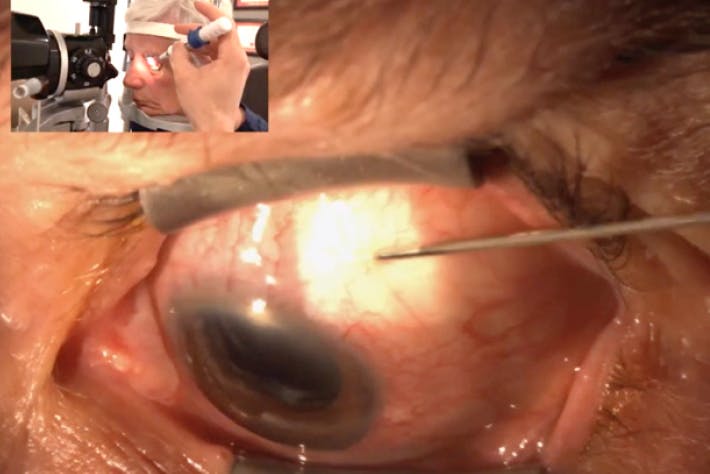
Xen Implantation at the Slit Lamp
APPROACH AND OUTCOMES
The transition to performing MIGS at the slit lamp should be straightforward, as this approach carries a similar learning curve to performing a needling procedure at the slip lamp. The first case may be stressful, but the procedure quickly becomes more intuitive with subsequent cases.
When implanting a Xen at the slit lamp (Video), I utilize an ab externo, closed-conjunctiva approach. I first administer mitomycin C mixed with lidocaine and 2% epinephrine. I wait about 5 to 7 minutes until the medication is about 90% reabsorbed so that I have a small area of conjunctival space to drive the Xen implant. Next, using the reticle of the slit lamp, I aim approximately 2 to 2.5 mm from the limbus for the scleral entry while ensuring that I can see the tip of the needle. Once the tip is visualized in the in the anterior chamber, I start to push on the injector to slowly release the Xen implant while simultaneously slowly pulling back to retract the injector.1
My colleagues’ and my experiences performing MIGS at the slit lamp have been comparable to others’ published in the literature. In our study,2 we found the postoperative medication rate to be low, decreasing from 3.18 medications preoperatively to 0.25 medications by 6 months postoperatively. The proportion of eyes with an IOP of 15 mm Hg or less increased from 2.9% preoperatively to 82.3% at 6 months postoperatively. A total of 88% of eyes were medication-free after placement of a Xen at the slit lamp. Needling was required in 12.7% of cases. One revision was required, but no serious adverse events occurred.
STERILIZATION IN THE CLINIC: WAY OF THE FUTURE?
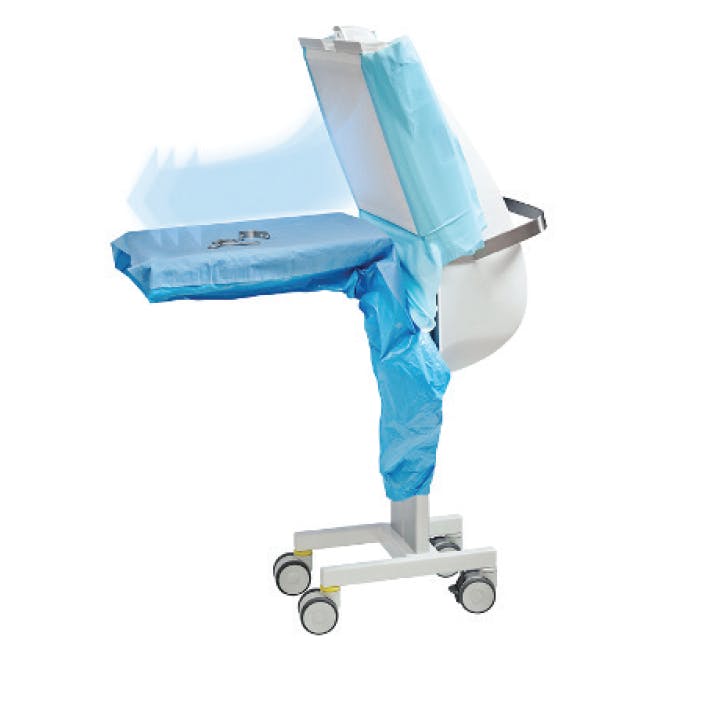
The Operio Mobile (Toul Meditech) is a sterile air zone system that can be used to ensure that a surgical site and instruments remain sterile during a surgical procedure. The unit circulates ambient air through a high-efficiency particulate air (HEPA) filter to clean the air and prevent airborne bacteria-carrying particles from coming into contact with a surgical wound or nearby surgical instruments. According to the company, the Operio Mobile system can be used in all types of ORs and surgical preparation rooms, independent of their ventilation systems, and it comes with a detachable instrument tray.
THE ADVANTAGES
Performing MIGS in the clinic offers a range of advantages to multiple beneficiaries, including patients, health care systems, and the environment.
Time and perception. Performing MIGS at the slit lamp is highly efficient because the procedure takes approximately 30 seconds to complete. I often tell my patients that, although the treatment is similar to a surgery in its mechanism, it is performed more like an injection. This explanation tends to reduce stress the patient may be experiencing about undergoing the procedure.
In Montreal, access to the OR can be a challenge, and patients are often subjected to long surgical wait times. With glaucoma, every millimeter of mercury counts, as does every second. Delayed access to the OR is problematic when addressing a progressive disease, especially in patients whose IOPs are above target. I am often required to try to prioritize my surgical cases when, in truth, they are all a priority. Not having to rely on access to the OR to perform MIGS has changed the way I practice.
Economics. In a public health care system such as Canada’s, every dollar counts. Cost per glaucoma patient increases with disease severity, as additional interventions and services are required with progression.3 By eliminating the challenge of delayed OR access and thus enabling earlier intervention, performing MIGS in the clinic may offer cost savings to the health care system as a whole.
Environment. About 10% to 12% of greenhouse gas emissions are produced by the health care sector. Performing one phaco surgery in a hospital setting produces the same level of CO2 emissions as driving a car for 500 km.4 Somewhat ironically, physicians’ efforts to care for patients wind up harming the environment. Although patient care will always be ophthalmologists’ primary concern, we should also think about the bigger impact of every step we take and try to minimize collateral damage in the process.
CONCLUSION
The boundary between medical and surgical treatments will continue to blur as pharmaceutical treatments become more invasive and surgical interventions become less invasive. As this occurs, glaucoma specialists should target their efforts toward improving surgical approaches, developing new techniques, influencing government partners to value time and cost savings, and improving health care’s environmental performance. Moving MIGS into the clinic when possible represents one step toward achieving these goals.
1. Vera V, Gagne S, Myers JS, Ahmed IIK. Surgical approaches for implanting Xen Gel Stent without conjunctival dissection. Clin Ophthalmol. 2020;14:2361-2371.
2. Gagné S. MIGS performed at the slit lamp: ab externo (closed conjunctiva) implantation of a gel microstent. Presented at: 2019 ASCRS Annual Meeting; May 3-7, 2019; San Diego, CA.
3. Varma R, Lee PP, Goldberg I, Kotak S. An assessment of the health and economic burdens of glaucoma. Am J Ophthalmol. 2011;152(4):515-522.
4. Thiel CL, Schehlein E, Ravilla T, et al. Cataract surgery and environmental stability: waste lifecycle and assessment of phacoemulsification at a private healthcare facility. J Cataract Refract Surg. 2017;43(11):1391-1398.

