


Like many of my glaucoma colleagues, my experience in clinical practice has encompassed a range of clinical and surgical challenges and complications (Figure). Because of these experiences, I grew determined to identify better ways of managing glaucoma that posed less risk to my patients. I became involved in clinical trials to explore new technologies that could improve glaucoma treatment.
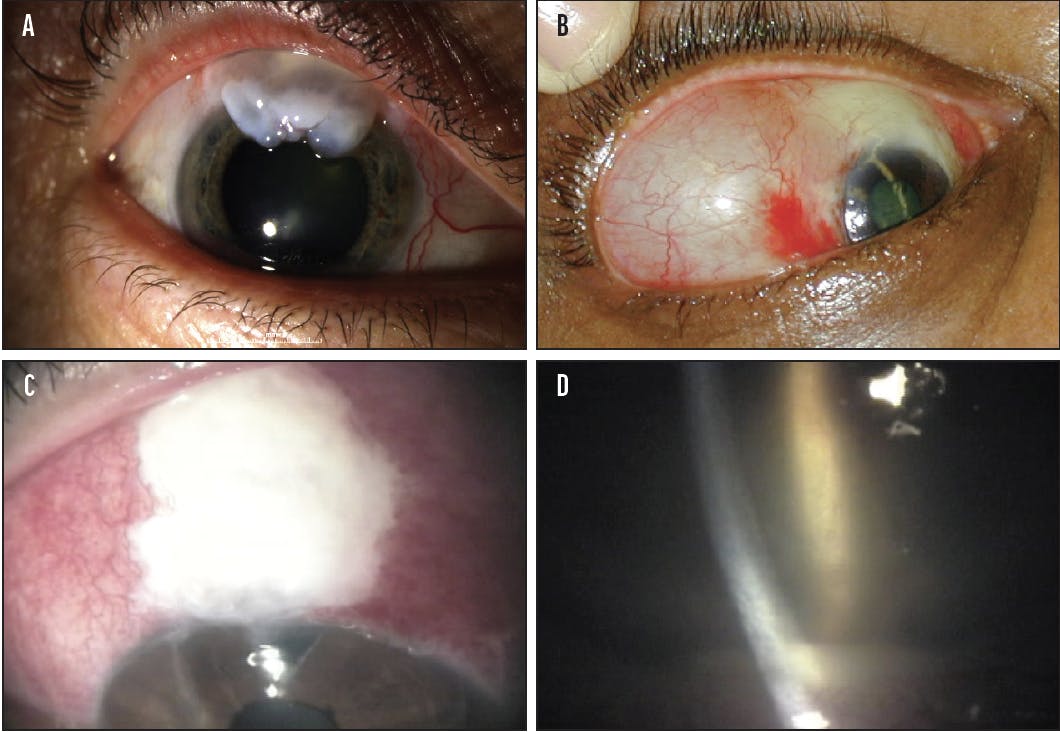
Figure. Complications that can occur after standard glaucoma procedures: bleb enlargement with irritation after trabeculectomy (A), diplopia after the placement of an aqueous shunt (B), blebitis (C), and hypopyon (D). These are the types of risks surgeons are trying to avoid by adopting less invasive procedures.
However, certain protocol requirements—while understandable in terms of reducing risk—can make it harder to analyze the efficacy of emerging treatment options. As such, these requirements may delay or preclude patient access to advances in glaucoma care. This article summarizes some existing deficiencies in glaucoma clinical trials that I have observed and outlines my wish list for protocol changes in future investigations.
DEFICIENCY NO. 1: PHACOEMULSIFICATION AND GLAUCOMA
With all clinical trials, the ultimate priority is patient safety. In glaucoma surgical trials, one of the ways in which the FDA attempts to minimize patient risk is by enrolling only study participants who already require intraocular surgery. This is one reason why combined cataract-glaucoma trials seem to predominate the trials mix. In these investigations, cataract surgery–only patients serve as the control group. Thus, they are not undergoing an incisional procedure solely to evaluate a new glaucoma device; they have already agreed to undergo cataract surgery and have therefore accepted the risks of intraocular surgery. Although the logic behind this approach is understandable, it raises the following question: How does the cataract surgery requirement affect clinical trials?
First, this design severely limits study recruitment to patients who have visually significant cataracts that require surgery. The cataract surgery–only group serves as the control group, but phacoemulsification is not a typical treatment for glaucoma (except chronic angle-closure glaucoma). This requirement frequently removes the opportunity to compare new glaucoma devices and surgical techniques directly against existing and accepted glaucoma treatments. Moreover, phacoemulsification is not a true control. A true control entails no treatment, and phacoemulsification affects postoperative IOP. Hence, in order to demonstrate a true difference in IOP lowering, it may be necessary to enroll more patients and to lengthen the trial, thereby increasing the study’s cost. This disadvantages small companies with good ideas that cannot cover such expenses.
In my view, the ideal clinical trial for surgical glaucoma innovations would compare a new MIGS device to another glaucoma treatment, be it another MIGS device or technique, maximum tolerated medical therapy, or a new laser therapy. This type of study would have enough statistical power to enable regulatory agencies and physicians to reach clinically meaningful conclusions.
Is it possible to remove the cataract requirement in order to recruit more patients and not just those who are undergoing cataract surgery? The answer is likely yes. In general, most MIGS procedures are safe and well tolerated; therefore, enrolling patients in a clinical trial to undergo MIGS alone likely would not place them at significant or increased risk compared with cataract surgery.
DEFICIENCY NO. 2: REFRACTORY GLAUCOMA REQUIREMENTS
The FDA allows clinical trial investigators and sponsors to remove the cataract requirement during studies of MIGS for the treatment of refractory glaucoma. This type of trial has the potential to show success and failure more clearly, ease recruitment, shorten the duration of the investigation, and possibly reduce costs. It is also associated with certain challenges.
With these trials, investigators are typically required to enroll patients with the most recalcitrant disease and the highest risk of treatment failure, more difficult surgery (eg, previous scarring), and significant optic nerve damage. The MIGS device must prove its mettle in this setting. In some respects, this study design gives a MIGS device the best chance to show efficacy in a convincing manner, but isn’t it essentially stacking the deck against the test device? In order to be investigated fairly, MIGS devices should be tested in patients with mild to moderate glaucoma.
Refractory glaucoma studies, however, offer one key advantage in that they require a smaller number of participants compared with other glaucoma surgical trials. This provides smaller companies with an opportunity to test a new treatment or technology and reduces costs for all study sponsors. Another solution would be to allow investigators to test glaucoma devices both in a smaller number of patients and in patients without a history of multiple interventions, which is the current definition of refractory.
Overall, angle-based MIGS devices are extremely safe and valuable for the treatment of early to moderate glaucoma. There is no real advantage to placing them in patients with refractory glaucoma who have already experienced significant damage. These MIGS devices are proactive in that they can be used to modulate IOP fluctuation early in the disease course and perhaps obviate the need for future filtration surgery and other more invasive procedures. Why not construct clinical trials to test MIGS devices earlier in the disease course, particularly once preliminary safety studies are complete?
DEFICIENCY NO. 3: SUCCESS VERSUS ACCESS
Clinical trial success does not guarantee that patients will have access to the treatment. Most glaucoma specialists are still having to wage constant battles with insurers, in which they are told that a procedure or a device is experimental. It would be helpful if an FDA approval after a clinical trial carried weight with insurance carriers. Quality of life (QOL) measurements are a way this could be achieved—and at the time a trial is being conducted.
Identifying and incorporating accurate QOL measurements for glaucoma into clinical trials could help physicians make the case to insurance carriers that a procedure is in a patient’s best interest. Although this approach would entail some additional work for clinical trial investigators, it would allow them to demonstrate real and meaningful differences, such as the rapid visual recovery and fewer complications appreciated by many MIGS patients.
A WISH LIST
With these deficiencies in mind, I believe the following changes would improve glaucoma clinical trials:
- Remove the cataract requirement, particularly once a device has been proven safe;
- Compare glaucoma treatments to each other and not to phacoemulsification or compare them to maximum tolerated medical therapy;
- Permit testing earlier in the course of nonrefractory glaucoma and require the enrollment of fewer participants;
- Use QOL measurements to demonstrate efficacy and help insurance payers appreciate that greater safety often means slower visual recovery but fewer reoperations and complications; and
- Answer the if, when, and how to use new devices to benefit patients.

