


The Collaborative Initial Glaucoma Treatment Study (CIGTS) was a randomized controlled trial that evaluated whether patients newly diagnosed with open-angle glaucoma are better managed initially with medications or with trabeculectomy. The primary outcome was visual field (VF) loss, and the secondary outcomes were health-related quality of life (HR-QOL), visual acuity, and IOP. Enrolled patients were between 25 and 75 years of age, had better than 20/40 visual acuity, and had not received more than 2 weeks of cumulative lifetime glaucoma treatment. Patients qualified by having one of three combinations of IOP, VF loss, and optic disc findings in one or both eyes:
- 1. IOP of at least 20 mm Hg with definitive VF loss and optic disc findings compatible with glaucoma;
- 2. IOP between 20 and 26 mm Hg with likely VF loss and glaucomatous optic disc damage; or
- 3. IOP of at least 27 mm Hg with glaucomatous optic disc damage.1
CIGTS TREATMENT PROTOCOL
Medical arm. Patients in the medical arm began stepped topical therapy followed by oral medications. If further intervention was required, the next treatment steps were argon laser trabeculoplasty (ALT), trabeculectomy, medications, trabeculectomy with an antifibrotic agent, and medications.1
Surgical arm. Patients in the surgical arm underwent trabeculectomy (with or without 5-fluorouracil). If additional treatment was required, ALT was performed, followed as needed by medications, repeat trabeculectomy with an antifibrotic agent, and medications.1
TREATMENTS AVAILABLE AT THE TIME
OF CIGTS
CIGTS enrolled 607 patients in the United States from October 1993 to April 1997.1 In 1993, the commonly used topical glaucoma medications were timolol, pilocarpine, and dipivefrin.2 Apraclonidine was available but was not commonly used due to high rates of allergic reaction.3 Overall, these topical medications led to more adverse effects compared with currently available medications (see Commonly Used Glaucoma Medications: A Timeline of Market Availability).
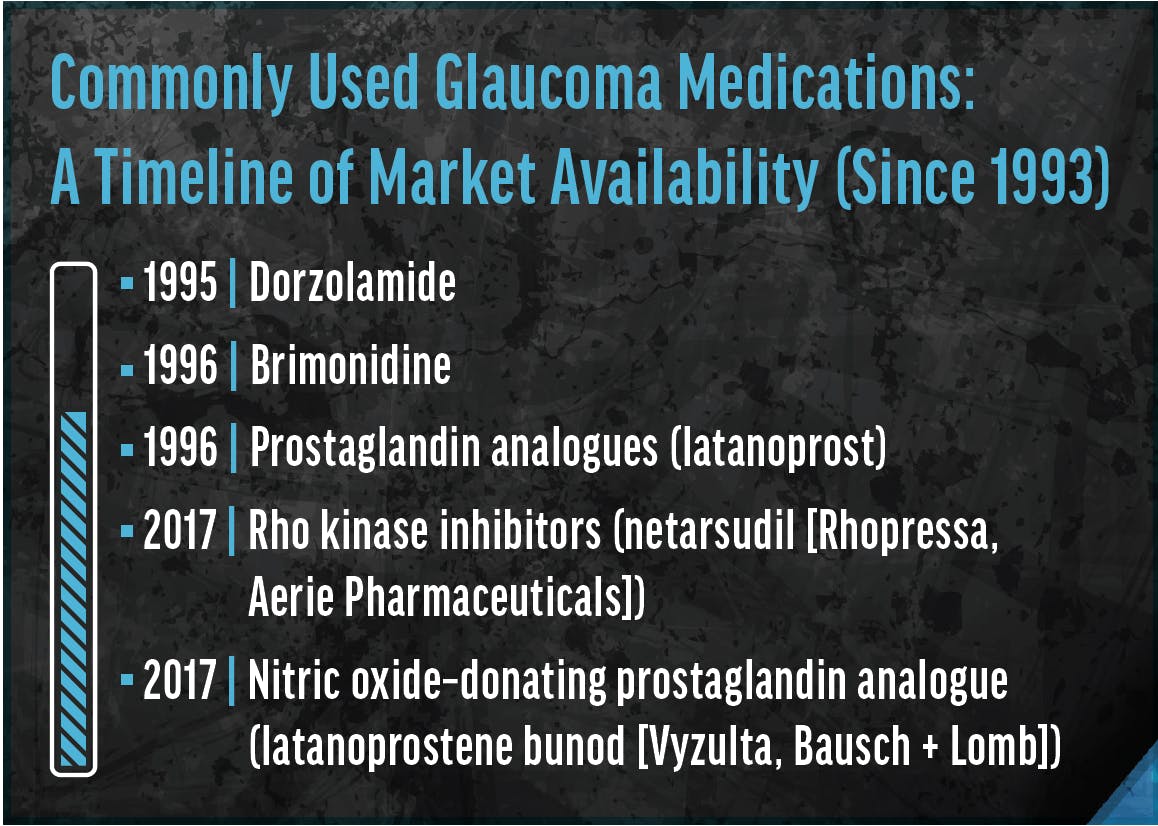
In the mid-1990s, trabeculectomy was the preferred initial surgery for glaucoma, with reported variability in the use of antifibrotic agents.4 At that time, glaucoma drainage devices were largely reserved for complicated postsurgical glaucoma and neovascular glaucoma.4 ALT was available but was usually performed after a trial of maximum tolerated medical therapy. Selective laser trabeculoplasty (SLT), with its improved safety profile, did not become available until 2001. An alternative option, diode laser transscleral cyclophotocoagulation, was described in 1992, but its use was reserved for cases of refractory glaucoma and eyes with poor visual potential.5
CIGTS STUDY FINDINGS
VF loss and IOP. In the CIGTS trial, investigators found no significant difference in VF loss at 5 years based on initial treatment.6 This relative stability was attributed to aggressive IOP reduction. Patients in the surgical arm experienced IOP reductions from a baseline of 27 mm Hg to 14 to 15 mm Hg (48%), whereas patients in the medical arm experienced IOP reductions from a baseline of 28 mm Hg to 17 to 18 mm Hg (35%) over 5 years.6 Although IOP reduction was consistently greater in the surgical group, this did not translate into greater preservation of the VF. The risk factors for VF progression included a higher baseline VF score, older age, non-White race, and diabetes.6 At the 9-year follow-up visit, the investigators found that patients with advanced VF loss at presentation (eg, baseline VF mean deviation of -10 dB) experienced less progression when treated surgically versus medically.7
Quality of life. There were few significant differences between the two treatment groups during 5 years of follow-up.8 In the first year, patients in the surgical arm reported more visual function symptoms, such as blurred vision, difficulty with bright lights, and problems navigating steps.8 The surgical group also reported more local eye symptoms, although only eye irritation and droopy eyelids were significant at 5 years.8 Patients in the medical arm reported more systemic symptoms, but only headache and wheezing were reported more than once.8 Initial medication had a slightly lower impact on QOL compared with initial surgery. One explanation is that new medications with fewer adverse effects were introduced during the trial period and the use of oral medications decreased.
CURRENT APPLICATIONS
CIGTS showed that having an aggressive personalized IOP target prevented progression at 5 years. For patients with moderate to severe VF loss at presentation (mean deviation ≥ -10 dB), earlier surgery may be beneficial because it can allow for better diurnal IOP control. However, trabeculectomy is not without risks. Patients in the surgical group underwent cataract surgery earlier and more frequently, and they reported more visual function and local eye symptoms.6,8 Furthermore, patients with diabetes did not do as well with initial glaucoma surgery as with initial medication.7
CIGTS was initially proposed to determine if earlier surgery could improve QOL by reducing the adverse effects of glaucoma medications.9 To address this question using currently available treatment options, the interventions that would likely be acceptable for treatment-naïve patients newly diagnosed with glaucoma, including mild disease, are SLT and MIGS. The Laser in Glaucoma and Ocular Hypertension (LIGHT) trial found that medication use and SLT yielded no difference in QOL or clinical outcomes at 3 years.10 Whereas the LIGHT study had a primary outcome of HR-QOL, this design was not possible with CIGTS, because QOL measurements were considered to be underdeveloped in ophthalmology at the time of its creation.9
A large multicenter randomized controlled trial investigating the effects of initial treatment with medication versus MIGS on HR-QOL and clinical outcomes has yet to be conducted. Such a study would likely be required to compare initial medication with cataract surgery to MIGS with cataract surgery. Certain MIGS devices, such as the iStent Trabecular Micro-Bypass Stent (Glaukos) and Hydrus Microstent (Ivantis), are approved by the FDA for use only in combination with cataract surgery. Moreover, studies have shown that cataract surgery alone can reduce IOP by up to 15%.11
CONCLUSION
CIGTS paved the way for the study and design of glaucoma-specific measures for HR-QOL. The trial was patient-centric to elucidate the full impact of glaucoma and its treatments on QOL and clinical outcomes. It is with this mindset that physicians should continue to investigate and advance glaucoma management.
1. Musch DC, Lichter PR, Guire KE, Standardi CL. The Collaborative Initial Glaucoma Treatment Study: study design, methods, and baseline characteristics of enrolled patients. Ophthalmology. 1999;106(4):653-662.
2. Groves N. Tracing history of glaucoma drugs. Ophthalmology Times. May 10, 2019. Accessed January 1, 2021. www.ophthalmologytimes.com/view/tracing-history-glaucoma-drugs
3. Butler P, Mannschreck M, Lin S, Hwang I, Alvarado J. Clinical experience with the long-term use of 1% apraclonidine. Incidence of allergic reactions. Arch Ophthalmol. 1995;113(3):293-296.
4. Chen PP, Yamamoto T, Sawada A, Parrish RK 2nd, Kitazawa Y. Use of antifibrosis agents and glaucoma drainage devices in the American and Japanese Glaucoma Societies. J Glaucoma. 1997;6(3):192-196.
5. Hennis HL, Stewart WC. Semiconductor diode laser transscleral cyclophotocoagulation in patients with glaucoma. Am J Ophthalmol. 1992;113(1):81-85.
6. Lichter PR, Musch DC, Gillespie BW, et al. Interim clinical outcomes in the Collaborative Initial Glaucoma Treatment Study comparing initial treatment randomized to medications or surgery. Ophthalmology. 2001;108(11):1943-1953.
7. Musch DC, Gillespie BW, Lichter PR, Niziol LM, Janz NK. Visual field progression in the Collaborative Initial Glaucoma Treatment Study: the impact of treatment and other baseline factors. Ophthalmology. 2009;116(2):200-207.
8. Janz NK, Wren PA, Lichter PR, et al. The Collaborative Initial Glaucoma Treatment Study: interim quality of life findings after initial medical or surgical treatment of glaucoma. Ophthalmology. 2001;108(11):1954-1965.
9. Lichter PR, Musch DC, Janz NK. The investigators’ perspective on the Collaborative Initial Glaucoma Treatment Study (CIGTS). Arch Ophthalmol. 2008;126(1):122-124.
10. Gazzard G, Konstantakopoulou E, Garway-Heath D, et al. Selective laser trabeculoplasty versus eye drops for first-line treatment of ocular hypertension and glaucoma (LiGHT): a multicentre randomised controlled trial. Lancet. 2019;393(10180):1505-1516.
11. Armstrong JJ, Wasiuta T, Kiatos E, Malvankar-Mehta M, Hutnik CML. The effects of phacoemulsification on intraocular pressure and topical medication use in patients with glaucoma: a systematic review and meta-analysis of 3-year data. J Glaucoma. 2017;26(6):511-522.

