One Year of Netarsudil and Latanoprost Fixed-Dose Combination for Elevated Intraocular Pressure: Phase 3, Randomized MERCURY-1 Study
Brubaker JW, Teymoorian S, Lewis RA, et al1
Industry support: Aerie Pharmaceuticals
ABSTRACT SUMMARY
This phase 3 randomized controlled trial compared the safety and efficacy at reducing IOP of a once-daily fixed-dose combination (FDC) of netarsudil 0.02% and latanoprost 0.005% (Rocklatan, Aerie Pharmaceuticals) to those of each of the agent’s active components. A total of 718 patients with open-angle glaucoma and/or ocular hypertension and no history of laser or incisional glaucoma surgery were enrolled. The primary efficacy endpoint was mean IOP change through 3 months, but safety and efficacy were evaluated for a total of 12 months.
STUDY IN BRIEF
A clinical trial found a once-daily fixed-dose combination (FDC) of netarsudil 0.02% and latanoprost 0.005% (Rocklatan, Aerie Pharmaceuticals) to be superior to each of its individual components for lowering IOP in patients with open-angle glaucoma and ocular hypertension. The FDC’s ocular safety profile was favorable and similar to that of netarsudil 0.02% alone.
WHY IT MATTERS
FDC therapies can simplify complex dosing regimens for the treatment of glaucoma and ocular hypertension. Until recently, however, all of the FDCs available in the United States required dosing twice per day or more often, and none contained a prostaglandin analogue. This trial supported FDA approval of netarsudil 0.02%/latanoprost 0.005%.
The FDC demonstrated statistically superior IOP lowering compared to each of its components at every assessment through 12 months from a mean baseline diurnal IOP of 23.6 ±1 mm Hg in each treatment group. At month 12, mean diurnal IOP was 16.2 ±0.23 mm Hg for the FDC, 17.9 ±0.20 mm Hg for netarsudil, and 17.6 ±0.18 mm Hg for latanoprost (P < .05 for the FDC vs each comparator).
DISCUSSION
What are the primary ocular safety concerns with this topical FDC?
The most frequent ocular adverse effect in all treatment groups was conjunctival hyperemia—63.0%, 51.4%, and 21.9% in the FDC, netarsudil, and latanoprost groups, respectively. Most instances of hyperemia were graded as mild (85.3% in the FDC group), and severity did not increase with continued dosing.
Cornea verticillata was reported in 17.6%, 13.6, and 0% of patients in the FDC, netarsudil, and latanoprost groups, respectively. All cases of verticillata were asymptomatic (ie, not affecting visual acuity and visible only at the slit lamp). Treatment was discontinued because of verticillata in only 1.7% and 1.2% of the eyes treated with the FDC and netarsudil, respectively. In both groups, all cases of cornea verticillata resolved after the cessation of treatment.
Does netarsudil have a lasting effect after discontinuation?
Both netarsudil alone and in an FDC with latanoprost demonstrated a durable IOP-lowering effect; IOP had returned to baseline in less than 50% of patients in both groups 2 months after treatment was halted (trial months 13 and 14). The investigators speculate that long-term treatment with netarsudil may induce remodeling of the trabecular outflow pathway and block the profibrotic effects of transforming growth factor beta on trabecular meshwork cells.2
Phase 3, Randomized, 20-Month Study of Bimatoprost Implant in Open-Angle Glaucoma and Ocular Hypertension (ARTEMIS 1)
Medeiros FA, Walters TR, Kolko M, et al; ARTEMIS 1 Study Group3
Industry support: Allergan
ABSTRACT SUMMARY
This phase 3 multicenter prospective randomized controlled trial evaluated the safety and efficacy of 10- and 15-µg bimatoprost intracameral implants in comparison to topical timolol maleate 0.5% dosed twice daily for lowering IOP in adults with open-angle glaucoma or ocular hypertension. A total of 594 patients (n = 198 in each study group) were enrolled, and the trial lasted a total of 20 months (12 months of active treatment followed by 8 months of extended follow-up).
STUDY IN BRIEF
A phase 3 trial demonstrated the safety and efficacy of a bimatoprost sustained-release intracameral implant for lowering IOP for patients with open-angle glaucoma and ocular hypertension. Based on the favorable results of this trial, the FDA approved a single administration of the 10-µg implant (Durysta, Allergan) for the treatment of open-angle glaucoma and ocular hypertension.
WHY IT MATTERS
An intracameral implant offers potential advantages over topical drops for lowering IOP. A long-term, sustained reduction in IOP could reduce the burden of treatment on patients and caregivers.
Eyes randomly assigned to either implant group underwent administration of implants at day 1, week 16, and week 32, a total of three administrations. Control eyes underwent sham implantation at the same time points to maintain masking.
At the week 12 primary endpoint analysis, the investigators found both dose strengths of bimatoprost to be noninferior to twice-daily timolol in terms of the IOP reduction from baseline. Average IOP reductions from baseline at week 12 were greater in the bimatoprost implant groups: 6.8, 7.0, and 6.5 mm Hg with the 10-µg implant, the 15-µg implant, and timolol, respectively. Overall, the study’s risk-benefit assessment favored the 10-µg implant (Durysta, Allergan; Figure), primarily because it was associated with lower rates of ocular adverse events while maintaining a reduction in IOP of 30% or more from baseline through 12 weeks.
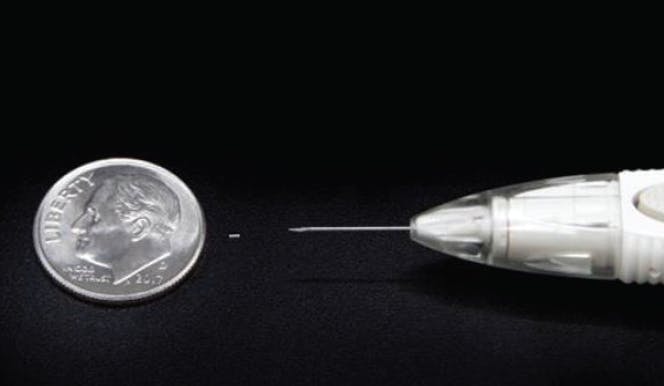
Figure. A 10-µg bimatoprost intracameral implant and its injector.
Courtesy of Marina Bejanian, PhD, and Allergan
DISCUSSION
What were the most common safety issues?
The most common adverse effects associated with the administration of the 10-µg bimatoprost implant were conjunctival hyperemia (27.2%), photophobia (8.6%), foreign body sensation (10.2%), conjunctival hemorrhage (7.5%), and eye pain (9.7%). Of note, side effects typically associated with prostaglandin analogues rarely occurred in either bimatoprost group; there were no reports of eyelash growth or periorbital fat atrophy in either treatment group, and iris pigmentation change occurred in only five patients.
Did the intracameral implant affect corneal endothelial cells?
Mean endothelial cell density decreased in a time- and dose strength–dependent manner in both bimatoprost groups, but the loss was greater in the 15-µg group. Data suggest that there is a greater potential for endothelial cell loss when more implants occupy the inferior iridocorneal angle during a short period of time.
Does the bimatoprost implant have a sustained effect on IOP?
In the year after treatment with three consecutive bimatoprost implants, IOP was controlled without additional treatment in most individuals (82.1% in the 10-µg group). The investigators hypothesize that the observed extended duration of effect might have been due to matrix metalloproteinase–mediated extracellular matrix remodeling of the uveoscleral and trabecular meshwork pathways.4
1. Brubaker JW, Teymoorian S, Lewis RA, et al. One year of netarsudil and latanoprost fixed-dose combination for elevated intraocular pressure: phase 3, randomized MERCURY-1 study. Ophthalmol Glaucoma. 2020;3(5):327-338.
2. Ren R, Li G, Le TD, et al. Netarsudil increases outflow facility in human eyes through multiple mechanisms. Invest Ophthalmol Vis Sci. 2016;57(14):6197-6209.
3. Medeiros FA, Walters TR, Kolko M, et al; ARTEMIS 1 Study Group. Phase 3, randomized, 20-month study of bimatoprost implant in open-angle glaucoma and ocular hypertension (ARTEMIS 1). Ophthalmology. 2020:127(12):1627-1641.
4. Ooi YH, Oh DJ, Rhee DJ. Effect of bimatoprost, latanoprost, and unoprostone on matrix metalloproteinases and their inhibitors in human ciliary body smooth muscle cells. Invest Ophthalmol Vis Sci. 2009;50(11):5259-5265.