The current era of interventional glaucoma has prompted closer consideration of how certain elements of the disease and its management affect patients outside the clinic. As a result, several facets of care, such as the feasibility of long-term drop use, have been called into question, and proactive attempts to minimize patients’ treatment burden, maximize quality of life, and achieve earlier disease stability are underway. An increasing number of tools are available for this pursuit and can be used to decrease IOP aggressively without compromising safety or affecting refractive outcomes.
Given the evolving mindset and advancing treatments, I would argue that now is the perfect time to also recognize cataract surgery as an opportunity to maximize quality of vision and quality of life for patients with glaucoma. These individuals deserve to have the best vision possible, which may indicate the use of toric IOLs, extended depth of focus (EDOF) IOLs, and sometimes even multifocal IOLs. This article explores the use of modern IOL technologies, with two case reports that illustrate their value for patients with glaucoma.
IOL SELECTION AND GLAUCOMA
Although once a principle of glaucoma care, the blanket statement that, “Patients with glaucoma are not candidates for premium IOLs” should be approached more critically today. It is important to differentiate which type of patient and which premium IOL technology are in question. For example, if a patient has mild preperimetric glaucoma, a healthy ganglion cell complex (GCC), and stable IOPs and visual fields, I feel comfortable offering a multifocal/trifocal IOL. With the use of these lenses, however, it is essential to ensure that disease stability can be maintained, which means being able to predict whether a patient’s glaucoma is likely to progress. It is also vital to be familiar with the various lens technologies and their likelihood of success in glaucomatous eyes.
Monofocal accommodating and EDOF IOLs. For patients with glaucoma, I have found great benefits may be afforded by the use of monofocal accommodating IOLs and EDOF IOLs. Monofocal accommodating IOLs such as the Crystalens (Bausch + Lomb) do not degrade quality of vision (similarly to standard monofocal IOLs), but they do provide a slightly increased range of vision for distance and intermediate. The Crystalens can be used in patients with dry eye, and I feel comfortable offering this IOL in cases of mild, moderate, and severe glaucoma. It is important to note that patients with pseudoexfoliation and potential zonular issues may not be good candidates for this lens, and those with more advanced glaucoma and fixation loss may not be able to fully appreciate the extended depth of focus it provides.
A newer lens option on the market, the AcrySof IQ Vivity IOL (Alcon), features a nondiffractive wavefront technology that creates an extended focal range by stretching and shifting the wavefront, as opposed to splitting the wavefront into multiple focal points as diffractive multifocal lenses do. Contrast sensitivity with the Vivity is close to that of a monofocal IOL, which is important in glaucomatous eyes, especially those with visual field loss or GCC loss.
The Tecnis Symfony (Johnson & Johnson Vision) EDOF IOL features echellettes that are embedded within the achromatic diffractive profile to extend depth of focus by about 1.00 D to 1.50 D. This lens maintains fairly high contrast sensitivity, but some patients have reported experiencing spider webs in their vision postoperatively. For patients with early visual field loss or GCC loss, an EDOF IOL may be an appropriate option.
Not designated in the United States as a premium IOL, the Eyhance (Johnson & Johnson Vision) is a recently approved monofocal IOL that has extended range of vision properties due to a continuous increase in power from the periphery to the center of the lens. Studies have shown that patients achieve significantly improved intermediate vision, especially in low-illumination settings.
An exciting monofocal technology, the Light Adjustable Lens (RxSight), allows surgeons to modify the lens power postoperatively. This lens can be useful in patients with previous refractive surgery and in cases in which IOL calculations are less predictable. It can also be helpful when targeting monovision outcomes.
Toric monofocal IOLs. A lens technology that I feel has potential for greater use in patients with glaucoma are toric monofocals. Patients with astigmatism, especially higher amounts, lose contrast sensitivity with spectacle-based versus lens-based astigmatism correction. Therefore, I educate patients on why they are likely to achieve better visual outcomes with a monofocal IOL with built-in astigmatism correction, and I find the iTrace (Tracey Technologies) to be a valuable tool for this purpose. Using this device, I can show patients what their quality of vision would be like with and without astigmatism correction (Figure 1). This information has helped me appreciate how lower amounts of astigmatism still negatively affect quality of vision. It also helps me verify whether patients with lower magnitudes of astigmatism will benefit from astigmatic correction and enables me to confidently offer a toric IOL if so. Now, with lower-power toric IOLs such as the enVista toric (Bausch + Lomb), I often correct corneal astigmatism down to 0.75 D, especially when it is against the rule.
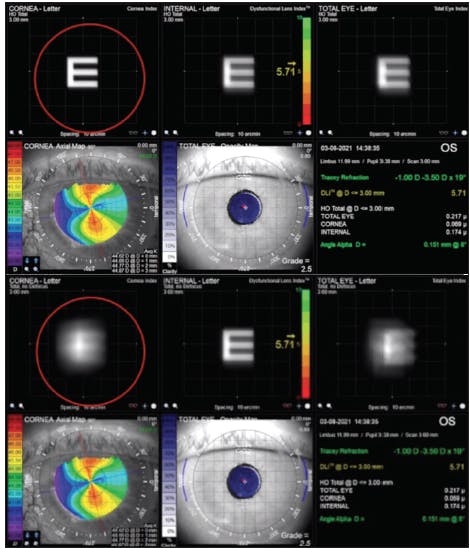
Figure 1. Toric IOL candidates can see their potential vision with (top) and without (bottom) astigmatism correction.
The following case examples shed light on some of the nuances of IOL selection in patients with glaucoma. With the appropriate diagnostic information and careful consideration, it is possible to successfully marry the benefits of advanced IOL technology and glaucoma surgery to ultimately improve patients’ quality of life.
CASE EXAMPLES
Case No. 1. A 76-year-old woman with a history of open-angle glaucoma complained of experiencing a decrease in night vision for several years. Although her glasses had worked well previously, she stated that she could no longer use them for reading, required more light to see, and could not drive at night due to significant glare and halos.
Upon examination, UCVA was 20/70 OD and 20/60 OS, and BCVA was 20/30 OD and 20/25 OS. The patient had a 2+ nuclear sclerotic cataract. On the brightness acuity test, glare measured 20/50 OD and 20/40 OS with correction. The patient was moderately myopic with significant cylinder, about +3.00 D with-the-rule in both eyes. Pachymetry was fairly normal. Corneal hysteresis, or the measurement of the shock-absorbing ability of the eye, was low.
Ocular surface evaluation revealed significant superficial punctate keratitis, dry eye, decreased tear film breakup time, and an unhealthy tear film. The patient was using a prostaglandin analogue (PGA) once nightly and a combination of brimonidine and timolol twice daily. Studies have shown that the use of glaucoma drops may increase the risk of dry eye and the subsequent need for dry eye therapy.2,3 It is important to address ocular surface disease (OSD) as quickly and as aggressively as possible before conducting final IOL calculations and performing cataract surgery. I aim to eliminate all glaucoma medications if possible and utilize solutions such as the bimatoprost intracameral implant (Durysta, Allergan) or selective laser trabeculoplasty while addressing OSD.
In addition to OSD, this patient had bow-tie astigmatism and a dysfunctional lens index of 5, indicating a significant loss of quality of the lens. She had significant corneal higher-order aberrations, and her angle alpha (the difference between the center of the limbus and the visual axis) was high, suggesting that she could end up looking through the diffractive rings of a multifocal IOL rather than through the central optical zone.
The patient had significant diffuse retinal nerve fiber layer (RNFL) defects inferiorly in both eyes and significant GCC loss, which was greater in the right eye than in the left eye (Figure 2). It is important to remember that significant RNFL loss and GCC loss take place before visual field loss occurs. A patient’s visual fields may look healthy, but if GCC loss or RNFL loss has occurred, then they have already lost contrast sensitivity—this is where understanding the value of structure versus function comes into play. If I observe significant RNFL loss or GCC loss, I shy away from offering a multifocal lens, regardless of the patient’s visual fields.
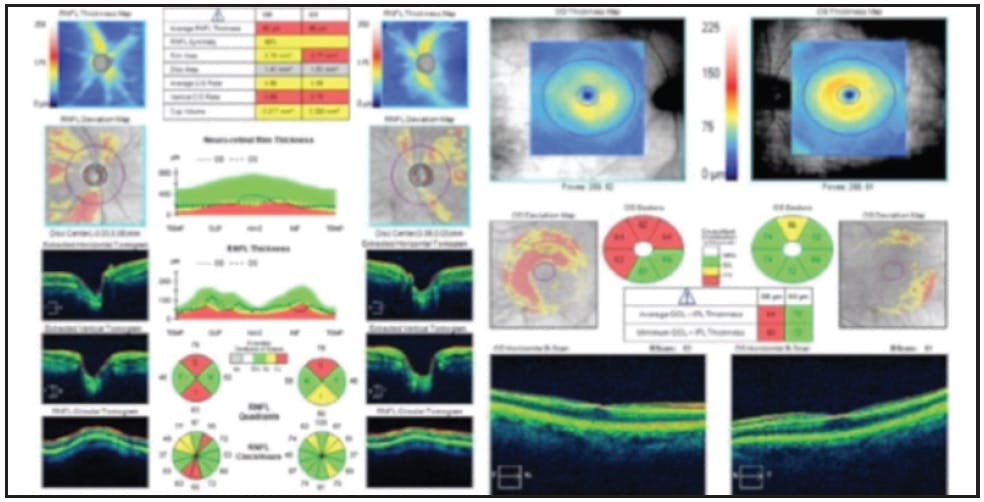
Figure 2. In Case No. 1, the patient had significant diffuse RNFL defects inferiorly in both eyes and significant GCC loss.
In this case, the three primary variables I took into consideration were: (1) the patient had mild open-angle glaucoma based on her visual fields (Figure 3), (2) the patient was not happy about taking three medications, and (3) the patient had significant RNFL loss and GCC loss, indicating damage had occurred and was likely to progress. With this in mind, I decided not to implant a multifocal IOL but to address her astigmatism with a monofocal toric IOL to give her the best-quality optics possible.
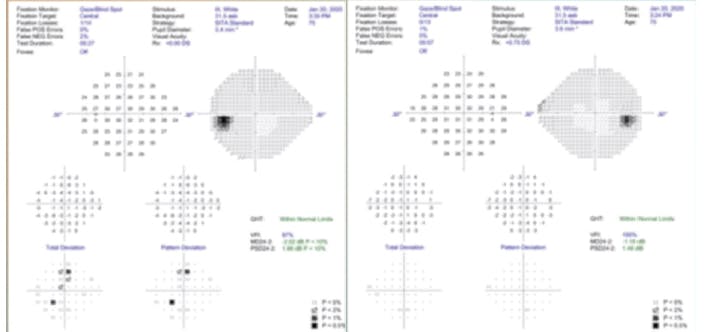
Figure 3. In Case No. 1, the patient’s visual fields appeared normal, although significant RNFL and GCC loss had occurred.
After thorough discussion with the patient, we opted to move forward with the enVista monofocal toric IOL. This zero-aberration lens leaves the cornea with +0.27 µm of spherical aberration to provide an extended depth of focus without a significant loss of contrast sensitivity. A few months before surgery, I placed a bimatoprost intracameral implant to eliminate the PGA and improve the ocular surface. With the cataract procedure, I targeted plano for the right eye and -0.75 D for the left eye to provide modified monovision. I also performed a viscodilating procedure and implanted a stent to address her glaucoma and decrease her drop burden.
Postoperatively, the patient achieved a distance UCVA of 20/20 OD and 20/25 OS and J1 at near. She does not need to wear reading glasses for most of the day, and the health of her ocular surface has improved significantly. IOP remains stable at around 16 mm Hg on no medication, and the patient is very satisfied with her outcome.
Case No. 2. A 58-year-old woman with a family history of glaucoma and a history of SLT expressed a desire to be off medication. She had been prescribed a PGA and timolol but reported poor compliance. Her IOPs fluctuated from the upper teens to the low 20s mm Hg. The patient had cataracts, with cortical and nuclear sclerotic changes in both eyes. She had been reluctant to undergo cataract extraction for some time due to fear of the postoperative course but had become accepting of surgery.
Pachymetry was fairly normal, and corneal hysteresis was slightly lower than normal. The IOLMaster (Carl Zeiss Meditec), Pentacam (Oculus), and iTrace showed significant against-the-rule corneal astigmatism. Unlike the patient in Case No. 1, this patient’s GCC and RNFL appeared healthy (Figure 4). The 24-2 visual fields of both eyes also looked healthy and had been stable for around 5 years (Figure 5). Although her IOP had fluctuated, disease progression was slow.
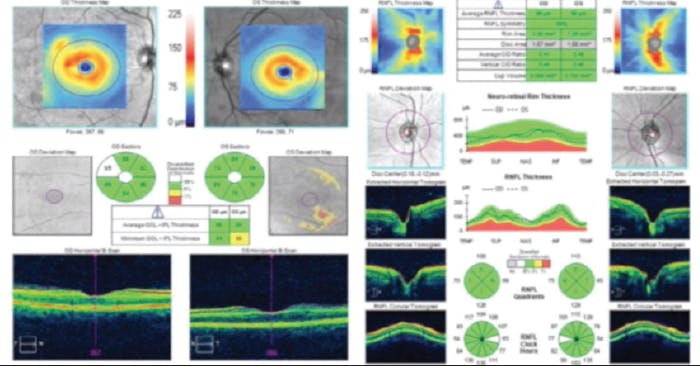
Figure 4. In Case No. 2, the patient’s GCC and RNFL appeared healthy.
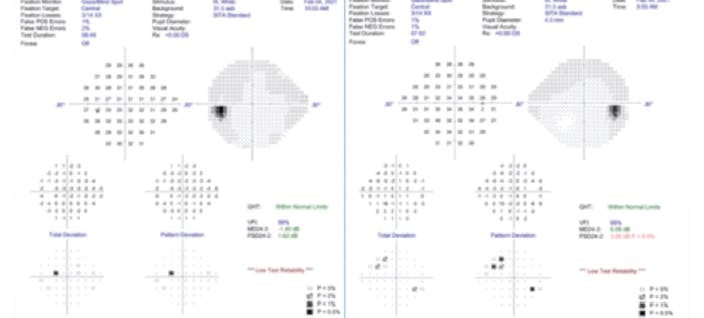
Figure 5. In Case No. 2, the patient’s 24-2 visual fields appeared healthy and were stable.
The patient’s daily activities required not only distance vision but also near vision for computer work and reading. She therefore desired a full range of vision. Given the health of her GCC, I felt confident that a multifocal toric IOL would be successful and ultimately decided to implant a PanOptix toric IOL (Alcon). In addition, the patient underwent a combination of viscodilation and stenting. All procedures were uneventful.
On postoperative day 1, UCVA was 20/25 with minimal inflammation. I prescribed twice-daily use of an NSAID, which was stopped after 4 weeks without tapering. In all cases, I aim to minimize obstacles surrounding postoperative drop adherence and therefore tend to utilize steroid drug delivery devices (eg, Dextenza [Ocular Therapeutix] and Dexycu [EyePoint Pharmaceuticals]). If steroid drops are required, I use brand-name loteprednol (Lotemax SM [Bausch + Lomb] or Inveltys [Kala Pharmaceuticals]) to minimize the risk of IOP spikes.
Once both eyes were treated, the patient had a UCVA of 20/20 and J1 reading. Now, at around 9 months postoperatively, IOP is in the middle teens off medication, and the patient can perform all activities without glasses. It is likely that her past SLT had prevented her from experiencing more significant glaucomatous progression and had protected her ocular surface by enabling her to avoid preservative-containing drops for years. As shown in the LIGHT study, patients who undergo SLT are less likely to require incisional glaucoma surgery than patients whose disease is managed with medications.4
CONCLUSION
A number of datasets have shown that combining cataract surgery and MIGS helps not only to prevent glaucomatous progression but also to improve patients’ quality of life.5,6 Incorporating the use of premium IOL technologies further helps optimize patients’ vision and address issues surrounding their quality of life. It is through these efforts that ophthalmologists can truly make a significant, long-term impact and deliver superior patient-centered care.
1. Data on file. Bausch + Lomb.
2. Leung EW, Medeiros FA, Weinreb RN. Prevalence of ocular surface disease in glaucoma patients. J Glaucoma. 2008;17(5):350-355.
3. Rossi GC, Pasinetti GM, Scudeller L, et al. Risk factors to develop ocular surface disease in treated glaucoma or ocular hypertension patients. Eur J Ophthalmol. 2013;23(3):296-302.
4. Gazzard G, Konstantakopoulou E, Garway-Heath D, et al. Selective laser trabeculoplasty versus eye drops for first-line treatment of ocular hypertension and glaucoma (LiGHT): a multicentre randomised controlled trial. Lancet. 2019;393(10180):1505-1516.
5. Samuelson TW, Chang DF, Marquis R, et al; HORIZON Investigators. A Schlemm canal microstent for intraocular pressure reduction in primary open-angle glaucoma and cataract: The HORIZON Study. Ophthalmology. 2019;126(1):29-37.
6. Samuelson TW, Singh IP, Williamson BK, et al. Quality of life in primary open-angle glaucoma and cataract: an analysis of VFQ-25 and OSDI from the iStent inject pivotal trial. European Glaucoma Society Journal Club. April 2021. Accessed August 1, 2021. www.eugs.org/eng/journalclub_showjournalclub.asp?id=3493