


Glaucoma is the leading cause of irreversible blindness worldwide. In developing countries, there are numerous challenges related to glaucoma diagnosis and treatment. Some of these include a higher incidence and prevalence of the disease, poor understanding of the disease given its asymptomatic nature, late diagnosis due to limited access to care, poor adherence to medications because of low literacy rates and poverty, frequent lack of follow-up, a shortage of ophthalmologists and glaucoma specialists, and limited resources and insufficient infrastructure. Incisional surgery is typically the first intervention to preserve sight. Trabeculectomy is the most cost-effective procedure for advanced glaucoma in developing countries, but there is a high risk of complications with inadequate follow-up. Therefore, glaucoma drainage devices are an excellent alternative, especially with broader indications, as demonstrated in recent clinical trials. Unfortunately, high cost remains an obstacle for both the devices and patch graft materials. In this article, Dr. Aref discusses two new glaucoma drainage devices that could be invaluable in resource-limited countries. In the preliminary studies, these devices have shown to be efficacious in addition to being extremely cost-effective.
Sarwat Salim, MD, FACS | Section Editor
The medical expenses of patients with glaucoma are significant and expected to rise in the near future.1,2 The need to reduce the cost of care and provide more cost-effective glaucoma treatment options is becoming more pressing.3
The use of aqueous shunts continues to increase as the indications for their implantation broaden beyond refractory disease states.4 In the United States, currently available devices include the Ahmed Glaucoma Valve (Model FP-7, New World Medical), the Ahmed ClearPath Glaucoma Drainage Device (New World Medical), and the Baerveldt glaucoma implant (Johnson & Johnson Vision). The Ahmed Glaucoma Valve has a drainage surface area of 184 mm2. It is composed of flexible silicone and designed with a valve system to restrict aqueous outflow at an IOP below 8 to 10 mm Hg. The Ahmed ClearPath Glaucoma Drainage Device and the Baerveldt glaucoma implant are both nonvalved devices composed of silicone that allow for aqueous drainage over a 250-mm2 or 350-mm2 surface area.
Two lower-cost devices have been introduced to the international ophthalmic community. This article provides an overview of these alternatives and their role in glaucoma management.
At A Glance
- As medical costs for patients with glaucoma rise, the need for more costeffective treatment options becomes more pressing.
- The Aurolab Aqueous Drainage Implant and Paul Glaucoma Implant are two novel, low-cost glaucoma devices that have expanded global access to aqueous shunt surgery.
- Data published on these devices suggest safety and efficacy profiles that are similar to those of glaucoma drainage devices that are commercially available in the United States.
AUROLAB AQUEOUS DRAINAGE IMPLANT
The Aurolab Aqueous Drainage Implant (AADI; Aurolab [India]) is a nonvalved silicone implant with a 350-mm2 surface area. Its design is similar to that of the Baerveldt glaucoma implant.
Puthuran and colleagues recently reported intermediate-term outcomes with the AADI in a retrospective, noncomparative, interventional case series of 158 eyes of 158 patients.5 Surgical failure was defined as an IOP greater than 18 mm Hg, an IOP reduction of less than 30% below baseline on two consecutive visits after 3 months, statistical hypotony, reoperation for glaucoma, or loss of light perception vision. Mean baseline IOP was 34.7 mm Hg (standard deviation [SD] = 9.9; 95% CI, 33.1–36.2). It decreased to 15.3 mm Hg (SD = 6.6; 95% CI, 14.3-16.3) at 6 months and stabilized thereafter (15.30 mm Hg at 48 months; SD = 7.6; 95% CI, 12.5–18.1). A Kaplan-Meier analysis showed that the cumulative failure rate increased from 9.5% at 1 year to 50.1% at 4 years. These study findings indicate that the safety and efficacy of the AADI may be similar to those of the Baerveldt glaucoma implant.6 Differences in study populations, however, make it difficult to draw definitive conclusions.
Hafeezullah and colleagues performed a matched case-control study to compare the AADI and Baerveldt implant.7 The investigators compared the outcomes of 25 consecutive patients who received an AADI and case-matched control patients who received a Baerveldt implant at a single academic center. After 1 year of follow-up, median IOPs were similar in the two treatment groups (16 mm Hg vs 13 mm Hg for the Baerveldt device and AADI, respectively; P = .38). Success and failure rates were also similar, as were the complication rates for each device.
PAUL GLAUCOMA IMPLANT
The Paul Glaucoma Implant (PGI; Advanced Ophthalmic Innovations [Singapore]) is composed of medical-grade silicone, and it drains aqueous over a surface area of 342.1 mm2 (Figure). An important difference between the PGI and aforementioned glaucoma drainage devices is that the internal and external diameters of the tube portion of the PGI are of significantly smaller calibers (0.127 mm and 0.467 mm, respectively). This theoretically decreases the risks of tube-corneal touch and conjunctival erosion.
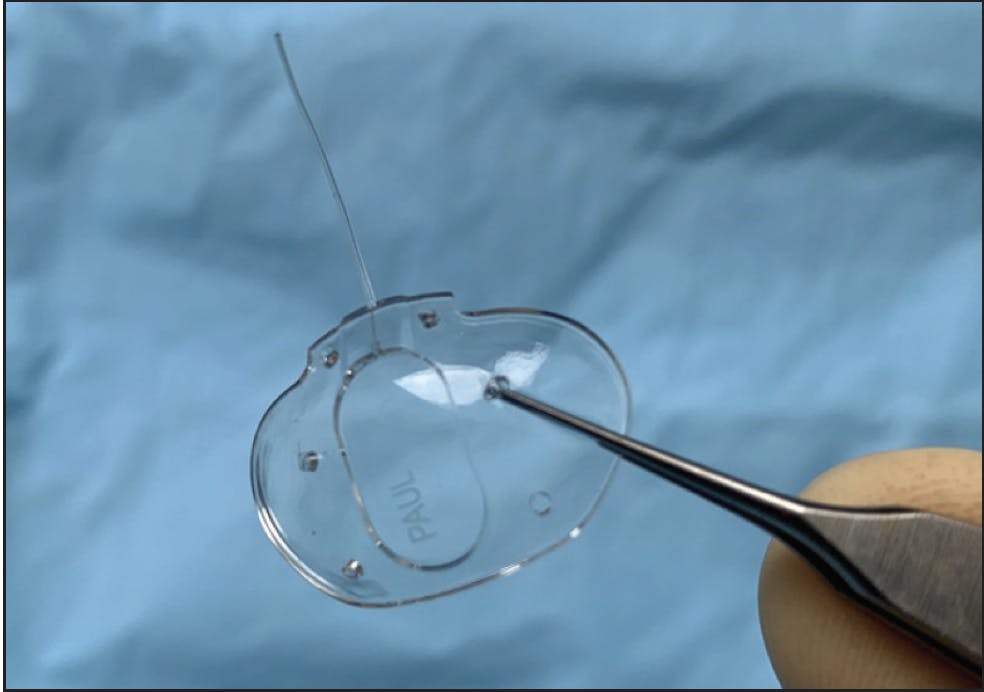
Figure. The PGI is composed of medical-grade silicone and filters aqueous over a surface area of 342.1 mm2. The internal and external tube diameters of the device are 0.127 mm and 0.467 mm, respectively.
Koh and colleagues investigated the safety and efficacy of the PGI in 74 eyes of 74 patients after 1 year of follow-up.8 In the study group, mean baseline medicated IOP decreased from 23.1 +8.2 mm Hg to 13.2 +3.3 mm Hg at 1 year. This corresponded to a decrease in medication use from 3.3 +0.9 medications at baseline to 0.3 +0.6 medications at 1 year. Importantly, surgeons implanting the PGI in this study used a variety of techniques to limit immediate postoperative hypotony. These techniques included tube ligation, ripcord suture placement, and/or the use of an OVD to fill the anterior chamber. Postoperative complications included self-limited anterior chamber shallowing (14.9%), hypotony requiring an intracameral OVD injection (9.5%), tube shunt occlusion (6.8%), tube exposure (4.1%), and endophthalmitis (1.4%).
Longer-term follow-up and experience with the PGI are required to better assess the device’s place in the glaucoma treatment armamentarium, but results thus far are encouraging.
CONCLUSION
The AADI and PGI are novel glaucoma devices that have expanded global access to aqueous shunt surgery. Both devices have attained the CE Mark in Europe but have yet to be approved by the FDA. To date, published data on these devices suggest that their safety and efficacy profiles are similar to those of devices that are commercially available in the United States.
1. Prager AJ, Liebmann JM, Cioffi GA, Blumberg DM. Self-reported function, health resource use, and total health care costs among Medicare beneficiaries with glaucoma. JAMA Ophthalmol. 2016;134(4):357-365.
2. Bramley T, Peeples P, Walt JG, et al. Impact of vision loss on costs and outcomes of Medicare beneficiaries with glaucoma. Arch Ophthalmol. 2008;126(6):849-856.
3. Feldman RM, Cioffi GA, Liebmann JM, Weinreb RN. Current knowledge and attitudes concerning cost-effectiveness in glaucoma pharmacotherapy: a glaucoma specialists focus group study. Clin Ophthalmol. 2020;14:729-739.
4. Vinod K, Gedde SJ, Feuer WJ, et al. Practice preferences for glaucoma surgery: a survey of the American Glaucoma Society. J Glaucoma. 2017;26(8):687-693.
5. Puthuran GV, Palmberg P, Wijesinghe HK, et al. Intermediate-term outcomes of an affordable aqueous drainage implant in adults with refractory glaucoma. Ophthalmol Glaucoma. 2019;2(4):258-266.
6. Christakis PG, Zhang D, Budenz DL, et al. Five-year pooled data analysis of the Ahmed Baerveldt Comparison Study and the Ahmed Versus Baerveldt Study. Am J Ophthalmol. 2017;176:118-126.
7. Hafeezullah N, Alhilali S, Alghulaydhawi F, et al. A preliminary comparison of the Aravind Aurolab drainage implant with the Baerveldt glaucoma implant: a matched case-control study. Eur J Ophthalmol. March 18, 2020. doi:10.1177/1120672120912383
8. Koh V, Chew P, Triolo G, et al. Treatment outcomes using the PAUL glaucoma implant to control intraocular pressure in eyes with refractory glaucoma. Ophthalmol Glaucoma. 2020;3(5):350-359.


