


Interventional glaucoma (IG) represents a paradigm shift in glaucoma care. The goal is a proactive, rather than a reactive, approach to treatment. IG has become more popular with the advent of MIGS and implantable drug delivery systems. Because MIGS procedures are associated with lower complication rates compared with traditional glaucoma procedures such as trabeculectomy and tube shunt implantation, surgeons can offer options for early intervention either as standalone treatments or in combination with cataract surgery. In addition to preventing or slowing early glaucomatous damage, IG aims to improve patients’ quality of life by minimizing the treatment burden associated with IOP-lowering eye drops.
This evolution in treatment requires clinicians to adopt a different mindset when evaluating patients. To make the shift, clinicians need solid diagnostic testing strategies that can offer highly repeatable and objective results. In other words, a paradigm shift in the approach to treatment demands a paradigm shift in diagnostics. The conventional approach to glaucoma treatment is to start with medications and to proceed to surgery when visual field (VF) defects and progression occur. By that point, however, a significant number of retinal ganglion cells have already been lost. The use of OCT technology can help change this paradigm of glaucoma diagnosis.
DRAWING COMPARISONS
Even a single OCT scan demonstrating early defects offers time for action before VF defects emerge.1 Unfortunately, anatomic variations and artifacts on OCT scans are quite common. These anatomic variations and artifacts can cause problems with comparisons to a normative database, so a single OCT scan can be misleading.2
OCT progression analysis can change how clinicians diagnose or rule out glaucoma. First, it can reveal subtle changes with high repeatability. Second, because OCT progression analysis does not depend on comparisons to a normative database, it eliminates the effect of anatomic variations; patients’ data are compared instead to their own data.
DETECTION
The high reproducibility of modern OCT systems permits the detection of progressive retinal nerve fiber layer (RNFL) loss while RNFL thickness measurements are still in the normal range of the normative database. OCT progression analysis can thus reveal multiple steps of statistically significant change while the measurements are still within the normal (green) range (Figure 1). The opposite is also true: OCT progression analysis allows patients with stable ocular hypertension to be observed without unnecessary intervention or medical treatment.
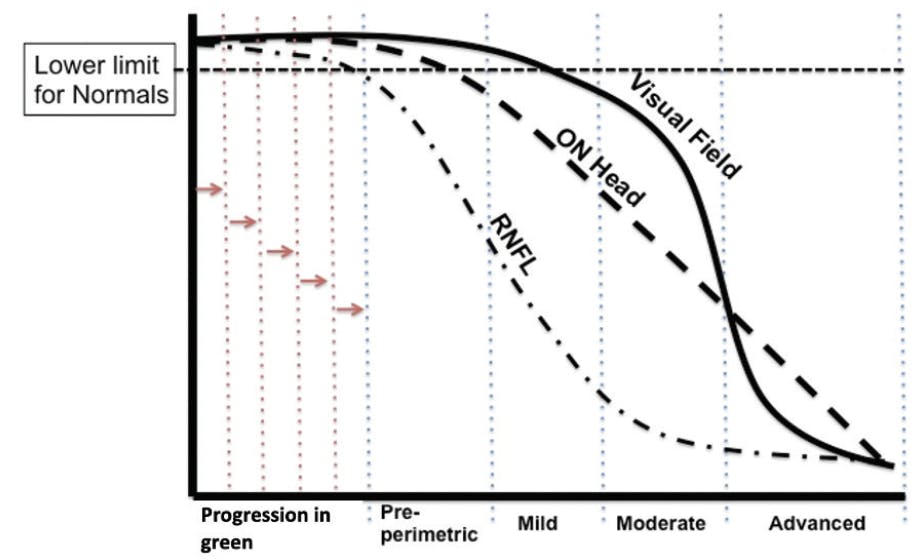
Figure 1. RNFL thinning is one of the earliest signs of glaucomatous damage. OCT progression analysis can identify multiple steps of statistically significant change while the RNFL thickness is still within a normal range on OCT (red arrows). Modified with permission from Weinreb RN. Shaffer Lecture at the 105th Annual Meeting of the American Academy of Ophthalmology. Presented at: AAO Annual Meeting; 2001; New Orleans, LA.
Understanding the concept of progression in green requires an awareness of the technical advances incorporated into current OCT platforms. These machines can acquire a high number of A-scans with high resolution, which makes the precise registration of serial scans possible. Precise registration permits the accurate alignment of two or more OCT scans obtained at different times. These serial scans can be compared by matching the corresponding points. Good reproducibility with low test-retest variability is essential to the detection of true disease progression. By combining high reproducibility and low test-retest variability, OCT progression analysis provides robust data about the presence or absence of progressive change. If average RNFL thickness is chosen as a single parameter, multiple steps of statistically significant change can be demonstrated while results are still in the green range.
The intervisit reproducibility coefficient of average RNFL thickness measured by most modern spectral-domain OCT devices is approximately 5 μm.3 If one patient’s eyes are scanned repeatedly over time, a decrease of more than 5 μm in average RNFL thickness is expected to be randomly found less than 2.5% of the time. A reduction of 5 μm or more in average RNFL thickness is thus a statistically significant change that has a false positive rate of 2.5%.
In other words, progression can be identified in glaucoma suspects by looking for thinning of 5 μm or more in average RNFL thickness on serial OCT scans. This amount of change, if confirmed with a second test, is randomly observed in less than 1% of stable patients.
By using the change in average RNFL thickness measurement as the main outcome measure for identifying progression, clinicians can identify patients who are losing nearly one-third of their RNFL thickness yet whose results may still be in the green range of the normative database of OCT devices (Figure 2). A change from baseline on spectral-domain OCT could therefore be an early detection strategy in glaucoma suspects. Figure 3 shows early structural progression in a patient using the Guided Progression Analysis (GPA) of the Cirrus HD-OCT (Carl Zeiss Meditec).
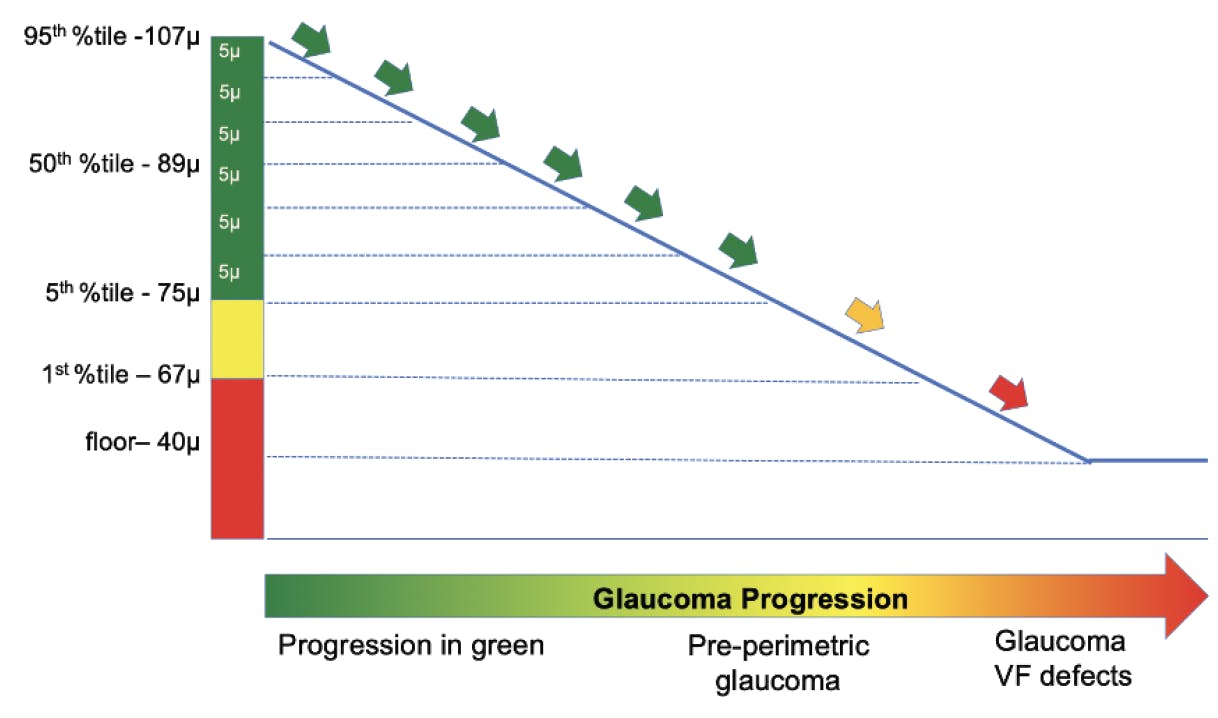
Figure 2. The vertical axis shows the RNFL thickness values for a 69-year-old patient. Serial scans and OCT progression analysis software can show multiple steps of statistically significant RNFL loss while the thickness values are still in the normal thickness range of the normative database (green arrows). Modified with permission from presentation by Patella M, Goni F, Bron A, Heijl H. Aurora Meeting; 2015; Berlin, Germany.
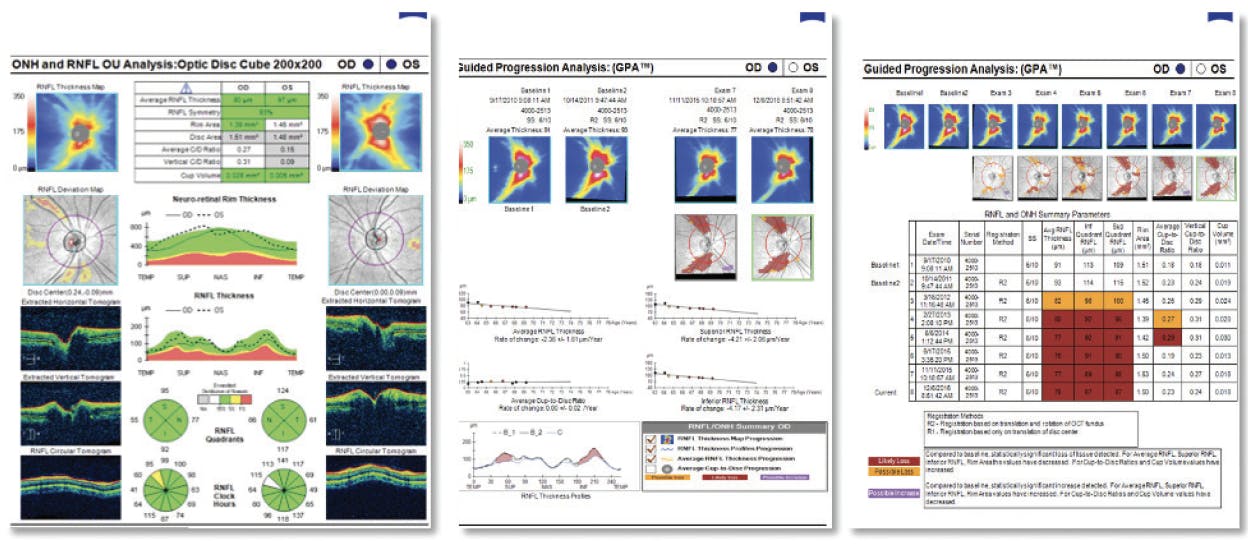
Figure 3. An OCT scan of a patient from August 2013 shows nearly normal RNFL thickness data for the right eye. The GPA from 2010 to 2013 shows that a significant amount of RNFL was lost in the right eye during the follow-up period. The scan on the left (July 2013), which looks nearly normal and mostly green, is the fourth test in the GPA, and the average RNFL thickness is already 11 μm thinner than baseline. This is an example of progression in green. The patient underwent a trabeculectomy in the right eye in January 2014, which stabilized the RNFL loss.
CONCLUSION
If the value of OCT progression analysis for early glaucoma management becomes well recognized, IG will be more readily incorporated into daily practice. Making OCT progression analysis a pillar of early glaucoma management can permit earlier intervention and thus decrease the number of patients who develop VF defects.
1. Kuang TM, Zhang C, Zangwill LM, Weinreb RN, Medeiros FA. Estimating lead time gained by optical coherence tomography in detecting glaucoma before development of visual field defects. Ophthalmology. 2015;122:2002‐2009.
2. Akman A. Artifacts and anatomical variations in optical coherence tomography. In: Akman A, Bayer A, Nouri-Mahdavi K, eds. Optical Coherence Tomography in Glaucoma: A Practical Guide. Springer Nature; 2018:101-161.
3. Leung CK, Cheung CY, Weinreb RN, et al. Retinal nerve fiber layer imaging with spectral-domain optical coherence tomography: a variability and diagnostic performance study. Ophthalmology. 2009;116:1257-1263.

