


On a busy Thursday morning last December, my phone rang and displayed an unlisted number. “Probably spam,” I thought to myself, annoyed. Some errant spark of curiosity nevertheless compelled me to answer.
“This is Gretchen Whitmer,” said the caller. I was surprised into silence. She prompted helpfully, “Your governor.”
There’s a backstory here. In the autumn of 2020, as the weather turned colder and people started intermingling indoors again, Michigan and the nation at large saw the dreaded second wave of COVID-19 emerge. Perhaps recalling the devastation that occurred in Detroit in the spring of 2020, Governor Whitmer quickly reinstated a partial lockdown of the state. Effective November 18, 2020, the “pause in reopening,” as it was somewhat rosily termed, was designed to put the brakes on the train before it well and truly ran away. The effort worked. On a graph showing COVID-19 cases in Michigan, November 18 was a literal inflection point on the curve (Figure).
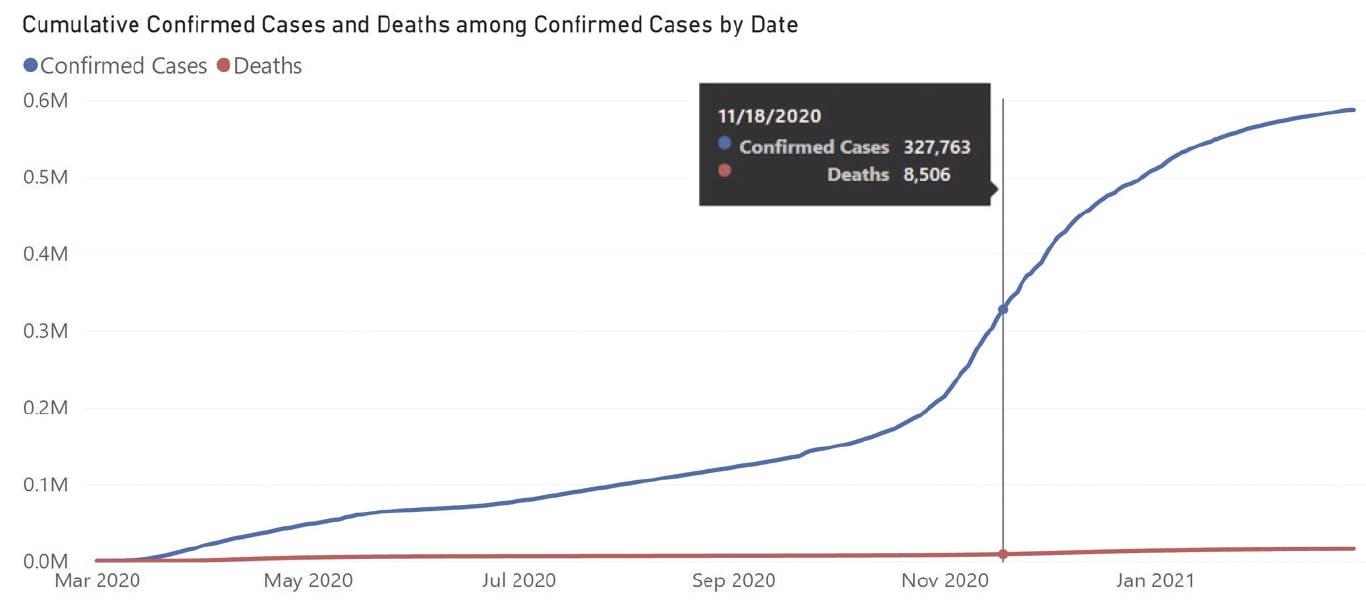
Figure. On November 18, 2020 (line), a partial lockdown was reinstated in Michigan with the intention of stopping a surge in COVID-19 cases. This graph of COVID-19 cases in Michigan shows a noticeable change in the slope of the curve corresponding to a decrease in infection rates. Source: michigan.gov public use datasets.
The pause, however, was not without controversy or risk, as it was announced in the immediate aftermath of a wildly contentious presidential election and against the backdrop of a terrifyingly credible kidnapping plot against the governor herself. An unqualified medical catastrophe had become a political bludgeon, and acts of public health were being recast as attempts to oppress the populace. Imagining an imminent tsunami of protestation, I wanted to make a small stand for medical science. I found the suggestion box on michigan.gov and wrote something to the effect of, “I’m a doctor, and I 100% support the cause. You’re saving lives. I admire your courage. Don’t let the haters get you down.” I didn’t think my words would amount to much. In fact, I doubted Governor Whitmer would even see the message, but perhaps when some intern tallied up all the yeas and nays, my iota of support would tilt the scales some infinitesimal amount. I hit send and mostly forgot about it.
Two weeks later, the Governor of Michigan called me on my cell phone. She thanked me for my support, and I thanked her for continuing to stick up for public health. Our conversation was brief, but it was meaningful to me. It meant that advocacy works, and perhaps more importantly, it meant that advocacy can be as simple and as easy as writing a letter.
WHY ADVOCATE?
Like many others, I haven’t participated enough in medical advocacy. Throughout medical school and residency, it was impressed upon me again and again that advocacy is an important part of our careers. Even so, I remain part of the 78.5% of AAO members who do not contribute to OPHTHPAC, the Academy’s political action committee. I don’t volunteer for advocacy trips to Washington, DC, and I generally ignore the OPHTHPAC update emails that come out every so often. As a resident, I joined my class on a trip to our state capital, but once there, I mostly sat quietly and listened. Perhaps you’re in the same boat and for some of the same reasons: We don’t have the time, we don’t have the money, we aren’t particularly good at schmoozing and elbow-rubbing, we’re not sure we’re terribly persuasive, we don’t even really know all the details, and we don’t have time to read about it. In short, we’re doctors, not politicians.
The thing is, advocacy is important, and it affects each and every one of us. Representation is important. The 17 physicians currently serving in Congress have walked in our shoes and understand more about our profession than anyone else ever could. Medical education is important, and the recent expansion of residency positions was both necessary and overdue. Compensation is important, even if it’s gauche to say so. The 2021 Medicare cuts might have been even more severe if not for our collective and vociferous dissent. Health care availability is important, and incentivizing care in rural and underserved areas can help us reach those patients who need us most. Scope of practice, as well as reducing the burden of prior authorizations and stepwise therapy, is important because we have a duty to protect our patients. Finally, as this past year of pandemic and pandemonium has shown us beyond a shadow of a doubt, public health, disease prevention, vaccination, research funding, and data-driven policy making are incredibly important. Advocating for our profession is one and the same as advocating for a better and safer health care system for our patients.
HOW TO ADVOCATE
How do we get started? The good news is that there’s more than one way to get involved and that most are easier than you’d think.
Contact your representatives. This is probably the easiest and most personal way to get involved. All elected officials have contact information listed on their webpages. As their constituent, you have a right to be heard. Do you like what they’re doing? Tell them that. Do you wish they’d focus on something important to you? Tell them that, too. Most of these communiqués will probably be filtered by their staff, but an aggregate picture will be conveyed to your representative. Many drops make a flood. Furthermore, the more locally you start, the more likely you are to get a response. Don’t underestimate the importance of lawmaking at the city, county, and state levels; those are the laws that affect you most.
Join a local, state, or national society. Many major cities have their own ophthalmologic societies. Most states do as well. Every subspecialty has its own society, and most have an advocacy arm. The American Glaucoma Society (AGS) has its own Advocacy Days, although this year’s has not yet been scheduled becaue of the pandemic. There are also numerous advocacy-related threads in the AGS’ very active online forums. If you want to pitch in but don’t know where to begin, your local ophthalmologic society or the AGS is a great place to start.
Contribute to OPHTHPAC. One of the easiest ways to advocate is to contribute to OPHTHPAC. The benefits are obvious: The organization is big, well known, and well managed, and it takes very little effort to get involved. There are downsides, however. OPHTHPAC’s agenda is determined on a national level, and it may or may not align with your specific interests. Although it’s very possible to start participating in the conversation, for most of us, taking part in OPHTHPAC’s advocacy means cutting a check. Depending on your financial situation and career stage, this may or may not be an option.
Get involved nationally. If you want to advocate in person on a national level, the AAO’s Mid-Year Forum is a good place to start. This is where the direction of OPHTHPAC for the upcoming year is debated and decided. This year’s Mid-Year Forum is virtual, making it incredibly easy to attend. You can register for the event at bit.ly/AAOMid-YearForum. If you’d like to lobby personally for our profession, consider becoming a Congressional Advocate for the AAO. Lobbying experience is not required as the AAO offers support and training. You can sign up to volunteer at bit.ly/AAOAdvocacy.
CONCLUSION
Advocacy isn’t limited to a single path, topic, or level of governance. As someone who always felt particularly untalented at advocacy, I want to share my perspective and encourage you to get involved however you can. Advocacy isn’t just for the politically minded. It doesn’t always require a large investment of time or other resources. There are many ways to advocate and no single right path. Whatever comes most naturally to you is your best way of speaking up for yourself, your colleagues, and your patients. No matter your method, advocacy is meaningful and worthwhile, and it is part of our duty both as physicians and as citizens of a democracy.

