Case Presentation
A 67-year-old woman presents with recurrent hyphemas in the right eye. The patient has a history of uneventful cataract surgery and placement of a Hydrus Microstent (Ivantis) in each eye 2 years ago. She also has a remote history of a scarred trabeculectomy in the right eye.
The patient is allergic to benzalkonium chloride and cannot tolerate most eye drops. Before cataract surgery, the IOP was in the upper teens and not fully controlled on preservative-free timolol and travoprost ophthalmic solution 0.004% (Travatan Z, Alcon). Because of physical distance from the office, she has been monitored by another eye care provider since her last surgical procedure. Although the IOP remained well controlled without medication, 18 months after surgery, she began developing recurrent hyphemas in the right eye. Each time, this resulted in a transient IOP spike and hazy vision that lasted for 5 to 7 days. She has had a total of four episodes in the right eye. The most recent occurred 4 weeks ago, and it resolved.
The patient is administering no glaucoma medications. She started therapy with clopidogrel bisulfate (Plavix, Bristol-Myers Squibb and Sanofi Pharmaceuticals) a year ago to treat coronary artery disease.
On examination, UCVA is 20/30 OU, and IOP is 14 mm Hg OU. A slit-lamp examination reveals a scarred trabeculectomy in the right eye, a well-positioned IOL in each eye, and no active hyphema. On gonioscopy, the appearance of the stent in the nasal angle of each eye is unremarkable (Figure 1). A fundus examination reveals cupping of both optic nerves. Visual field testing demonstrates stable superior arcuate scotomas in both eyes, and OCT shows cupping and thinning of the retinal nerve fiber layer in both eyes (Figures 2 and 3).
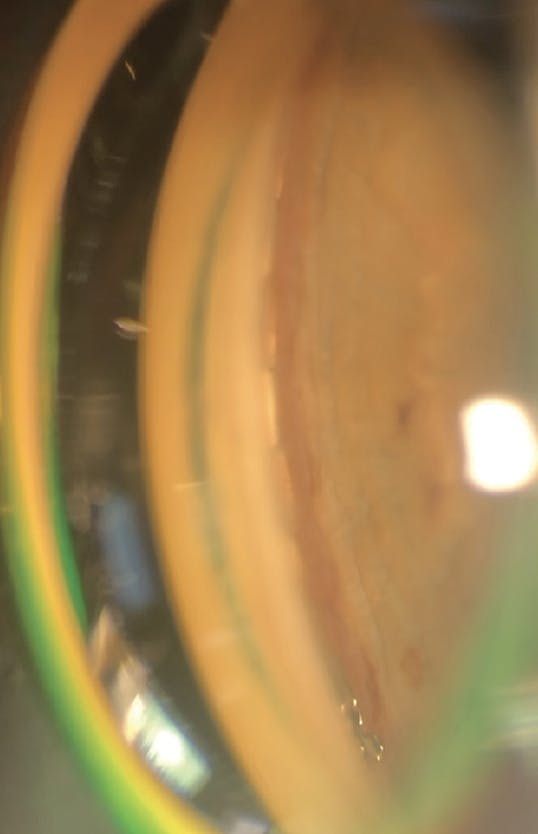
Figure 1. A Hydrus Microstent in situ in the right eye.
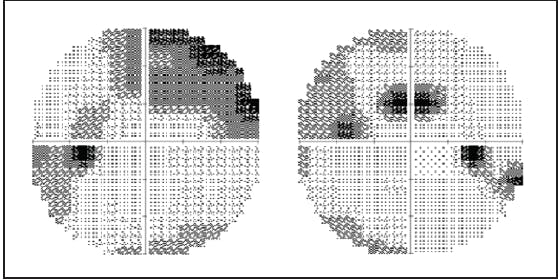
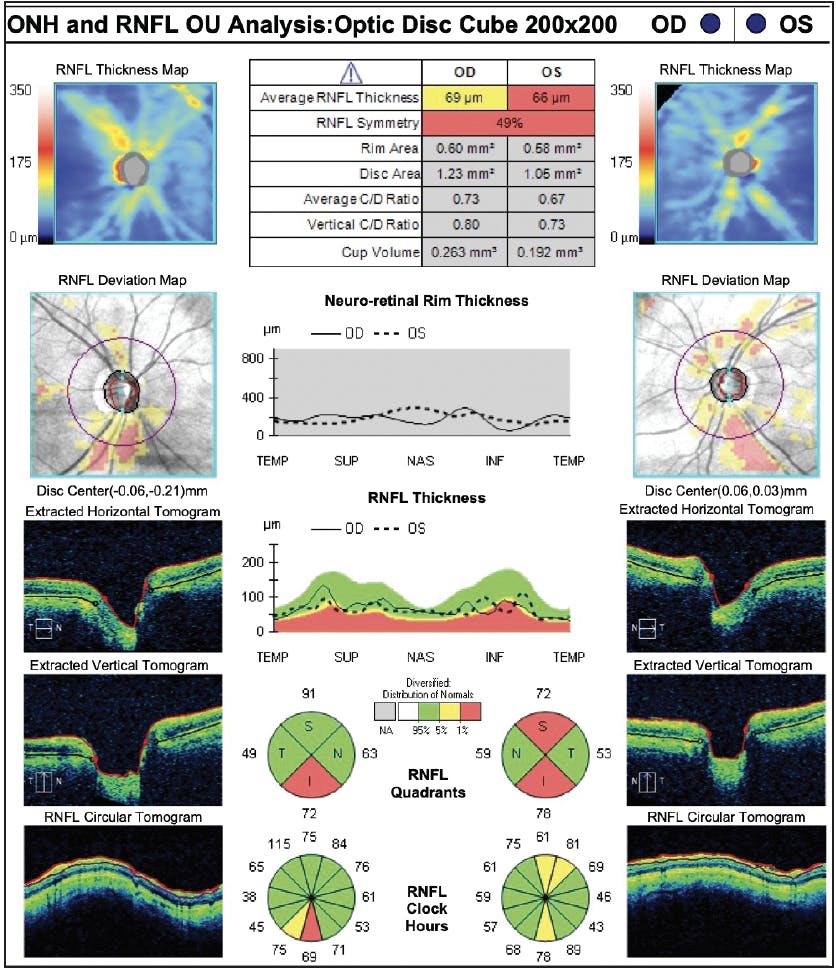
Figure 3. OCT shows cupping of the optic nerve and thinning of the retinal nerve fiber layer in each eye.
The patient has been happy with the results of her prior surgical procedures, but a solution to the episodic hyphemas is required. How would you treat the recurrent hyphemas? How would you plan to address IOP control given the difficulty she has tolerating medication and her desire to continue avoiding IOP-lowering medical therapy?
—Case prepared by Jacob Brubaker, MD
SAHAR BEDROOD, MD, PHD
This is a fascinating case with multiple layers. The first step is to determine the cause of the hyphemas. They could be a result of angle surgery and implantation of a Hydrus Microstent. This device may be embedded in an area that is in contact with blood vessels, or there may be significant blood reflux. Either situation in combination with blood thinners may be causing a small vessel to bleed into the anterior chamber. Other possible causes of the hyphemas are chronic inflammation from uveitis-glaucoma-hyphema syndrome and inflammation from a herpes simplex virus or varicella zoster virus infection. A more rare but important possibility is neoplasm, namely ciliary body tumors, melanoma, and lymphoma/leukemia with systemic platelet deficiencies. These must be ruled out with anterior segment OCT, ultrasound biomicroscopy, and a full fundus examination.
Provided the more malignant causes are ruled out, the next step is to discuss with the patient’s cardiologist a trial without blood thinners. If the patient is unable to tolerate a discontinuation of clopidogrel bisulfate, then I would consider removing the stent from the angle. In the OR, an OVD would be injected into the angle, and the device would be extracted with micrograspers.
Once bleeding stabilized, I would consider additional glaucoma surgery to lower the IOP. Given the patient’s history of hyphema, I would recommend a bleb-based procedure such as the placement of a Xen Gel Stent (Allergan) in lieu of angle surgery. If there is an inflammatory component to the hyphema and IOP spikes, a glaucoma drainage device such as an Ahmed Glaucoma Valve (New World Medical) or a Baerveldt glaucoma implant (Johnson & Johnson Vision) might be a better option.
XIONGFEI LIU, MD
A uveitis-glaucoma-hyphema scenario is complicated by this patient’s need for a blood thinner and her desire to avoid topical glaucoma therapy. The Hydrus Microstent appears to have been well placed, but hyphema can result if episcleral venous pressure increases transiently with blood reflux into Schlemm canal. Movement of the iris in response to light or eye rubbing and a hidden cyclodialysis cleft are two other possible causes of hyphema. In addition, when a one-piece IOL is well positioned in the bag, anatomically decreased interplicata distance—a rare occurrence during open-angle gonioscopy—can result in hyphema.1 Ultrasound biomicroscopy would therefore be performed to evaluate the eye for a hidden cleft and to assess lens-haptic position, ciliary body position, and interplicata distance.
I would either prescribe pilocarpine therapy or offer to perform an argon laser iridoplasty/cautery if microtrauma from stent-iris touch is the cause of hyphema. If ciliary body position or interplicata distance is the issue, I would prescribe cycloplegics. If neither the ciliary body nor the lens is involved, then I would repeat automated perimetry and OCT in 3 months to assess the eye for glaucomatous progression. If progression is noted in the setting of recurring hyphema, I would discuss with the patient removal of the stent, but I would clarify the risk of the procedure because of fibrosis as well as the possibility of cleft creation and postoperative hyphema.
If removal of the device is elected, either ab interno goniotomy adjacent to the site of removal or needling of the scarred bleb could be attempted. Transscleral cyclophotocoagulation using the Cyclo G6 Glaucoma Laser System with MicroPulse P3 Glaucoma Device (Iridex) would be a safer course. Before surgery, a sickle cell prep should be done if sickle cell anemia is suspected clinically.
WHAT I DID: JACOB BRUBAKER, MD
On examination, nothing seemed to be remarkable about the stent in the right eye. There were no aberrant vessels or other obvious causes of hyphema. I suspected, however, that a hidden vessel was in contact with the stent and causing the hyphemas. If so, when the patient was upright, the stent’s inlet would naturally have a downward trajectory, and I postulated that this might be facilitating the escape of red blood cells. I therefore recommended removal of the stent.
The patient and I discussed two options: a resumption of topical glaucoma therapy after removal of the device or repositioning of the stent in the inferior angle after the device’s removal. She was happy with the IOP control she had achieved and elected to have the device repositioned.
In the OR, I created a 1.5-mm sideport incision at the 7:30 clock position. Using a Hydrus injector under gonioscopic visualization, I grasped and removed the stent. A few trabecular adhesions were visible and presented moderate resistance. Once the stent was freed, it retracted suddenly into the injector, causing minor trauma to the iris and a focal hyphema. This was tamponaded with an additional amount of an OVD. On inspection, damage to the peripheral iris did not appear to be significant.
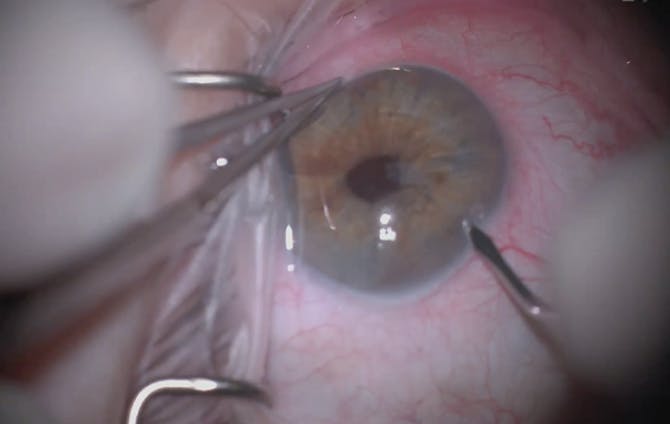
I turned my attention to placing the stent in the inferior angle. I repositioned myself at the head of the bed and created an additional sideport incision at the 10:30 clock position. The patient was asked to look down, and the stent was placed in the inferior angle (Figure 4).
One day after surgery, a minimal hyphema was evident, and IOP was 14 mm Hg. Damage to the iris was minimal and without a cyclodialysis cleft. During postoperative week 1, the microhyphema quickly cleared. The patient was very satisfied. Topical glaucoma therapy has not been required, and no hyphema has occurred (Figure 5).
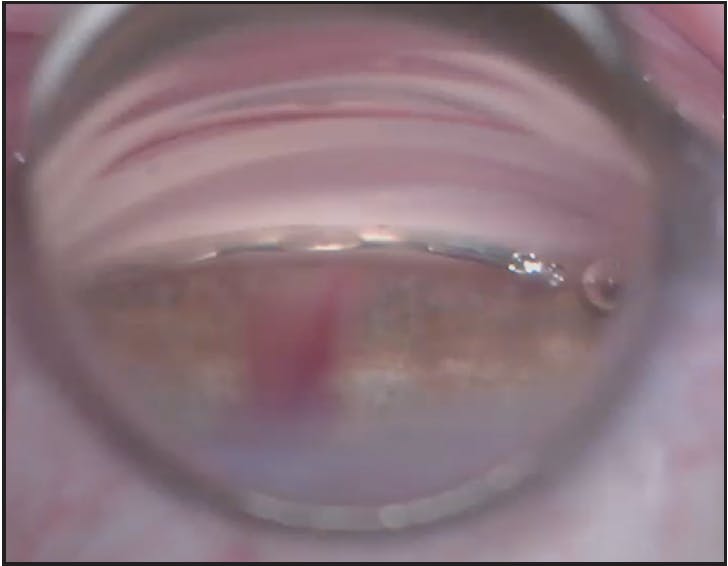
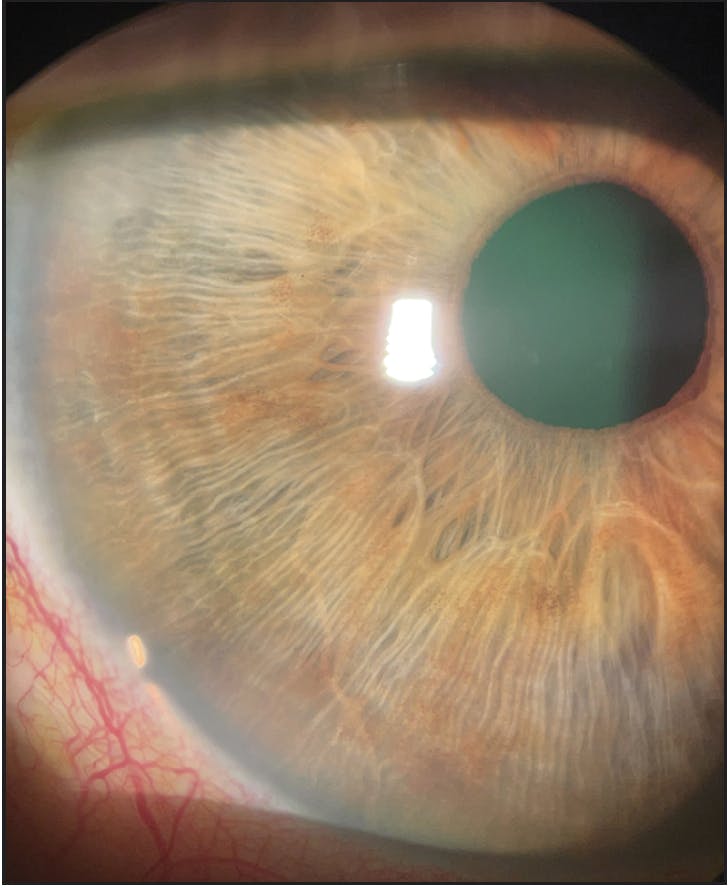
Figure 5. Appearance of the eye 2 weeks postoperatively. The edge of the stent is visible at the 7:30 clock position.
1. Man X, Reed D, Queen J, Ayres B, Moroi S. Interplicata distance as part of ciliary body biometry to understand complications of plateau iris configuration. Invest Ophthalmol Vis Sci. 2018;59:5886.