The rates of glaucoma in Sub-Saharan Africa are the highest in the world, and they are predicted to nearly double by 2040. The results of a clinical trial recently released on World Sight Day could, however, help pave the way for improvements in disease management throughout the region.1
The study, conducted through a research partnership between the Kilimanjaro Christian Medical Centre (KCMC) in Moshi, Tanzania, and the International Centre for Eye Health in London, is the first randomized controlled trial to investigate the use of SLT in patients with advanced glaucoma in Sub-Saharan Africa. The project was funded by the Seeing is Believing Innovation Fund and the international disability charity Christian Blind Mission.
The investigators found that selective laser trabeculoplasty (SLT) may be more effective for managing glaucoma than the standard treatment of timolol eye drops and may be affordable in low-income settings. This article reviews the study findings in detail and explores the viability of this treatment option in Sub-Saharan Africa.
ABOUT THE STUDY
The Kilimanjaro Glaucoma Intervention Programme (KiGIP) SLT trial was a two-arm, parallel-group, single-masked randomized trial based at KCMC. The study was designed to compare the effectiveness of SLT with twice daily timolol 0.5%, which is currently the primary treatment for glaucoma in Sub-Saharan Africa.9 The study enrolled 201 patients (382 eyes) with moderate or advanced glaucoma. Half of the eyes were treated with timolol 0.5%, and half were treated with SLT. The primary outcome was the proportion of success after 12 months, defined as an IOP not exceeding an individual target IOP based on disease severity. At 1 year, 339 eyes were analyzed (Figure). The investigators found that treatment was successful in 60.7% of eyes treated with SLT and 31.23% of eyes treated with timolol.1
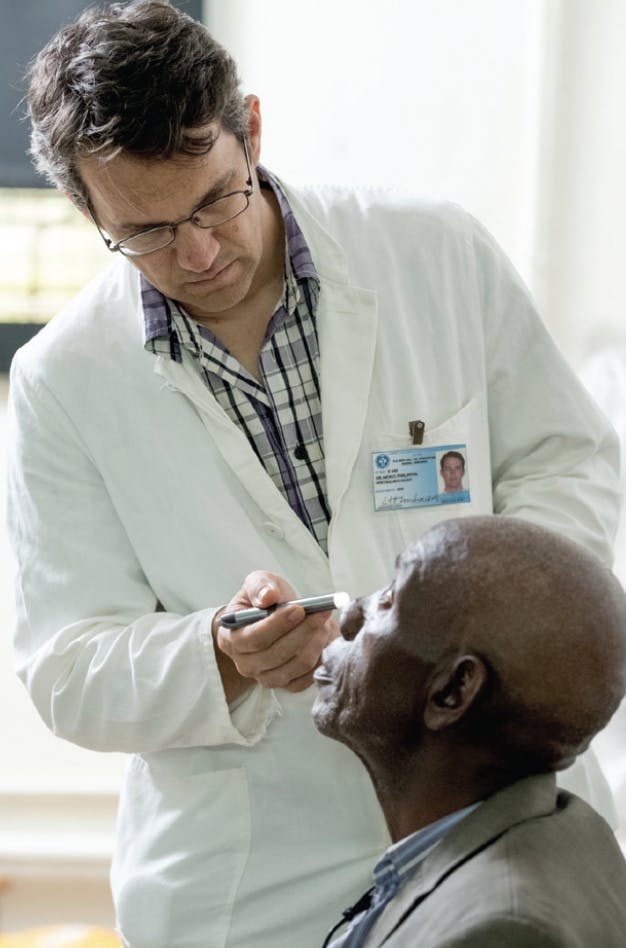
Figure. Heiko Philippin, MD, with a patient. Dr. Philippin was based at Kilimanjaro Christian Medical Centre from 2009 to 2018 and managed the Kilimanjaro Glaucoma Intervention Programme SLT trial.
The study authors also considered the affordability of SLT. They determined that, despite the initial cost of the laser equipment, hospitals that treat high volumes of patients with glaucoma could offer SLT at a similar expense to an annual supply of eye drops.
current GLAUCOMA CARE IN NORTHERN TANZANIA
KCMC serves people in Northern Tanzania, which is a rural area that also includes urban centers such as Arusha and Moshi (near Kilimanjaro). A population-based survey of rural central Tanzania determined that 3.1% of the region’s population has primary open-angle glaucoma.2 This high burden of disease was also found in other parts of Africa, which has the highest prevalence and incidence of glaucoma and the highest prevalence of blindness from glaucoma and related disabilities of all world regions.3,4 Human resources for eye care are limited in Africa, with a mean 3.7 ophthalmologists per 1 million people in low-income areas, compared with 76.2 ophthalmologists per 1 million people in high-income regions.5
Commonly used glaucoma therapies are less affordable in relation to the median annual household income in Africa compared with other world regions.6 Out-of-pocket payment for eye care services, including glaucoma care, is relatively common across Africa. Although an increasing number of health insurance options are becoming available, the uptake of coverage remains low.7
Case Study
A 67-year-old man from the Kilimanjaro area of Tanzania named Just Phidelis Laswai (Figure) was in the SLT treatment arm of the Kilimanjaro Glaucoma Intervention Programme SLT trial.
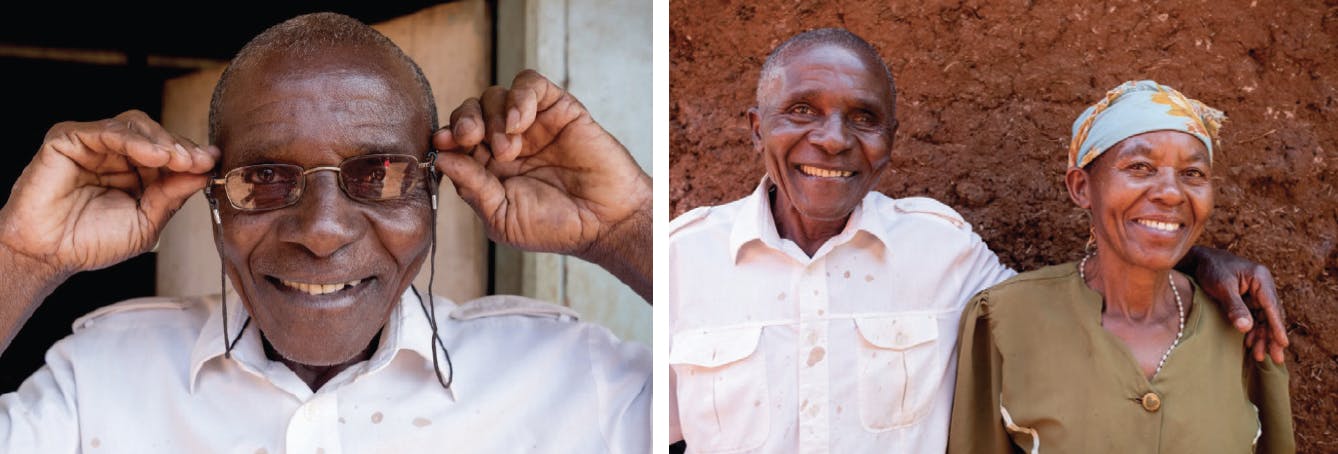
Figure. Just Phidelis Laswai, a patient with glaucoma who was enrolled in the Kilimanjaro Glaucoma Intervention Programme SLT trial, with his wife at home in the Rombo district of Tanzania.
Laswai is a farmer who lives with his wife and five grandchildren. He first started to experience vision problems in his left eye more than 10 years ago. He was diagnosed with glaucoma and prescribed eye drops to lower IOP in his left eye and preserve his vision in his right eye. He eventually completely lost sight in his left eye, which left him more reliant on help from his wife and grandchildren to work on his farm. He also experienced pain in his left eye that was so severe at times that he could not eat. Slowly, his vision in his right eye began to worsen. After having lost sight completely in one eye, Laswai became terrified that he might lose sight in the other eye and be unable to take care of himself or work.
Every 3 months, Laswai had to go to the clinic to pick up his glaucoma medication. The trip was not long but placed a significant burden on him, as it was difficult for him to afford the bus fare and to navigate the long lines with his poor vision.
As a participant in the glaucoma trial, Laswai received SLT treatment in his right eye to stop his vision from further deterioration. The laser treatment was successful, and, despite having low vision, Laswai has not completely lost sight, and the burden of regular travel to pick up medication has been greatly reduced.
In general, visual impairment has a knock-on effect on poverty, employment, and development.10 The number of people affected by glaucoma is expected to increase due to aging and population growth, particularly in resource-limited settings.3,10 Implementing new standard treatments in eye care units based on promising evidence, such as the results of the KiGIP SLT trial, could help to prevent visual impairment and blindness from glaucoma.
SLT’S POTENTIAL FOR SUCCESS IN RESOURCE-LIMITED REGIONS
Glaucoma therapy must be adapted to the context and characteristics of each patient. Currently, timolol is the most affordable and most commonly available conservative treatment option in most African countries, and trabeculectomy is the main surgical procedure.6,8,9 Other types of eye drops and surgical interventions are available in larger urban centers, but these options are typically neither affordable nor accessible for the majority of the population.8 Regular use of eye drops can be affected by low adherence, limited availability, high cumulative costs, and side effects.
The KiGIP SLT trial results showed that, after 1 year, the estimated odds for success with SLT were 3.37 times higher than the odds for success with timolol 0.5% eye drops. Safety, acceptance of treatment, vision-related quality of life, and preservation of visual acuity were similar between the two groups. The study’s follow-up period of 1 year is sufficient to evaluate the primary outcome of IOP lowering; however, a longer period of time may be required to observe differences in the secondary outcomes and in the duration of the IOP-lowering effect.1 Long-term follow-up of the trial participants is ongoing.
The use of SLT could reduce the adherence challenges inherent to eye drop use. SLT can be administered as a quick outpatient procedure, whereas the success of topical treatment depends on the ability of the patient (or their caregiver) to properly administer eye drops and regularly purchase new prescriptions. In cases of insufficient IOP reduction from SLT, the two treatments could be combined before additional pharmaceutical or surgical interventions are considered.
Although SLT would be new in most areas of Sub-Saharan Africa, other laser therapies for conditions such as posterior capsular opacification and diabetic retinopathy are already in use, so training eye care professionals to perform SLT is a reasonable possibility.
CHALLENGES TO WIDESPREAD ADOPTION OF SLT
Following a bottom-up micro-costing approach, a nonprofit eye care service provider in the region would need to treat around 500 eyes per year to be able to offer the procedure at a similar price to a 1-year supply of timolol eye drops, covering all costs.
Despite the initial investment and ongoing maintenance requirements, the costs of SLT could be offset by integrating the laser equipment into a glaucoma care network based around a larger referral eye care unit. This strategy would need to be implemented in conjunction with efforts to improve community awareness, which would enable earlier detection of glaucoma in primary care settings and strengthen the referral pathway to large eye care units.1 Greater community awareness would also increase the demand for affordable and convenient glaucoma care, such as SLT.7
Recognizing that there are costs for implementing, maintaining, and repairing the equipment, it is worth noting that the SLT laser used at KCMC has not required maintenance or repair in its 5 years of use.
CONCLUSION
SLT may be used as an alternative to timolol eye drops, the current first-line glaucoma therapy in Tanzania and most African countries, or as an additional treatment option. Laser treatment has the potential to play an important role by providing efficacious IOP reduction, providing a good safety profile, and helping to prevent vision loss and blindness from glaucoma in regions where the disease prevalence is highest, potentially at no extra cost. Barriers to widespread adoption of SLT include the high initial investment for implementation and the ability to treat enough patients to offset the costs.
1. Philippin H, Matayan E, Knoll KM, et al. Selective laser trabeculoplasty versus 0·5% timolol eye drops for the treatment of glaucoma in Tanzania: a randomised controlled trial. Lancet Glob Heal. 2021;9:e1589-e1599.
2. Buhrmann RR, Quigley HA, Barron Y, et al. Prevalence of glaucoma in a rural East African population. Invest Ophthalmol Vis Sci. 2000;41:40–8.
3. Tham YC, Li X, Wong TY, et al. Global prevalence of glaucoma and projections of glaucoma burden through 2040: a systematic review and meta-analysis. Ophthalmology. 2014;121:2081-2090.
4. Bourne RRA, Steinmetz JD, Saylan M, et al. Causes of blindness and vision impairment in 2020 and trends over 30 years, and prevalence of avoidable blindness in relation to VISION 2020: The Right to Sight: an analysis for the Global Burden of Disease Study. Lancet Glob Heal. 2021;9:e144-e160.
5. Resnikoff S, Lansingh VC, Washburn L, et al. Estimated number of ophthalmologists worldwide (International Council of Ophthalmology update): will we meet the needs? Br J Ophthalmol. 2020;104:588-592.
6. Zhao PY, Rahmathullah R, Stagg BC, et al. A worldwide price comparison of glaucoma medications, laser trabeculoplasty, and trabeculectomy surgery. JAMA Ophthalmol. 2018;136:1271-1279.
7. Kyari F, Adekoya B, Abdull MM, Mohammed AS, Garba F. The current status of glaucoma and glaucoma care in sub-Saharan Africa. Asia-Pacific J Ophthalmol. 2018;7:375-386.
8. Ocansey S, Kyei S, Diafo A, et al. Cost of the medical management and prescription pattern for primary open angle glaucoma (POAG) in Ghana—a retrospective cross-sectional study from three referral facilities. BMC Health Serv Res. 2016;16:1-8.
9. Murdoch IE, Smith AF, Baker H, Shilio B, Dhalla K. The cost and quality of life impact of glaucoma in Tanzania: an observational study. PLoS One. 2020;15:e0232796.
10. Burton MJ, Ramke J, Marques AP, et al. The Lancet Global Health Commission on Global Eye Health: vision beyond 2020. Lancet Glob Health. 2021;9:e489-e551.