Glaucoma is a leading cause of age-related blindness worldwide, characterized by a progressive loss of retinal ganglion cells (RGCs) and their axons. Could reversing the age of RGCs restore youthful function that would rescue vision lost because of glaucoma? A recent study sought to answer this question.1
Although glaucoma is a multifactorial disease for which genetic studies have identified numerous risk factors, by far the most significant risk factor associated with glaucoma is aging. Surprisingly, experimental evidence suggesting the possibility of reversing the age of cells has been around for some time. DNA methylation pattern changes predictably during aging and can therefore be used to reliably estimate biological age (known as DNA methylation age).2,3 Both somatic cell nuclear transplantation4 and the induction of pluripotent stem cells5 from aged mammalian cells could reset the DNA methylation age of the original genome2,6 and produce new individuals with normal lifespans.7 However, in both cases, reprogramming is accompanied by dedifferentiation and loss of cellular identity. To reverse the age of cells within the tissues of a living organism and keep the cellular identity intact, a new approach is required.
A NOVEL APPROACH TO EPIGENETIC REPROGRAMMING
In this new study,1 we employed a novel form of epigenetic reprogramming to reverse the aging of RGCs. Unlike a previous in vivo epigenetic reprogramming study,8 our approach used only three of the four famous Yamanaka reprogramming factors, Oct4, Sox2, and Klf4 (OSK). The oncogene c-Myc was excluded to avoid tumorigenesis. In addition, the reprogramming genes were delivered to RGCs through adeno-associated virus (AAV), a clinically approved gene therapy cargo,9 and engineered under tight control of the doxycycline-inducible promoter. The length of time epigenetic reprogramming lasts can be determined by administering doxycycline to mice via drinking water. Even when OSK genes were consistently expressed in RGCs for 15 months, there was no evidence of cellular dedifferentiation or retinal structure alterations.
Mice experience age-related vision loss similarly to humans. By the time mice are 12 months old, they have experienced a significant loss of visual function, as detected by pattern electroretinogram (pERG) and optomotor reflex (OMR). When in vivo epigenetic reprogramming using OSK was induced in the RGCs of these aging mice, it significantly increased their vision, as detected by pERG and OMR. This change in function coincided with a reversal of the DNA methylation age and restoration of a youthful transcriptome and methylome in RGCs, directly linking the reversal of cellular age with the restoration of RGC function and vision.
The power of this technology to counteract RGC injury was first tested in an optic nerve crush model,1 an acute model of optic nerve injury,10 where a mechanical crush was introduced at the optic nerve head, causing the death of 80% of the RGCs and axons within 2 weeks. OSK-triggered epigenetic reprogramming induced robust axon regeneration, a capacity that is lost in mice within days after birth. Surprisingly, even when reprogramming was induced after the crush injury had already occurred, axons were still regenerated, an effect that has not yet been achieved by other interventions.
Encouraged by the effect of epigenetic reprogramming in the optic nerve crush injury,1 we next tested OSK reprogramming using the microbead model of glaucoma in mice.11 The injection of microbeads into the anterior chamber blocks the aqueous humor outflow pathway, leading to elevated IOP and a loss of RGCs and axons by 4 weeks, which results in a significant reduction in pERG and OMR. OSK-expressing AAV was injected around 4 weeks after the glaucomatous damage occurred, and a short term of epigenetic reprogramming resulted in a significant increase in pERG and OMR, an effect not observed in the control groups (Figure).
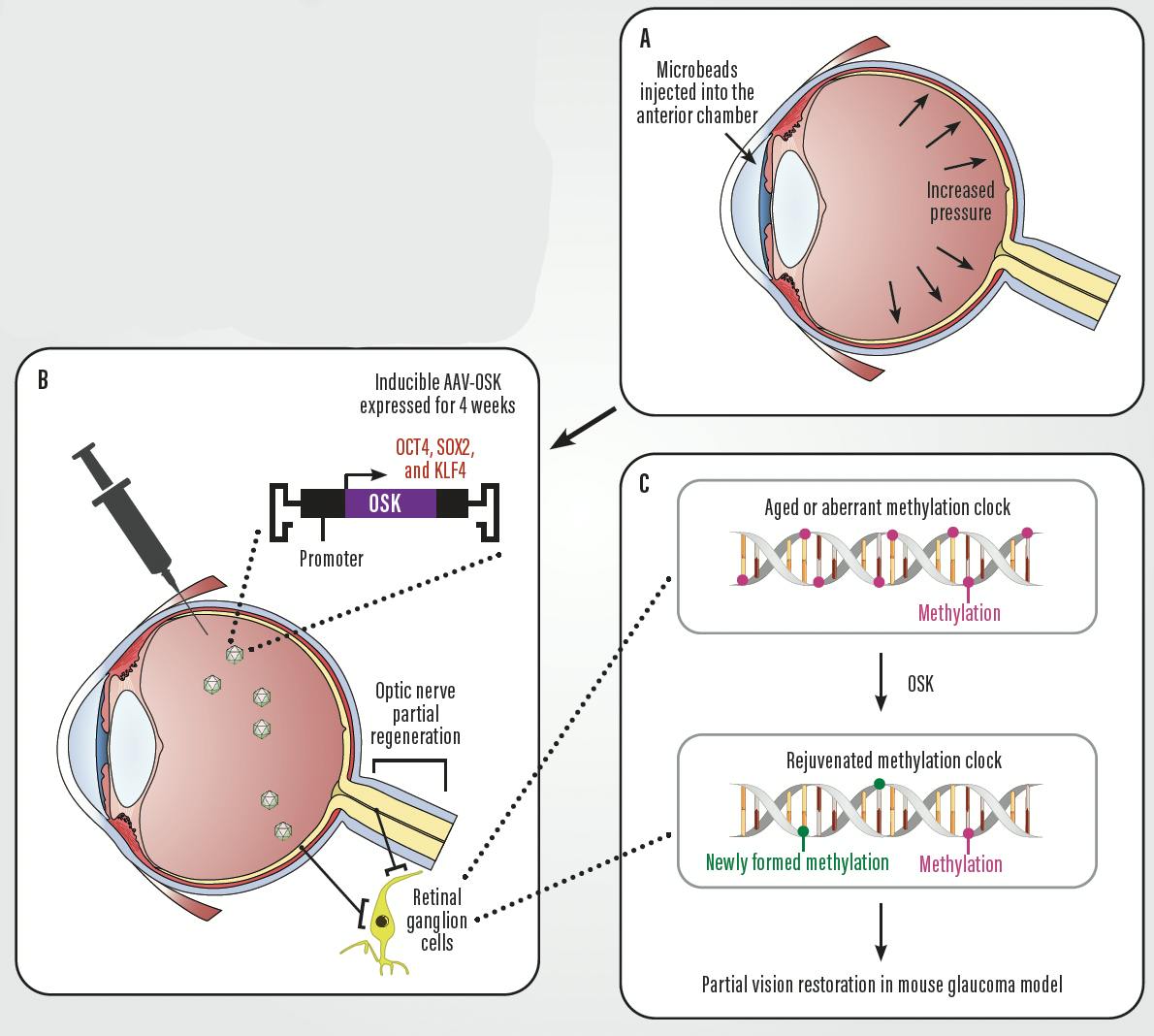
Figure. Epigenetic reprogramming in a mouse model of glaucoma. Microbeads were injected into the anterior chamber, resulting in elevated IOP, a loss of RGCs, and a loss of visual function (A). Following induction of glaucoma and loss of visual function, mice were treated with an inducible gene therapy consisting of an intravitreal injection of AAV expressing Oct4, Sox2, and Klf4 (OSK) that targets expression of OSK specifically to RGCs. Short-term OSK gene expression was induced for 4 weeks (B). RGCs in young mice have low DNA methylation age that coincides with a healthy functional transcriptome and provide normal vision. RGCs in aged or glaucomatous mice have higher DNA methylation age and dysfunctional transcriptomes, leading to loss of visual function. OSK reprogramming of aged or glaucomatous RGCs reversed the DNA methylation pattern to a young phenotype, restoring a healthy transcriptome and normal visual function (C).
THERAPEUTIC POTENTIAL FOR GLAUCOMA
Rescue of visual function by a treatment that is initiated after glaucomatous damage has occurred has significant clinical potential. Our hypothesis is that epigenetic reprogramming rejuvenates RGCs that are dysfunctional but not dead by restoring a youthful transcriptome and methylome that allows the injured cells to recover from the injury, something that aged RGCs are incapable of doing.
There have been numerous approaches to treating glaucoma in rodent models. These include targeting inflammation,12-19 apoptosis,11,20,21 prosurvival,22-26 and metabolic pathways.22,23 The majority of these studies initiated treatment before or during the initial stages of glaucoma when IOP was increasing but no axonal damage or decrease in visual function had yet occurred. Although these experiments demonstrated neuroprotection that prevented neuronal damage, their mode of action may limit their window of efficacy to patients in earlier stages of the disease.
CONCLUSION
Epigenetic reprogramming is a new form of gene therapy that can reverse the age of cells in mice, restoring youth to their transcriptome and methylome. Importantly, this rejuvenating effect can allow the retina to recover functions that were lost with aging, such as axon regeneration and sensory perception. OSK-mediated epigenetic reprogramming appears to hold great therapeutic potential in humans, not only for glaucoma but also for a variety of age-related eye diseases (eg, age-related macular degeneration) and for other tissues affected by age-induced cellular dysfunction.8
Related lab work was supported by the Harvard Medical School Epigenetics Seed Grant and Development Grant, The Paul F. Glenn Foundation for Medical Research, and a gift from E. Schulak.
1. Lu Y, Brommer B, Tian X, et al. Reprogramming to recover youthful epigenetic information and restore vision. Nature. 2020;588:124-129.
2. Horvath S. DNA methylation age of human tissues and cell types. Genome Biol. 2013;14(10):R115.
3. Horvath S, Raj K. DNA methylation-based biomarkers and the epigenetic clock theory of ageing. Nat Rev Genet. 2018;19(6):371-384.
4. Gurdon JB, Elsdale TR, and Fischberg, M. Sexually mature individuals of Xenopus laevis from the transplantation of single somatic nuclei. Nature. 1958;182:64-65.
5. Takahashi K, Yamanaka S. Induction of pluripotent stem cells from mouse embryonic and adult fibroblast cultures by defined factors. Cell. 2006;126(4):663-676.
6. Petkovich DA, Podolskiy DI, Lobanov AV, Lee S, Miller RA, Gladyshev VN. Using DNA methylation profiling to evaluate biological age and longevity interventions. Cell Metab. 2017;25(4):954-960.e956.
7. Burgstaller JP and Brem G. Aging of cloned animals: a mini-review. Gerontology 2017;63(5):417-425.
8. Ocampo A, Reddy P, Martinez-Redondo P, et al. In vivo amelioration of age-associated hallmarks by partial reprogramming. Cell. 2016;167(7):1719-1733.e1712.
9. Smalley E. First AAV gene therapy poised for landmark approval. Nat Biotechnol. 2017;35(11):998-999.
10. Williams PR, Benowitz LI, Goldberg JL, He Z. Axon regeneration in the mammalian optic nerve. Annu Rev Vis Sci. 2020;6:195-213.
11. Krishnan A, Kocab AJ, Zacks DN, Marshak-Rothstein A, Gregory-Ksander M. A small peptide antagonist of the Fas receptor inhibits neuroinflammation and prevents axon degeneration and retinal ganglion cell death in an inducible mouse model of glaucoma. J Neuroinflamm. 2019;16(1):184.
12. Anderson MG, Libby RT, Gould DB, Smith RS, John SWM. High-dose radiation with bone marrow transfer prevents neurodegeneration in an inherited glaucoma. P Natl Acad Sci USA. 2005;102(12):4566-4571.
13. Howell GR, Soto I, Zhu X, et al. Radiation treatment inhibits monocyte entry into the optic nerve head and prevents neuronal damage in a mouse model of glaucoma. J Clin Investigation. 2012;122(4):1246-1261.
14. Williams PA, Tribble JR, Pepper KW, et al. Inhibition of the classical pathway of the complement cascade prevents early dendritic and synaptic degeneration in glaucoma. Mol Neurodegener. 2016;11:26.
15. Harder JM, Braine CE, Williams PA, et al. Early immune responses are independent of RGC dysfunction in glaucoma with complement component C3 being protective. P Natl Acad Sci USA. 2017;114(19):E3839-E3848.
16. Nakazawa T, Nakazawa C, Matsubara A, et al. Tumor necrosis factor-alpha mediates oligodendrocyte death and delayed retinal ganglion cell loss in a mouse model of glaucoma. J Neurosci. 2006;26(49):12633-12641.
17. Bosco A, Inman DM, Steele MR, et al. Reduced retina microglial activation and improved optic nerve integrity with minocycline treatment in the DBA/2J mouse model of glaucoma. Invest Opthalmol Vis Sci. 2008;49(4),1437-1446.
18. Roh, M, Zhang Y, Murakami Y, et al. Etanercept, a widely used inhibitor of tumor necrosis factor-α (TNF-α), prevents retinal ganglion cell loss in a rat model of glaucoma. PloS One. 2012;7(7):e40065.
19. Williams PA, Braine CE, Kizhatil K, et al. Inhibition of monocyte-like cell extravasation protects from neurodegeneration in DBA/2J glaucoma. Mol Neurodegener. 2019;14(1):6.
20. Libby RT, Li Y, Savinova OV, et al. Susceptibility to neurodegeneration in a glaucoma is modified by Bax gene dosage. Plos Genet. 2005;1(1),17-26.
21. Gregory MS, Hackett CG, Abernathy EF, et al. Opposing roles for membrane bound and soluble Fas ligand in glaucoma-associated retinal ganglion cell death. PloS One. 2011;6(3):e17659.
22. Zhong L, Bradley J, Schubert W, et al. Erythropoietin promotes survival of retinal ganglion cells in DBA/2J glaucoma mice. Invest Opthalmol Vis Sci. 2007;48(3):1212-1218.
23. Jiang C, Moore MJ, Zhang X, et al. Intravitreal injections of GDNF-loaded biodegradable microspheres are neuroprotective in a rat model of glaucoma. Mol Vis. 2007;13:1783-1792.
24. Fu QL, Li X, Yip HK, et al. Combined effect of brain-derived neurotrophic factor and LINGO-1 fusion protein on long-term survival of retinal ganglion cells in chronic glaucoma. Neuroscience. 2009;162(2):375-382.
25. Yang H, Hirooka K, Fukuda K, Shiraga, F. Neuroprotective effects of angiotensin II type 1 receptor blocker in a rat model of chronic glaucoma. Invest Opthalmol Vis Sci. 2009;50(12):5800-5804.
26. Feng L, Chen H, Yi J, et al. Long-term protection of retinal ganglion cells and visual function by brain-derived neurotrophic factor in mice with ocular hypertension. Invest Opthalmol Vis Sci. 2016;57(8):3793-3802.
27. Kim KY, Perkins GA, Shim MS, et al. DRP1 inhibition rescues retinal ganglion cells and their axons by preserving mitochondrial integrity in a mouse model of glaucoma. Cell Death Dis. 2015;6(8):e1839.
28. Williams PA, Harder JM, Foxworth NE, et al. Vitamin B3 modulates mitochondrial vulnerability and prevents glaucoma in aged mice. Science. 2017;355(6326),756-760.