Charles Bonnet was a Swiss philosopher and naturalist who studied the visual hallucinations his grandfather was experiencing. The disease eventually came to be named after Bonnet.
About 18 months ago, I began experiencing visual hallucinations as a result of my progressive vision loss. Although I was not sure exactly what was happening at the time, I had a hunch that my visions were caused by Charles Bonnet syndrome (CBS).
The hallucinations caused by CBS are a normal result of failing eyesight and the brain’s inability to compensate. The associated visions typically take two main forms: (1) simple hallucinations of repeated patterns and shapes and (2) complex hallucinations such as faceless people, strange animals, and surreal landscapes. Visions can appear for seemingly no reason and may last for minutes or hours.
IN THE LITERATURE
A recent investigation of adult patients with open-angle glaucoma (n = 337) found a 7.1% prevalence of CBS.1 Patients with CBS were more likely to have at least one eye with a visual field index of 30% or less compared to patients without CBS. Those with a combination of advanced visual field loss and low BCVA had the highest risk of CBS, but one in three patients with CBS had a BCVA of at least 0.5 logMAR OU.
In a meta-analysis of eight studies, investigators found a 2.8% prevalence of CBS in patients with various stages of glaucoma and ocular comorbidities. In patients with glaucoma who visited vision rehabilitation clinics, presumably owing to extensive vision impairment, the prevalence of CBS was 20.1%.2
Subhi and colleagues concluded that “CBS may not be rare in patients with advanced glaucoma with and without ocular comorbidities. … More studies are needed to better understand the prevalence and risk factors among different populations of patients with glaucoma.”1
IN THE CLINIC
When I broached the topic with my glaucoma specialist, her eyes grew wide, and she exclaimed, “Whoa! I’ve met only two patients in my career with Charles Bonnet, and they are both blind. I mean, B-L-I-N-D. They can’t see a thing!” Although I appreciated the desire to keep it real and know that my doctor wasn’t trying to downplay what I was saying or belittle me, I had to explain how this comment could easily be misconstrued by a patient experiencing these strange and unsettling symptoms.
CBS is a condition that, I suspect, is taught in medical school but may often go unnoticed in clinical practice. Patient-facing education about the disease is lacking, and many patients wrongly assume that their visual hallucinations are linked to mental health disorders or dementia, and they may suffer unnecessarily as a result.
GREATER AWARENESS
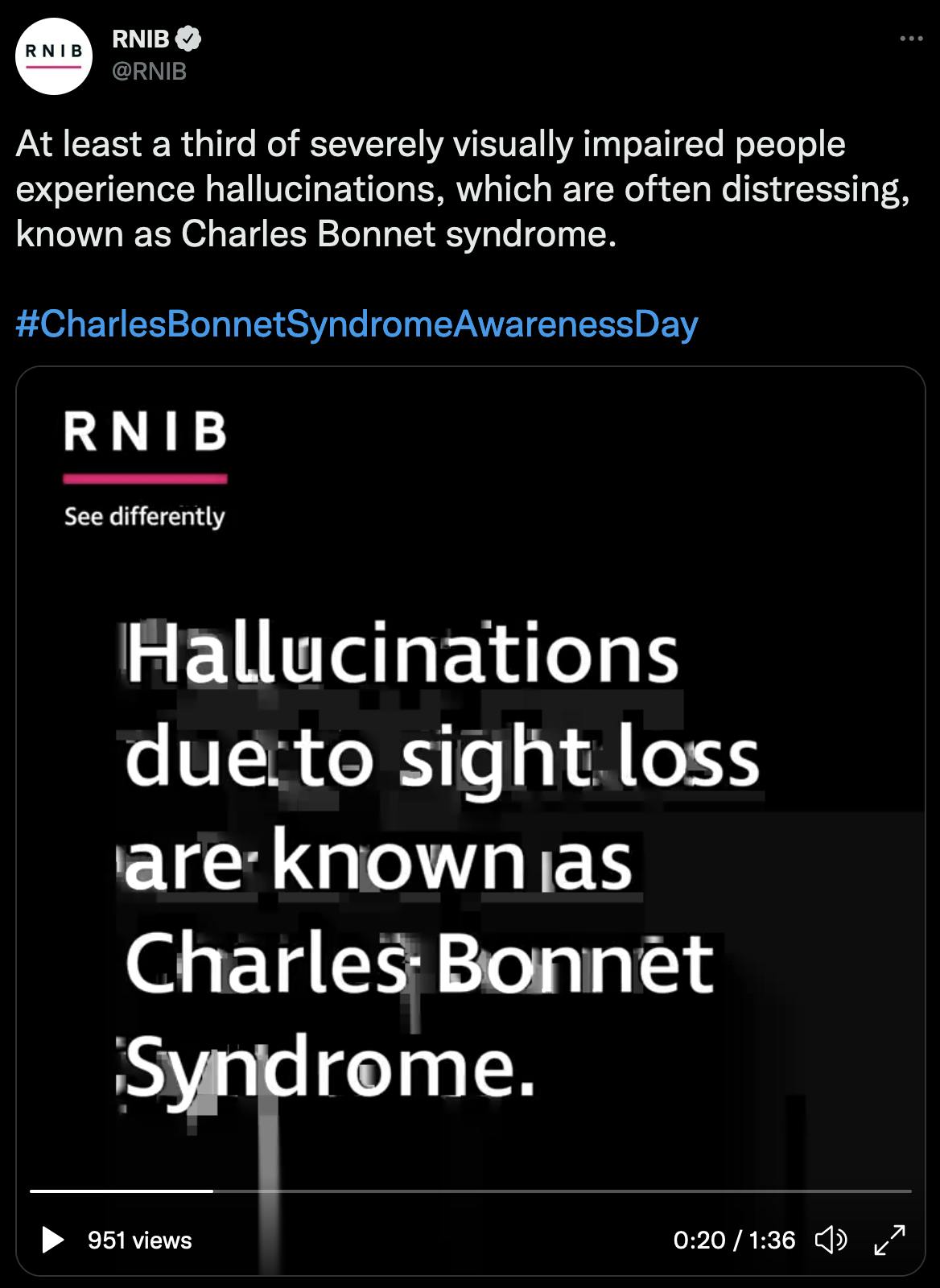
While researching CBS, I was thrilled to learn about Esme’s Umbrella (charlesbonnetsyndrome.uk), an organization that works to build awareness of the condition and create a support network for patients. In another effort to increase awareness, the Royal National Institute of Blind People compiled and shared a video of patients with CBS describing their experiences with visual hallucinations (watch below).
CONCLUSION
CBS may not be top of mind for many glaucoma doctors. I encourage practitioners to talk with patients about this often underdiscussed consequence of vision loss. Awareness is key, and the first step in building understanding.
ABOUT THE AUTHOR
Richie Kahn, MPH, is a health policy professional by training, clinical researcher by trade, and patient advisor by necessity. He is passionate about incorporating patient and caregiver perspectives into the clinical development process and ultimately reducing the time it takes to bring promising new therapeutics and diagnostics to market.
1. Subhi Y, Schmidt DC, Bach-Holm D, et al. Prevalence of Charles Bonnet syndrome in patients with glaucoma: a systematic review with meta-analyses. Acta Ophthalmol. 2021;99:128-133.
2. Peters D, Molander S, Lomo T, Singh A. Charles Bonnet syndrome in patients with open-angle glaucoma: prevalence and correlation to visual field loss. Ophthalmol Glaucoma. 2022;5(3):337-344.