Medical glaucoma has come a long way since the 1800s, with significant advances occurring in recent years (Figure). As a refresher, pilocarpine was introduced around 1877, and the gold-standard prostaglandin analogues (PGAs) became available in the 1990s. At that point, however, progress in the medical glaucoma space essentially came to a halt. Its growth recently resumed with the development of some novel drugs and drug delivery devices. This article reviews the challenges associated with tried-and-true medical glaucoma management and the novel solutions positioned to revolutionize care.
CHALLENGES IN MEDICAL GLAUCOMA MANAGEMENT
As ophthalmologists know well, multiple challenges are associated with medical glaucoma management. Many patients struggle to adhere to their prescribed medication regimens because of a range of factors, including the frequency of dosing, difficulty with drop administration, side effects, cost, ocular surface disease, and glaucoma fatigue.1,2 Not only do these barriers inhibit the appropriate treatment of glaucoma, but they also negatively affect patients’ quality of life. The medication burden has therefore become a prominent focus in the assessment and adaptation of medical disease management over time.
RETHINKING MEDICAL THERAPY
As a result of the challenges associated with drops and the growing emphasis on quality of life, efforts have been made to reshape medical therapy. In an evidence-based review of the attributes associated with adherence, Joseph and Pasquale1 identified several strategies to improve patients’ adherence to prescribed medical therapy. They recommended improving efficacy, minimizing side effects, maintaining safety, placing minimal burden on the patient, focusing on the health of the ocular surface, and emphasizing quality of life.1 Several solutions have been developed with these objectives in mind, such as preservative-free medications, fixed-combination medications, compounded medications, and medications with new mechanisms of action altogether (Figure).

Latanoprostene bunod. Patients with primary open-angle glaucoma have lower levels of nitric oxide markers. This deficiency may increase cell contractility in the trabecular meshwork and elevate IOP.3 Latanoprostene bunod 0.024% (Vyzulta, Bausch + Lomb) is a PGA that contains an arm of nitric oxide, providing a dual mechanism of action. This agent was approved by the FDA in 2017, is dosed once daily, and can be used as a first-line treatment.
In the VOYAGER study comparing latanoprostene bunod 0.024% with latanoprost 0.005%, investigators found that patients who received the combination of latanoprost acid and nitric oxide achieved an additional 1.23 mm Hg reduction in IOP.4 For patients who would benefit from obtaining the maximum treatment effect with one daily dose, latanoprostene bunod is a great option.
Additionally, ophthalmologists are thinking more about IOP on a continuum because some patients experience disease progression despite having controlled IOP in the office. In a study comparing the diurnal and nocturnal effects of latanoprostene bunod versus timolol on IOP, Liu et al found that latanoprostene bunod provided a reduction in nocturnal IOP that was 2.5 mm Hg lower than baseline and 2.3 mm Hg lower than that provided by timolol.5
Netarsudil. At the cellular level, Rho kinase acts on actin and myosin to increase contraction in the trabecular meshwork. Approved by the FDA in 2017, netarsudil (Rhopressa, Aerie Pharmaceuticals) is a Rho kinase inhibitor that relaxes the trabecular meshwork and increases outflow facility through the natural outflow pathway while decreasing distal resistance.6,7 This is the first class of medication that also decreases episcleral venous pressure (EVP).8 Retrograde pressure occurs when aqueous humor meets the episcleral veins. Normal EVP is between 8 and 10 mm Hg; lowering EVP can provide an additive IOP-lowering effect.
Netarsudil, which is dosed once daily, has been found to be noninferior to timolol dosed twice daily. The agent also serves as an effective adjunctive therapy, whether combined with a PGA or fixed-combination therapy, and it has been shown to provide about an additional 4 mm Hg reduction in IOP.9 The side effect profile is generally mild, but cases of conjunctival hyperemia and corneal verticillata have been reported with use of this medication.10
As MIGS continues to redefine the treatment of glaucoma, it is important to elucidate the role of medications following these procedures. Xu et al11 looked at the use of netarsudil in patients who underwent goniotomy with the Kahook Dual Blade (New World Medical; see Netarsudil After Goniotomy). The investigators found that 80% of patients who had goniotomy achieved a primary endpoint of a 20% reduction in IOP with netarsudil compared with 52% who had not had goniotomy. The percentage of IOP reduction was 29.5 ±16.1% in goniotomy-treated eyes versus 19.4 ±14.0% in goniotomy-naïve eyes. The study authors theorize that removal of the trabecular meshwork may facilitate additional IOP-lowering effects by targeting EVP in addition to the trabecular meshwork. It is likely that more data like these on the use of medications after MIGS will emerge.
Netarsudil After Goniotomy
Investigators conducted a retrospective chart review of 50 eyes of 37 adult patients with glaucoma who were treated with netarsudil between 2017 and 2020.1 They compared the IOP-lowering effects of netarsudil on eyes with previous goniotomy with the Kahook Dual Blade (KDB; New World Medical) versus on goniotomy-naïve eyes.
The investigators found that KDB-treated eyes experienced a significantly greater IOP reduction with netarsudil compared with control eyes (Figure). “We hypothesize that excisional goniotomy may facilitate netarsudil’s effects in reducing episcleral venous pressure. Following excision of [trabecular meshwork] at the nasal angle in KDB-treated eyes, a greater concentration of netarsudil may be able to travel downstream to the distal outflow system and act on episcleral veins to reduce [episcleral venous pressure].”
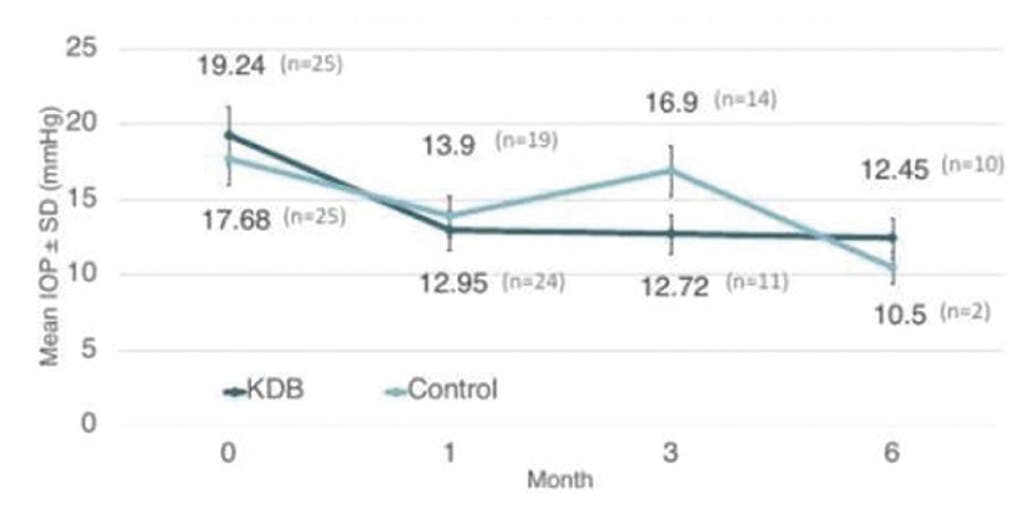
Figure. Mean IOP reduction for KDB eyes versus control eyes over 6 months of netarsudil administration.
The rates of conjunctival hyperemia (44%) and discontinuation (58%) were significantly higher than with other conventional medications, the study authors noted. However, none of the adverse reactions was vision threatening, and all resolved upon discontinuation of netarsudil.
Limitations of the study include its retrospective, open-label design and limited follow-up period.
1. Xu H, Thomas M, Lee D, Hirabayashi MT, An JA. Response to netarsudil in goniotomy-treated eyes and goniotomy-naïve eyes: a pilot study [published online March 11, 2022]. Graefes Arch Clin Exp Ophthalmol. doi:10.1007/s00417-022-05609-6
Netarsudil/latanoprost. In 2019, a once-daily, fixed-dose combination of netarsudil and latanoprost became available (Rocklatan, Aerie Pharmaceuticals). In a pooled analysis of the MERCURY-1 and MERCURY-2 phase 3 studies, greater statistical superiority was achieved with the combination of these agents compared with either agent alone.12 A total of 62% of patients treated with netarsudil/latanoprost achieved a 30% or greater reduction in IOP. Additionally, a significantly greater proportion of patients achieved absolute IOP targets with netarsudil/latanoprost than with monotherapy, and 32% of patients treated with netarsudil/latanoprost achieved an IOP of 14 mm Hg or lower.12
Laser treatment. Although not a drop and suitable as a first-line therapy, selective laser trabeculoplasty (SLT) can also be used to decrease patients’ medication burden.13 I find that I am using SLT more as a first-line therapy. The Laser in Glaucoma and Ocular Hypertension (LiGHT) study provided important data on the efficacy of SLT and on the reduced need for additional treatment and surgery with SLT versus drops.
DRUG DELIVERY
In addition to new pharmacologic agents, novel solutions for delivering medication are emerging in the glaucoma space.
Bimatoprost implant. In 2020, a sustained-release intracameral bimatoprost implant (Durysta, Allergan) was approved to reduce IOP in patients with open-angle glaucoma or ocular hypertension. I offer this option to my patients as a first-line treatment or in conjunction with SLT, MIGS, or other medications. The bimatoprost implant is indicated for a single administration and is implanted in an office-based procedure. Investigations have shown the bimatoprost implant to be noninferior to twice-daily timolol and found that patients have sustained an IOP of around 16 to 17 mm Hg through 12 weeks after implantation.14
The bimatoprost implant’s duration of effect is reported to be around 4 to 6 months; however, in one study, one-third of patients experienced a sustained effect for 2 years.15 This suggests that placement of the bimatoprost implant may induce a change in the remodeling of the trabecular meshwork. Further, in a study of patients with open-angle glaucoma, a statistically significant difference in the rate of visual field progression was observed with the bimatoprost implant versus timolol at 52 weeks.16
With the insertion of any device, it is important to consider the potential effects on the corneal endothelium. In the phase 1/2 APOLLO study of the bimatoprost implant, the mean corneal endothelial cell density was 2,607.0 ±203.0 and 2,651.6 ±196.4 cells/mm2 in the study eyes and fellow eyes, respectively, reflecting mean reductions from baseline of 88.9 ±135.3 and 22.2 ±127.8 cells/mm2 over 2 years in the study and fellow eyes, respectively. Additionally, mean endothelial cell density at 24 months was comparable among patients treated with one or two administrations of the bimatoprost implant.17
The bimatoprost implant can be used as first-line or additive treatment, and it is a viable option for patients who have difficulty adhering to their prescribed medication regimen. By removing the need for a preservative to promote absorption of the medication and minimizing contact of the drug with the ocular surface and skin, the bimatoprost implant may minimize side effects such as redness, fluctuating vision, meibomian gland dysfunction, and pigmentary changes. It can therefore be considered for patients who have ocular surface disease or are intolerant of a medication.
Intracameral travoprost-eluting insert. Several drug delivery devices are in the pipeline, including an intracameral travoprost-eluting insert (iDose TR, Glaukos), which is in phase 3 investigations. Surgeons who use the iStent (Glaukos) will find that implantation is similar for both devices, although the travoprost-eluting stent is larger than the iStent inject W. The iDose is inserted through the main corneal incision. Its drug-eluting membrane is reported to produce a treatment effect for 36 months or potentially longer. The implant was designed to be removed and replaced once all travoprost is released.
In the phase 2b trial of the travoprost-eluting insert, patients treated with the implant performed similarly to those treated with twice-daily timolol; they achieved about an 8.5 mm Hg reduction in IOP at 36 months. No clinically significant corneal endothelial cell loss was reported. The phase 3 investigation of the implant consists of two prospective, randomized, double-masked clinical trials, and the primary efficacy endpoint is noninferiority to timolol over 3 months and safety evaluations for up to 12 months.
Intracanalicular dexamethasone. Although not specific to glaucoma, the sustained release of antiinflammatory medication may play a role in the management of patients with the disease. The dexamethasone ophthalmic insert (Dextenza, Ocular Therapeutix) is a small intracanalicular stent indicated for the treatment of pain and inflammation after ocular surgery. The device is implanted into Schlemm canal (requiring dilation of the punctum), and it has been shown to provide a slow release of 0.4 mg of dexamethasone for up to 30 days.18 The insert also works as a punctal plug for ocular surface disease. This option may be a useful adjunct for patients who are undergoing a filtration procedure or the implantation of a MIGS device.
CONCLUSION
Advances in drugs and drug delivery are helping ophthalmologists to individualize glaucoma care; improve treatment adherence; achieve better efficacy, safety, and stability; and improve patients’ overall quality of life. Regarding medical glaucoma care and its integration with surgical management, any step toward minimizing the medication burden is a step in the right direction.
1. Joseph A, Pasquale LR. Attributes associated with adherence to glaucoma medical therapy and its effects on glaucoma outcomes: an evidence-based review and potential strategies to improve adherence. Semin Ophthalmol. 2017;32(1):86-90.
2. Emerick GT. Quality of life and glaucoma medications. Glaucoma Today. September/October 2005. Accessed May 1, 2022. https://glaucomatoday.com/articles/2005-sept-oct/0905_01.html
3. Nathanson JA, McKee M. Alterations of ocular nitric oxide synthase in human glaucoma. Invest Ophthalmol Vis Sci. 1995;36(9):1774-1784.
4. Weinreb RN, Ong T, Sforzolini BS, Vittitow JL, Singh K, Kaufman PL; VOYAGER study group. A randomised, controlled comparison of latanoprostene bunod and latanoprost 0.005% in the treatment of ocular hypertension and open angle glaucoma: the VOYAGER study. Br J Ophthalmol. 2015;99(6):738-745.
5. Liu J, Slight JR, Vittitow J, Sforzolini BS, Weinreb RN. Efficacy of latanoprostene bunod 0.024% compared with timolol 0.5% in lowering intraocular pressure over 24 hours. Am J Ophthalmol. 2016;169:249-257.
6. Wang K, Read AT, Sulchek T, Ethier CR. Trabecular meshwork stiffness in glaucoma. Exp Eye Res. 2017;158:3-12.
7. Lin CW, Sherman B, Moore LA, et al. Discovery and preclinical development of netarsudil, a novel ocular hypotensive agent for the treatment of glaucoma. J Ocul Pharmacol Ther. 2018;34(1-2):40-51.
8. Kazemi A, McLaren JW, Kopczynski C, et al. The effects of netarsudil ophthalmic solution on aqueous humor dynamics in a randomized study in humans. J Ocul Pharmacol Ther. 2018;34(5):380-386.
9. Zaman F, Gieser SC, Schwartz GF, Swan C, Williams JM. A multicenter, open-label study of netarsudil for the reduction of elevated intraocular pressure in patients with open-angle glaucoma or ocular hypertension in a real-world setting. Ophthalmology. 2021:1011-1020.
10. Singh IP, Fechtner R, Myers JS, et al. Pooled efficacy and safety profile of netarsudil ophthalmic solution 0.02% in patients with open-angle glaucoma or hypertension. J Glaucoma. 2020;29(10):878-884.
11. Xu H, Thomas M, Hirabayashi M, An J. Comparison of response to netarsudil in Kahook Dual Blade goniotomy treated eyes and goniotomy-naïve eyes. Poster presented at: American Glaucoma Society Annual Meeting. March 4, 2021.
12. Asrani S, Bacharach J, Holland E, et al. Fixed-dose combination of netarsudil and latanoprost in ocular hypertension and open-angle glaucoma: pooled efficacy/safety analysis of phase 3 MERCURY-1 and -2. Adv Ther. 2020;37(4):1620-1631.
13. Gazzard G, Konstantakopoulou E, Garway-Heath D, et al; LiGHT Trial Study Group. Selective laser trabeculoplasty versus eye drops for the first-line treatment of ocular hypertension and glaucoma (LiGHT): a multicentre randomised controlled trial. Lancet. 2019;393(10180):1505-1516.
14. Medeiros FA, Walters TR, Kolko M, Robinson MR, Weinreb RN; ARTEMIS 1 study group. Phase 3, randomized, 20-month study of bimatoprost implant in open-angle glaucoma and ocular hypertension (ARTEMIS 1). Ophthalmology. 2020;127(10):1627-1641.
15. Khouri AS. Predictive factors for long-term IOP lowering after bimatoprost implant 10-ug administration in phase 3 ARTEMIS studies. Poster presented at: AAO Annual Meeting; 2020; Virtual. P0176.
16. Bacharach J, Tatham A, Ferguson G, et al; ARTEMIS 2 study group. Phase 3, randomized, 20-month study of the efficacy and safety of bimatoprost implant in patients with open-angle glaucoma and ocular hypertension (ARTEMIS 2). Drugs. 2021;81:2017-2033.
17. Craven RE, Walters T, Christie WC, et al; Bimatoprost SR study group. 24-month phase I/II clinical trial of bimatoprost sustained-release implant (Bimatoprost SR) in glaucoma patients. Drugs. 2020;80:167-179.
18. Ocular Therapeutix. Dextenza (dexamethasone ophthalmic insert) 0.4 mg, for intracanalicular use: US prescribing information. 2019. Accessed May 22, 2022. www.dextenza.com