Glaucoma is a chronic optic neuropathy characterized by functional visual field deficits and changes to the optic nerve. Glaucoma was originally understood to be exclusively a disease of increased IOP that, if untreated, caused blindness,1 but it is now recognized that glaucoma can occur in the context of normal IOP.2 Von Graefe first theorized that glaucoma could arise in the context of normal IOP in 1857, and he called this condition amaurosis without excavation.3 Schnabel verified the theory in 1908,4 but the concept of normal-tension glaucoma (NTG) did not become widely accepted until the 1980s.5
Studies have since demonstrated the prevalence of NTG. In the Baltimore Eye Survey, half of the participants with primary open-angle glaucoma (POAG) had an IOP of less than 21 mm Hg at the time of diagnosis; 20% of this subset had an IOP of less than 21 mm Hg on each of their initial three visits.6,7 Several population-based studies have validated that NTG is more prevalent than once believed. The mean percentage of NTG in all patients diagnosed with a glaucomatous visual field defect is between 30% and 40%.6,8,9 The prevalence of NTG has been reported to be 92.3% in Japan,10 84.6% in Singapore,11 83.58% in Northern China,12 82% in South India,13 79.3% in Southern China,14 77% in South Korea,15 57.1% in South Africa,16 46.9% in Iran,17 38.9% in Netherlands,9 31.7% in the United States,18 31.0% in Iceland,19 and 30.0% in Italy.20 Research has also shown racial and ethnic disparities in the prevalence of NTG, with a higher proportion of Asian individuals affected than patients of African descent, followed by Caucasian patients.21 The reasons for these differences are unknown.9-19
The early diagnosis of NTG is critical because visual field defects are often more significant and located closer to the central visual field than with other types of glaucoma.23 Prompt diagnosis, however, can be difficult owing to the unreliability of tension-based screening methods in these eyes.2 Because progressive optic neuropathy can occur at so-called normal IOPs, IOP is not always considered in the definition of glaucoma,23 further complicating the diagnosis of NTG and perpetuating the search for other mechanisms thought to play a role in its pathophysiology.
POAG VERSUS NTG
NTG has been defined as glaucoma with an IOP of less than 21 mm Hg.24 It has been theorized that POAG and NTG are on opposite sides of the spectrum of open-angle glaucomas.24 IOP is theorized to be the main risk factor in POAG, whereas IOP-independent risk factors are believed to play a crucial role in NTG.24 Clinically, it is imperative to differentiate pure POAG and NTG at each end of this continuum from mixed disease in the middle.2 IOP reduction is the mainstay of treatment in POAG,2 but reducing IOP alone may not be sufficient for treatment of NTG or mixed disease.2
Beyond IOP, nuanced clinical distinctions exist between POAG and NTG. In NTG eyes, the optic disc often presents with a narrower neuroretinal rim, especially inferiorly and inferotemporally.25 Beta zone peripapillary atrophy and disc hemorrhages are more commonly noted in NTG, and the presence of disc hemorrhages indicates a worse prognosis in NTG.26,27 Peripapillary crescents and haloes are present more frequently at the disc margin and appear to be regions of deficient retinal pigment epithelium.28
Localized cupping is also sometimes noted at the optic disc margin.28 These focal areas of cupping may be acquired pits of the optic nerve (APON), which are more common in NTG.29,30 They are frequently seen in the inferior optic disc and are linked to a higher incidence of disc hemorrhages and an elevated risk of worsening glaucoma.30,31 The presence of APON is also correlated with visual field deficits that often arise near fixation, similar to paracentral scotomas seen in NTG (Figures 1 and 2).30 Studies have shown that visual field defects in NTG are frequently more substantial, more focal, and more central than visual field deficits in POAG with elevated IOP.32,33
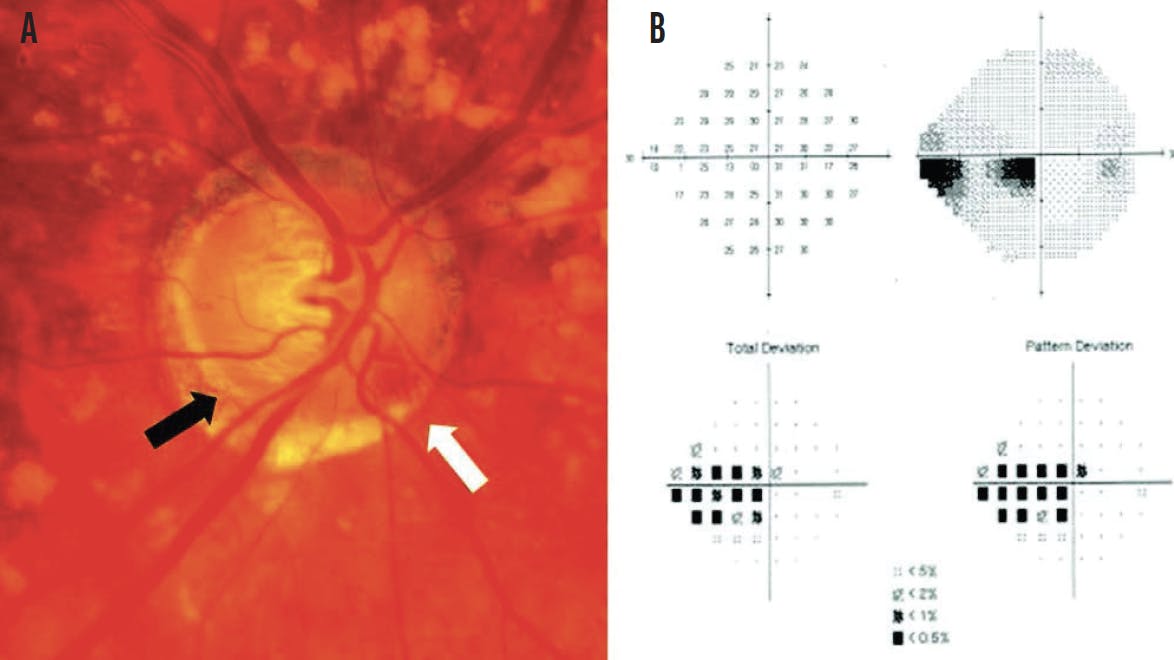
Figure 1. Right optic nerve. The black arrow indicates an inferotemporal APON (A). The inferonasal area (white arrow) also shows a disc hemorrhage. Standard automated perimetry demonstrates a superior paracentral arcuate defect and a corresponding inferior paracentral arcuate defect due to superior rim narrowing (B). Reprinted with permission from Brian Song, MD; Joseph Caprioli, MD, and Medknow Publications.23
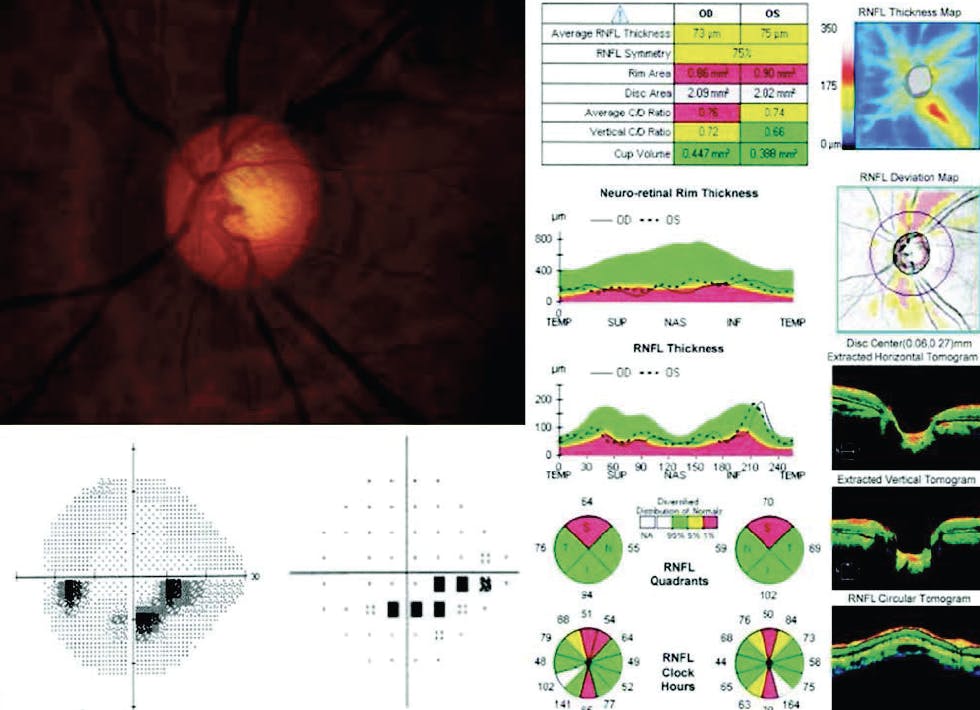
Figure 2. Left optic nerve with a superotemporal APON. OCT scan of the retinal nerve fiber layer shows corresponding thinning. The visual field reveals a corresponding inferior paracentral arcuate defect.
Although dissimilarities between POAG and NTG are often noted, clinical interpretation of these conditions is inconsistent; thus, there is likely some commonality in the fundamental pathogenesis of glaucomatous optic neuropathy between these two types of glaucoma.24
PATHOGENESIS
Ocular perfusion and hypotension. Systemic factors may play a role in the pathogenesis of NTG. The Collaborative Normal Tension Glaucoma Study (CNTGS) showed that, although IOP lowering slowed glaucomatous progression, the 5-year survival rate was 40% in the control arm and 80% in the treated arm.34 This suggests that either a 30% reduction from baseline IOP was inadequate for some patients or causes other than IOP played a role in the pathophysiology of the disease.
In 1858, Jaeger suggested that injury to the optic nerve head (ONH) was associated with a change in vascular perfusion.35 In 1959, Harrington suggested that decreased blood flow makes the optic nerve vulnerable to glaucomatous damage, even when IOP values are statistically normal.36 In 1962, Haas noted that vascular insufficiency may increase the optic nerve’s susceptibility to IOP-related damage.37 In 1968, Johnson and Drance introduced the idea of ocular perfusion pressure (OPP) and suggested that systemic hypotension may play a significant role in NTG.38 In the late 1990s, decreased peripapillary retinal blood flow was also noted in NTG.39
Several epidemiologic studies have documented the importance of OPP. In the Baltimore Eye Study,40 a diastolic OPP greater than 50 mm Hg (signifying high perfusion) was associated with a race and age-adjusted risk of OAG that was six times lower than a diastolic OPP lower than 30 mm Hg.40 The study authors concluded that OAG correlated to changes in ocular blood flow and damage to autoregulation.40 In the Barbados Eye Study,41 the 9-year relative risk of incident OAG with a low mean OPP was 2.6. The Egna-Neumarkt Study42 showed a higher prevalence of OAG with decreased diastolic OPP. The Proyecto Ver Study showed a four times higher risk of OAG in patients with diastolic OPPs lower than 50 mm Hg compared with diastolic OPPs lower than 80 mm Hg.43 The Rotterdam Study also showed that a low diastolic OPP was correlated with OAG in patients treated for systemic hypertension.44 In the Singapore Malay Eye Study, OAG was more frequently seen in patients with a mean OPP in the lowest quartile versus the highest quartile (odds ratio, 1.73).45 The Early Manifest Glaucoma Trial (EMGT) demonstrated that a low systolic OPP was a prognosticator of worsening glaucoma, with a hazard ratio of 1.42.46 The investigators determined that a vascular etiology may be responsible for glaucomatous progression.46 All of these studies suggest that overtreating systemic hypertension may cause low blood pressure (BP), low OPP, and glaucomatous progression.
Hypotension, especially nocturnal low BP, has been seen more frequently in NTG.47,48 Multiple studies have reported hypotension and circadian changes in the mean OPP as key risk factors for visual field defect progression in NTG.49-52 Hypotension causes low OPP and reduces ocular blood flow; optic nerve fibers thus suffer from a diminished blood supply. This is of particular importance for nocturnal BP “dippers.”53
Autoregulation. Blood flow autoregulation is the innate capability of the vasculature to maintain steady blood flow over a wide range of BPs while meeting the metabolic needs of a tissue.21 Autoregulation is known in many vascular arenas, including the eye,54 heart,55 kidney,56 brain,57 gut,58 and skeletal muscle.59 Vascular dysregulation is a tissue’s inability to provide a continuous blood supply with fluctuations in perfusion pressure.53
The ONH is served by a complicated vascular mechanism.45,60,61 Autoregulation of the ONH may be damaged by various pathologies.62 A study of the autoregulation of retrobulbar hemodynamics showed unchanged flow velocities in the short posterior ciliary arteries of healthy patients despite changes in posture.63 In contrast, an inadequate compensatory reaction to postural change has been found in patients with NTG and POAG.63 Because a disruption of autoregulation is a risk factor for worsening glaucoma,64-66 destruction of the optic nerve in NTG is believed to be due to vascular dysregulation and recurring reperfusion damage to the optic nerve.67 Moreover, the greater number of disc hemorrhages in these patients suggests a vascular cause of the optic nerve injury seen.68 Studies have also shown that patients with glaucoma have decreased end-diastolic velocities and increased resistivity indices in the central retinal artery, central retinal vein, ophthalmic artery, and lateral and medial short posterior ciliary arteries.69
The vascular endothelium is a crucial component of ocular blood flow autoregulation. By creating a layer of cells between blood and the vessel wall, dysfunction in the vascular endothelium may lead to a lack of blood flow autoregulation and ensuing ischemia to the ONH.70 Of note, the vascular endothelium is critical to hemostasis, angiogenesis, and inflammatory reactions.70
Endothelial pathologic changes may be instigated by oxidative stress, which causes deviations in the cellular concentration of mediators created by endothelial cells.21 Persistent endothelial damage can result from smoking, heart and renal failure, systemic hypertension, hypercholesterolemia,71 and elevated plasma homocysteine.72 Endothelial damage is predictive of cardiovascular disease occurrences and long-standing atherosclerotic disease worsening. Endothelin-1 (ET-1) is an endothelium-derived vasoregulatory molecule that serves as an endogenous vasoconstrictor, most commonly on small vessels.73-75 It is created and deposited from the ciliary processes in the eye and is thought to play a role in the control of ocular blood flow.73,76 Preclinical studies have shown that intravitreal injections of ET-1 can reduce perfusion of the ONH and cause apoptosis of retinal ganglion cells (RGCs).77-79 Unsurprisingly, a disproportion in ET-1 (which facilitates vasoconstriction) and nitric oxide (which facilitates vasodilation) is seen in glaucoma and contributes to endothelial pathologic changes. Some studies have connected NTG and higher ET-1 with subclinical inflammation and heart rate changes.80,81
The decreased availability of nitric oxide reduces blood flow to the ONH.82,83 Vasospasm is essentially an amplified vascular reaction to factors such as stress and temperature.84,85 Migraine and Raynaud phenomenon are two vasospastic conditions that are known risk factors for NTG.86 The CNTGS found that migraine is a risk factor for worsening disease.87 Obstructive sleep apnea is also more prevalent in NTG.88-90 ET-1 may play a role in vasospasm because basal plasma ET-1 is increased in NTG, with atypical plasma ET-1 concentrations seen in response to fluctuations in temperature91 and posture.92
The inflammatory cytokine tumor necrosis factor-α is highly stimulated by ischemic and pressure-overloaded glial cells, which causes RGC death.93-95 In contrast, decreased tumor necrosis factor-α may have a neuroprotective effect.93-95 This implies that an inflammatory, subclinical etiology may play a role in glaucoma and is likely why a link between autoimmune disease and NTG has been proposed. Cartwright et al showed that 30% of patients with NTG and 8% of control patients with ocular hypertension were diagnosed with one or more immune-related diseases.96 A higher incidence of paraproteinemia and autoantibodies has also been shown in NTG.97-99 An investigation of autoantibodies noted in the sera of patients with glaucoma discovered IgG antibody patterns against retinal antigens in patients with POAG and NTG.100,101 A subsequent study identified these antigen bands as vimentin, heat shock protein 70, and αβ-crystallin.101
The role of retinal venous pressure (RVP) in glaucoma has also been studied. RVP is the IOP at which the vein at or near the ONH begins to pulsate,102 and it is increased in patients with glaucoma.102-104 One possible theory for the role of ET-1 is that, when increased, it diffuses from fenestrated capillaries of the choroid into the ONH, circumventing the blood-retinal barrier, increasing the local concentration of ET-1, and leading to the constriction of retinal veins and an elevation of RVP.102,105 Another theory is that increased production from nearby diseased artery or retinal tissue elevates the local concentration of ET-1.102 Perhaps elevated RVP leads to lower perfusion pressure and increases the possibility of hypoxia surrounding the ONH.102 A study from Switzerland assessed the effect of low-dose nifedipine on RVP in patients with POAG; although there was a statistically significant decrease in RVP before and after treatment (mean decrease of 12.5 mm Hg [SD, 12.5]; P < .001), there were no significant differences in IOP.106 Studies of the importance of RVP in glaucoma and the effectiveness of treatment are warranted.
In 2012, Mroczkowska et al showed subclinical vascular aberrations at the micro- and macrovascular level in patients who were newly diagnosed with NTG.107 The higher prevalence of systemic diseases such as obstructive sleep apnea, migraine headaches, and Raynaud phenomenon in individuals with NTG suggests vascular irregularities.24,87-90,108
Oxidative stress. Reactive oxygen species (ROS) are created as a result of cellular metabolism.21 Although they play a key role in cell signaling and regulation, an excessive amount may overwhelm cells’ innate antioxidant capacity.21 This, in turn, may lead to structural damage, including DNA, proteins, and lipids.21 Oxidative stress can cause RGC death and, subsequently, glaucomatous optic neuropathy.109 One possible mechanism is for ROS to cause enzymatic oxidation of particular amino acid residues, thus acting as a second messenger and/or modulating protein function.109 Another study showed that ROS activate the antigen-presenting capability of glial cells and act as costimulatory molecules during antigen presentation; this may ignite an immune response during glaucomatous optic nerve damage.110
Neurovascular coupling. There is evidence of a link between the ONH vasculature and RGC neuronal activity.111,112 When activated by light, neurons either transmit a signal to blood vessels or stimulate astrocytes to exude vasoactive chemicals onto vessels to augment the flow of blood; neurotransmitter signaling, including glutamate, plays a role in both situations.113 Studies have suggested that hypoxia/perfusion variability may affect the ONH astrocytes114 and the mitochondria of RGC axons.115 This may lead to RGC autophagy116 and/or apoptosis.115 Alternatively, hypoxia could destroy astrocyte-astrocyte gap junctions, altering the homeostasis of RGC axons, damaging the autoregulatory abilities of ONH blood vessels, and leaving the ONH vulnerable to destruction.114
Cerebrospinal fluid pressure and translaminar cribrosa pressure difference. Recent studies have indicated that local tissue and biomechanical factors may influence the ONH’s vulnerability to pressure. Glaucomatous damage occurs at the lamina cribrosa,117 which is the boundary between the retrolaminar compartment (optic nerve interstitial pressure and retrobulbar cerebrospinal fluid pressure [CSFP]) and the intravitreal compartment (IOP).118-120 The translaminar cribrosa pressure difference (TLCPD) is the difference between IOP and retrobulbar CSFP. It is not the IOP but the TLCPD that acts on the lamina cribrosa.21 A low retrobulbar CSFP, as opposed to elevated IOP, can increase the TLCPD in patients with NTG.119 A link between elevated CSFP and lower BP, younger age, and a higher body mass index (BMI) has also been found.120 This may explain the high prevalence of NTG in Japan, where patients with NTG were older and often had lower BP and a lower BMI.10 It may also explain the comparatively lower reported prevalence of NTG in the United States, where patients with NTG had higher BP and a higher BMI.18 An increased BMI may even be protective against glaucoma.121-124
The Beijing Eye Study showed a stronger correlation between TLCPD and OAG (but not angle-closure glaucoma) than between IOP and OAG; a correlation was also present between TLCPD and the extent of glaucomatous optic nerve damage.125 This may support the role of TLCPD in NTG. The Korean National Health and Nutrition Examination Survey showed that TLCPD was linked with the prevalence of NTG in patients whose IOP was in the high teens but not in those whose IOP was in the low teens; on the other hand, systemic hypertension was more significantly linked with NTG in patients whose IOP was in the high teens.126 This suggests different root causes for NTG with IOPs in the low versus high teens.126 Leung et al performed a prospective cohort study of 470 eyes of 470 patients from a Hong Kong database; the investigators defined low-teens and high-teens NTG as a maximum untreated office IOP of 15 mm Hg or less and greater than 15 mm Hg, respectively, at all serial visits. Upon comparing the two groups according to these definitions, the investigators found that vascular risk factors were more common in the low-teens group.127
Further research into the role of TLCPD in NTG is warranted.21 The development of a noninvasive measurement of retrobulbar CSFP (instead of lumbar puncture) would allow TLCPD to be applied more broadly.21 In the past, a variety of methods were used, including Tympanic membrane reflectivity and ophthalmodynamometric venous pulsation pressure measurement as surrogates.21 Recently, an MRI-assisted measurement of the orbital subarachnoid space width was evaluated as a surrogate for CSFP; it proved to be helpful if the BMI and mean arterial BP were included in the measurement as well.128
For some reason, NTG patients have a lower CSFP compared to the normal population.129,130 One reason may be that the pressure gradient across the lamina cribrosa may change exclusively of IOP, as shown in animal studies.131,132 Theoretically, decreased CSFP may lead to higher translaminar pressure, which may then worsen glaucomatous optic neuropathy.133
Silent cerebral infarcts. The optic nerve is essentially a continuation of the central nervous system (CNS), where RGCs play a specific role.21 A silent cerebral infarct (SCI) is an infarct of the brain due to vascular obstruction coincidentally seen on MRI or computed tomography without the presence of clinically evident focal neurologic signs.21 An SCI is an independent risk factor for a potential stroke.134 MRI brain studies have shown vascular damage in patients with NTG.135 This finding has been confirmed by studies showing that ischemic insults are visible with MRI in 34% of patients with NTG.136,137 This link is plausible if the optic nerve is a part of the CNS because both are affected by the same risk factors.
Theoretically, vascular damage to the CNS can lead to the same damage to the optic nerve, decreasing perfusion and increasing the risk of NTG.21 Leung et al conducted a prospective cohort study of this relationship.138 SCIs were noted in 29.6% of patients with NTG and visual field worsening versus 15.3% of patients with NTG and stable visual fields (P = .004) after 3 years of follow-up.139 Kaplan-Meier survival analysis showed progression in 65.6% of SCI-positive patients and 45.9% of SCI-negative patients (P = .003).138 Cox proportional hazards regression analysis showed the presence of a disc hemorrhage (hazard ratio [HR] 2.28; 95% confidence interval [CI], 1.54–3.37; P < .001), central corneal thickness (per 30 µm of thinning; HR 1.35; 95% CI, 1.16–1.75; P < .001), systemic hypertension (HR 1.48; 95% CI, 1.04–2.10; P = .029), and SCI (HR 1.61; 95% CI, 1.09–2.36); P = .016) were correlated with visual field worsening.138
Subsequent studies have shown that MRI evidence of cerebral small vessel disease (SVD) is linked with POAG and with the level of damage to the visual field and cup-to-disc ratio.139,140 Currently, SCI is believed to be on the continuum of SVD.141 First coined in 1873, the term SVD is defined as any pathology that insults brain capillaries, venules, arterioles, and small end arteries and decreases or hinders perfusion of the affected organ.141 SVD mainly damages organs that obtain large percentages of cardiac output, including the brain and retina.141 It mainly affects the vascular endothelium142 and is primarily driven by systemic hypertension.143 A well-functioning endothelium regulates vascular penetrability to plasma constituents, decreases leukocyte and platelet accumulation, and controls vascular tone; these are critical for blood flow to meet a tissue’s metabolic needs and support blood vessels.142 Endothelial damage leads to lipohyalinosis and arteriolosclerosis.21 Research on SVD is ongoing. Additional studies are needed to investigate the effect of SVD treatment on NTG.21
CONCLUSION
NTG is a multifactorial subtype of OAG. Associated factors include but are not limited to oxidative stress, ocular perfusion, the effect of a difference between CSFP and translaminar cribrosa pressure, and IOP.2,21,53 Several factors may play a role in the pathogenesis of NTG. IOP-independent risk factors such as ocular blood flow, vasospasm, and endothelial dysfunction are likely key contributors.2,21,53 Part two of this series will review the diagnosis and treatment of NTG.
1. Obstbaum SA, Cioffi GA, Krieglstein GK, et al. Gold standard medical therapy for glaucoma: defining the criteria identifying measures for an evidence-based analysis. Clin Ther. 2004;26(12):2102-2120.
2. Song BJ, Caprioli J. New directions in the treatment of normal tension glaucoma. Indian J Ophthalmol. 2014;62(5):529-537..
3. von Graefe A. Amaurose mit sehnervenexcavation. Graefes Arch Clin Exp Ophthalmol. 1857;3:484.
4. Schnabel W. Klinische daten zur entwicklungsgeschichte der glaucomatosen. Xeitschr Augenheilkd. 1908;19:335.
5. Levene RZ. Low tension glaucoma: a critical review and new material. Surv Ophthalmol. 1980;24(6):621-664.
6. Sommer A, Tielsch JM, Katz J, et al. Relationship between intraocular pressure and primary open angle glaucoma among White and Black Americans: The Baltimore Eye Survey. Arch Ophthalmol. 1991;109(8):1090-1095.
7. Tielsch JM, Katz J, Singh K, et al. A population-based evaluation of glaucoma screening: The Baltimore Eye Survey. Am J Epidemiol. 1991;134(10):1102-1110.
8. Mitchell P, Smith W, Attebo K, Healey PR. Prevalence of open-angle glaucoma in Australia: The Blue Mountains Eye Study. Ophthalmology. 1996;103(10):1661-1669.
9. Dielemans I, Vingerling JR, Wolfs RC, et al. The prevalence of primary open-angle glaucoma in a population-based study in the Netherlands. The Rotterdam Study. Ophthalmology. 1994;101(11):1851-1855.
10. Iwase A, Suzuki Y, Araie M, et al. The prevalence of primary open-angle glaucoma in Japanese: The Tajimi Study. Ophthalmology. 2004;111(9):1641-1648.
11. Shen SY, Wong TY, Foster PJ, et al. The prevalence and types of glaucoma in Malay people: The Singapore Malay Eye Study. Invest Ophthalmol Vis Sci. 2008;49(9):3846-3851.
12. Liang YB, Friedman DS, Zhou Q, et al. Prevalence of primary open angle glaucoma in a rural adult Chinese population: The Handan Eye Study. Invest Ophthalmol Vis Sci. 2011;52(11):8250-8257.
13. Vijaya L, George R, Baskaran M, et al. Prevalence of primary open-angle glaucoma in an urban South Indian population and comparison with a rural population. Ophthalmology. 2008;115(4):648-54.e1.
14. Wang D, Huang W, Li Y, et al. Intraocular pressure, central corneal thickness, and glaucoma in Chinese adults: The Liwan Eye Study. Am J Ophthalmol. 2011;152(3):454-462.e1.
15. Kim CS, Seong GJ, Lee NH, Song KC. Prevalence of primary open-angle glaucoma in central South Korea: The Namil Study. Ophthalmology. 2011;118(6):1024-1030.
16. Rotchford A, Johnson G. Glaucoma in Zulus: a population-based cross-sectional survey in a rural district in South Africa. Arch Ophthalmol. 2002;120(4):471-478.
17. Pakravan M, Yazdani S, Javadi M, et al. A population-based survey of the prevalence and types of glaucoma in Central Iran: the Yazd eye study. Ophthalmology. 2013;120(10):1977-1984.
18. Klein B, Klein R, Sponsel W, et al. Prevalence of glaucoma. The Beaver Dam Eye Study. Ophthalmology. 1992;99(10):1499-1504.
19. Jonasson F, Damji KF, Arnarsson A, et al. Prevalence of open-angle glaucoma in Iceland: Reykjavik Eye Study. Eye. 2003;17(6):747-753.
20. Bonomi L, Marchini G, Marraffa M, et al. Prevalence of glaucoma and intraocular pressure distribution in a defined population: The Egna-Neumarkt study. Ophthalmology. 1998;105(2):209-215.
21. Leung DYL, Tham CC. Normal-tension glaucoma: current concepts and approaches-a review. Clin Exp Ophthalmol. 2022;50(2):247-259.
22. Caprioli J, Sears M, GL. S. Comparison of visual field defects in normal-tension glaucoma and high-tension glaucoma. Am J Ophthalmol. 1986;102(3):402-404.
23. Quigley H. 21st century glaucoma care. Eye. 2019;33(2):254-260.
24. Shields M. Normal tension glaucoma: Is it different from primary open-angle glaucoma? Curr Opin Ophthalmol. 2008;19:85-88.
25. Caprioli J, Spaeth GL. Comparison of the optic nerve head in high- and low-tension glaucoma. Arch Ophthalmol. 1985;103(8):1145-1149.
26. Tezel G, Kass MA, Kolker AE, Wax MB. Comparative optic disc analysis in normal pressure glaucoma, primary open-angle glaucoma, and ocular hypertension. Ophthalmology. 1996;103(12):2105-2113.
27. Ishida K, Yamamoto T, Sugiyama K, Kitazawa Y. Disk hemorrhage is a significantly negative prognostic factor in normal-tension glaucoma. Am J Ophthalmol. 2000;129(6):707-714.
28. Buus DR, Anderson DR. Peripapillary crescents and halos in normal-tension glaucoma and ocular hypertension. Ophthalmology. 1989;96(1):16-19.
29. Javitt J, Spaeth G, Katz L, et al. Acquired pits of the optic nerve: increased prevalence in patients with low-tension glaucoma. Ophthalmology. 1990;97:1038-1043.
30. Nduaguba C, Ugurlu S, Caprioli J. Acquired pits of the optic nerve in glaucoma: prevalence and associated visual field loss. Acta Ophthalmol Scand. 1998;76(3):273-277.
31. Ugurlu S, Weitzman M, Nduaguba C, Caprioli J. Acquired pit of the optic nerve: a risk factor for progression of glaucoma. Am J Ophthalmol. 1998;125(4):457-464.
32. Caprioli J, Spaeth GL. Comparison of visual field defects in the low-tension glaucomas with those in the high-tension glaucomas. Am J Ophthalmol. 1984;97(6):730-737.
33. Chauhan BC, Drance SM, Douglas GR, Johnson CA. Visual field damage in normal-tension and high-tension glaucoma. Am J Ophthalmol. 1989;108(6):636-642.
34. The effectiveness of intraocular pressure reduction in the treatment of normal-tension glaucoma. Collaborative Normal-Tension Study Group. Am J Ophthalmol. 1998;126(4):498-505.
35. Jaeger E. Über glaukom und seine heilung durch iridektomie. Z Ges Aerzte Wein. 1858;14:465-491.
36. Harrington D. The pathogenesis of the glaucoma field: clinical evidence that circulatory insufficiency in the optic nerve is the primary cause of visual field loss in glaucoma. Am J Ophthalmol. 1959;47:177-185.
37. Haas J. Low tension glaucoma. Trans Pac Coast Otoophthalmol Soc Annu Meet. 1962;43:153-160.
38. Johnson D, Drance S. Some studies on the circulation in patients with advanced open angle glaucoma. Can J Ophthalmol. 1968;3:149-153.
39. Chung HS, Harris A, Kagemann L, Martin B. Peripapillary retinal blood flow in normal tension glaucoma. Br J Ophthalmol. 1999;83(4):466-469.
40. Tielsch J, Katz J, Sommer A, et al. Hypertension, perfusion pressure and primary open-angle glaucoma. A population-based assessment. Arch Ophthalmol. 1995;113:216-221.
41. Leske M, Wu S, Hennis A, et al. Risk factors for incident open-angle glaucoma. The Barbados Eye Studies. Ophthalmology. 2008;115(1):85-93.
42. Bonomi L, Marchini G, Marraffa M, et al. Vascular risk factors for primary open angle glaucoma: The Egna-Neumarkt Study. Ophthalmology. 2000;107(7):1287-1293.
43. Quigley HA, West SK, Rodriguez J, et al. The prevalence of glaucoma in a population-based study of Hispanic subjects: Proyecto VER. Arch Ophthalmol. 2001;119(12):1819-1826.
44. Hulsman C, Vinglering J, Hofman A, et al. Blood pressure, arterial stiffness, and open-angle glaucoma: the Rotterdam Study. Arch Ophthalmol. 2007;125(6):805-812.
45. Zheng Y, Wong T, Mitchell P, et al. Distribution of ocular perfusion pressure and its relationship with open-angle glaucoma: the Singapore Malay Eye Study. Invest Ophthalmol Vis Sci. 2010;51(7):3399-3404.
46. Leske MC, Heijl A, Hyman L, et al. Predictors of long-term progression in the Early Manifest Glaucoma Trial. Ophthalmology. 2007;114(11):1965-1972.
47. Hayreh SS, Zimmerman MB, Podhajsky P, Alward WL. Nocturnal arterial hypotension and its role in optic nerve head and ocular ischemic disorders. Am J Ophthalmol. 1994;117(5):603-624.
48. Meyer JH, Brandi-Dohrn J, Funk J. Twenty four hour blood pressure monitoring in normal tension glaucoma. Br J Ophthalmol. 1996;80(10):864-867.
49. Graham SL, Drance SM. Nocturnal hypotension: role in glaucoma progression. Surv Ophthalmol. 1999;43:S10-16.
50. Leighton DA, Phillips CI. Systemic blood pressure in open-angle glaucoma, low tension glaucoma, and the normal eye. Br J Ophthalmol. 1972;56(6):447-453.
51. Choi J, Kyung HK, Jeong J, et al. Circadian fluctuation of mean ocular perfusion pressure is a consistent risk factor for normal-tension glaucoma. Invest Ophthalmol Vis Sci. 2007;48(1):104-111.
52. Okumura Y, Yuki K, Tsubota K. Low diastolic blood pressure is associated with the progression of normal-tension glaucoma. Ophthalmologica. 2012;228(1):36-41.
53. Killer HE, Pircher A. Normal tension glaucoma: review of current understanding and mechanisms of the pathogenesis. Eye. 2018;32(5):924-930.
54. Prada D, Harris A, Guidoboni G, et al. Autoregulation and neurovascular coupling in the optic nerve head. Surv Ophthalmol. 2016;61(2):164-186.
55. Berne R, Knabb R, Ely S, Rubio R. Adenosine in the local regulation of blood flow: a brief overview. Fed Proc. 1983;42(15):3136-3142.
56. Rein H. Vasomotorische regulationen. Ergebnisse der Physiol. 1931;32(1):28e72.
57. Paulson O, Strandgaard S, Edvinsson L. Cerebral autoregulation. Cerebrovasc Brain Metab Rev. 1990;2(2):161-192.
58. Lundgren O. Autoregulation of intestinal blood flow: physiology and pathophysiology. J Hypertens Suppl. 1989;7(4):S79-S84.
59. Folkow B, Sonnenschein R, Wright D. Loci of neurogenic and metabolic effects on precapillary vessels of skeletal muscle. Acta Physiol Scand. 1971;81(4):459-471.
60. Harris A, Jonescu-Cuypers C, Martin B, et al. Simultaneous management of blood flow and IOP in glaucoma. Acta Ophthalmol Scand. 2001;79(4):336-341.
61. Hayreh SS. The blood supply of the optic nerve head and the evaluation of it - myth and reality. Prog Retin Eye Res. 2001;20(5):563-593.
62. Shibata M, Oku H, Sugiyama T, et al. Disruption of gap junctions may be involved in impairment of autoregulation in optic nerve head blood flow of diabetic rabbits. Invest Ophthalmol Vis Sci. 2011;52(5):2153-2159.
63. Galambos P, Vafiadis J, Vilchez SE, et al. Compromised autoregulatory control of ocular hemodynamics in glaucoma patients after postural change. Ophthalmology. 2006;113(10):1832-1836.
64. Chung HS, Harris A, Evans DW, et al. Vascular aspects in the pathophysiology of glaucomatous optic neuropathy. Surv Ophthalmol. 1999;43(suppl 1):S43-50.
65. Flammer J, Costa VP, Orzalesi N, et al. The impact of ocular blood flow in glaucoma. Prog Retin Eye Res. 2002;21(4):359-393.
66. Grieshaber MC, Mozaffarieh M, Flammer J. What is the link between vascular dysregulation and glaucoma? Surv Ophthalmol. 2007;52(6 suppl):144-154.
67. Anderson D. Glaucoma, capillaries and pericytes: 1. Blood flow regulation. Ophthalmologica. 1996;210:257-262.
68. Gasser P, Flammer J. Influence of vasospasm on visual function. Doc Ophthalmol. 1987;18(3):3-18.
69. Kaiser HJ, Schoetzau A, Stumpfig D, Flammer J. Blood-flow velocities of the extraocular vessels in patients with high- tension and normal-tension primary open-angle glaucoma. Am J Ophthalmol. 1997;123(3):320-327.
70. Resch H, Garhofer G, Fuchsjager-Mayrl G, et al. Endothelial dysfunction in glaucoma. Acta Ophthalmol. 2009;87(1):4-12.
71. Félétou M, Vanhoutte PM. Endothelial dysfunction: a multifaceted disorder (The Wiggers Award Lecture). Am J Physiol Heart Circ Physiol. 2006;291(3):H985-1002.
72. Smith AD, Refsum H. Homocysteine – from disease biomarker to disease prevention. J Intern Med. 2021;290(4):826-854.
73. Källberg M, Brooks D, Garcia-Sanchez G, et al. Endothelin 1 levels in the aqueous humor of dogs with glaucoma. J Glaucoma. 2002;11:105-109.
74. Ghanem A, Elewa A, Arafa L. Endothelin-1 and nitric oxide levels in patients with glaucoma. Ophthalmic Res. 2011;46:98-102.
75. Galassi F, Giambene B, Varriale R. Systemic vascular dysregulation and retrobulbar hemodynamics in normal-tension glaucoma. Invest Ophthalmol Vis Sci. 2011;52:4467-4471.
76. Wollensak G, Schaefer H, Ihling C. An immunohistochemical study of endothelin-1 in the human eye. Curr Eye Res. 1998;17:541-545.
77. Sasoaka M, Taniguchi T, Shimazawa M, et al. Intravitreal injection of endothelin-1 caused optic nerve damage following to ocular hypoperfusion in rabbits. Exp Eye Res. 2006;83:629-637.
78. Lau J, Dang M, Hockmann K, Ball A. Effects of acute delivery of endothelin-1 on retinal ganglion cell loss in the rat. Exp Eye Res. 2006;82:132-145.
79. Taniguchi T, Shimazawa M, Sasaoka M, et al. Endothelin-1 impairs retrograde axonal transportand leads to axonal injury in rat optic nerve. Curr Neurovasc Res. 2006;3:81-88.
80. Cellini M, Strobbe E, Gizzi C, et al. Endothelin-1 plasma levels and vascular endothelial dysfunction in primary open angle glaucoma. Life Sci. 2012;91:699-702.
81. Lee N, Park H, Na K, et al. Association between heart rate variability and systemic endothelin-1 concentration in normal-tension glaucoma. Curr Eye Res. 2012;38:516-519.
82. Doganay S, Evereklioglu C, Turkoz Y, Er H. Decreased nitric oxide production in primary open-angle glaucoma. Eur J Ophthalmol. 2002;12(1):44-48.
83. Haefliger IO, Dettmann E, Liu R, et al. Potential role of nitric oxide and endothelin in the pathogenesis of glaucoma. Surv Ophthalmol. 1999;43(suppl 1):S51-58.
84. Walmsley D, Goodfield MJD. Evidence for an abnormal peripherally mediated vascular response to temperature in Raynaud’s phenomenon. Rheumatology. 1990;29(3):181-184.
85. Flammer J, Konieczka K. The discovery of the Flammer syndrome: a historical and personal perspective. EPMA J. 2017;8(2):75-97.
86. Flammer J, Haeflinger O, Orgul S, Resink T. Vascular dysregulation: a principal risk factor for glaucomatous damage? J Glaucoma. 1999;8(3):212-219.
87. Drance S, Anderson DR SM; Collaborative Normal-tension Glaucoma Study Group. Risk factors for progression of visual field abnormalities in normal-tension glaucoma. Am J Ophthalmol. 2001;131(6):699-708.
88. Mojon DS, Hess CW, Goldblum D, et al. High prevalence of glaucoma in patients with sleep apnea syndrome. Ophthalmology. 1999;106(5):1009-1012.
89. Mojon DS, Hess CW, Goldblum D, et al. Normal-tension glaucoma is associated with sleep apnea syndrome. Ophthalmologica. 2002;216(3):180-184.
90. Sergi M, Salerno DE, Rizzi M, et al. Prevalence of normal tension glaucoma in obstructive sleep apnea syndrome patients. J Glaucoma. 2007;16(1):42-46.
91. Nicolela MT, Ferrier SN, Morrison CA, et al. Effects of cold-induced vasospasm in glaucoma: the role of endothelin-1. Invest Ophthalmol Vis Sci. 2003;44(6):2565-2572.
92. Kaiser HJ, Flammer J, Wenk M, Lüscher T. Endothelin-1 plasma levels in normal-tension glaucoma: abnormal response to postural changes. Graefes Arch Clin Exp Ophthalmol. 1995;233(8):484-488.
93. Tezel G, Wax M. Increased production of tumor necrosis factor-α by glial cells exposed to stimulated ischemia or elevated hydrostatic pressure induces apoptosis in cocultured retinal ganglion cells. J Neurosci. 2000;20:8693-8700.
94. Sawada H, Fukuchi T, Tanaka T, Abe H. Tumor necrosis factor-alpha concentrations in the aqueous humor of patients with glaucoma. Invest Ophthalmol Vis Sci. 2010;51:903-906.
95. Shohami E, Bass R, Wallach D, et al. Inhibition of tumor necrosis factor alpha (TNFalpha) activity in rat brain is associated with cerebroprotection after closed head injury. J Cerebr Blood Flow Metab. 1996;16:378-384.
96. Cartwright M, Grajewski A, Friedberg M, et al. Immune-related disease and normal-tension glaucoma. Arch Ophthalmol. 1992;110:500-502.
97. Wax M, Barrett D, Pestronk A. Increased incidence of paraproteinemia and autoantibodies in patients with normal-pressure glaucoma. Am J Ophthalmol. 1994;117(5):561-568.
98. Romano C, Barrett D, Li Z, et al. Anti-rhodopsin antibodies in sera from patients with normal-pressure glaucoma. Invest Ophthalmol Vis Sci. 1995;36:1968-1975.
99. Grus F, Joachim S, Hoffman E, Pfeiffer N. Complex autoantibody repertoires in patients with glaucoma. Mol Vis. 2005;25:132-137.
100. Joachim S, Grus F, Pfeiffer N. Analysis of autoantibody repertoires in sera of patients with glaucoma. Eur J Ophthalmol. 2003;13:752-758.
101. Joachim S, Bruns K, Lackner K, et al. Antibodies to alpha B-crystallin, vimentin and heat shock protein 70 in aqueous humor of patients with normal tension glaucoma and IgG antibody patterns against retinal antigen in aqueous humor. Curr Eye Res. 2007;32:501-509.
102. Flammer J, Konieczka K. Retinal venous pressure: the role of endothelin. EPMA J. 2015;6(1):1-12.
103. Stodtmeister R, Koch W, Georgii S, et al. The distribution of retinal venous pressure and intraocular pressure differs significantly in patients with primary open-angle glaucoma. Klin Monbl Augenheilkd. 2022;239(3):319-325.
104. Jonas J. Central retinal artery and vein collapse pressure in eyes with chronic open angle glaucoma. Br J Ophthalmol. 2003;87(8):949-951.
105. Flammer J, Pache M, Resink T. Vasospasm, its role in the pathogenesis of diseases with particular reference to the eye. Prog Retin Eye Res. 2001;20(3):319-349.
106. Fang L, Turtschi S, Mozaffarieh M. The effect of nifedipine on retinal venous pressure of glaucoma patients with the Flammer-Syndrome. Graefes Arch Clin Exp Ophthalmol. 2015;253(6):935-939.
107. Mroczkowska S, Ekart A, Sung V, et al. Coexistence of macro- and micro-vascular abnormalities in newly diagnosed normal tension glaucoma patients. Acta Ophthalmol. 2012;90(7):1-7.
108. Phelps C, Corbett J. Migraine and low-tension glaucoma. A case-control study. Invest Ophthalmol Vis Sci. 1985;26:1105-1108.
109. Tezel G. Oxidative stress in glaucomatous neurodegeneration: mechanisms and consequences. Prog Retin Eye Res. 2006;25(5):490-513.
110. Tezel G, Wax M. The immune system and glaucoma. Curr Opin Ophthalmol. 2004;15(2):80-84.
111. Garhöfer G, Resch H, Weigert G, et al. Short-term increase of intraocular pressure does not alter the response of retinal and optic nerve head blood flow to flicker stimulation. Invest Ophthalmol Vis Sci. 2005;46(5):1721-1725.
112. Riva CE, Hero M, Titze P, Petrig B. Autoregulation of human optic nerve head blood flow in response to acute changes in ocular perfusion pressure. Graefes Arch Clin Exp Ophthalmol. 1997;235(10):618-626.
113. Attwell D, Buchan AM, Charpak S, et al. Glial and neuronal control of brain blood flow. Nature. 2010;468(7321):232-243.
114. Hernandez MR, Miao H, Lukas T. Astrocytes in glaucomatous optic neuropathy. Prog Brain Res. 2008;173(08):353-373.
115. Osborne NN. Mitochondria: their role in ganglion cell death and survival in primary open angle glaucoma. Exp Eye Res. 2010;90(6):750-757.
116. Lin WJ, Kuang HY. Oxidative stress induces autophagy in response to multiple noxious stimuli in retinal ganglion cells. Autophagy. 2014;10(10):1692-1701.
117. Quigley H, Addicks E, Green W, Maumenee A. Optic nerve damage in human glaucoma. II. The site of injury and susceptibility to damage. Arch Ophthalmol. 1981;99(4):635-649.
118. Morgan W, Yu D, Balaratnasingam C. The role of cerebrospinal fluid pressure in glaucoma pathophysiology: the dark side of the optic disc. J Glaucoma. 2008;17(5):408-413.
119. Ren R, Jonas J, Tian G, et al. Cerebrospinal fluid in glaucoma: a prospective study. Ophthalmology. 2010;117(2):259-266.
120. Burgoyne C, Downs J, Bellezza A, et al. The optic nerve head as a biomechanical structure: a new paradigm for understanding the role of IOP-related stress and strain in the pathophysiology of glaucomatous optic nerve damage. Prog Retin Eye Res. 2005;24(1):39-73.
121. Asrani S, Samuels B, Thakur M, et al. Clinical profiles of primary open angle glaucoma versus normal tension glaucoma: a pilot study. Curr Eye Res. 2011;36:429-435.
122. Leske M, Connell A, Wu S, et al. Risk factors for open-angle glaucoma. The Barbados Eye Study. Arch Ophthalmol. 1995;113:918-924.
123. Pasquale L, Willett W, Rosner B, Kang J. Anthropometric measures and their relation to incident primary open-angle glaucoma. Ophthalmology. 2010;117:1521-1529.
124. Ramdas W, Wolfs R, Hofman A, et al. Lifestyle and risk of developing open-angle glaucoma: The Rotterdam Study. Arch Ophthalmol. 2011;129:767-772.
125. Jonas J, Wang N, Wang Y, et al. Estimated trans-lamina cribrosa pressure difference versus intraocular pressure as biomarker for open-angle glaucoma. Acta Ophthalmol. 2015;93(1):e7-e13.
126. Lee SH, Kwak SW, Kang EM, et al. Estimated trans-lamina cribrosa pressure differences in low-teen and high-teen intraocular pressure normal tension glaucoma: The Korean national health and nutrition examination survey. PLoS One. 2016;11(2):1-15.
127. Leung D, Kwong Y, Li F, et al. Comparison of the clinical characteristics of normal tension glaucoma patients with pretreatment intraocular pressures in the high-teens and low-teens. Br J Ophthalmol. 2010;94(6):663-665.
128. Xie X, Zhang X, Fu J, et al. Noninvasive intracranial pressure estimation by orbital subarachnoid space measurement: The Beijing Intracranial and Intraocular Pressure (iCOP) study. Crit Care. 2013;17(4):R162.
129. Berdahl J, Fautsch M, Stinnett S, Allingham R. Intracranial pressure in primary open angle glaucoma, normal tension glaucoma, and ocular hypertension: a case-control study. Invest Ophthalmol Vis Sci. 2008;49:5412-5418.
130. Ren R, Jonas J, Tian G. Cerebrospinal fluid pressure in glaucoma: a prospective study. Ophthalmology. 2010;117:259-266.
131. Morgan W, Yu D, Alder V, et al. The correlation between the cerebrospinal fluid pressure and retrolaminar tissue pressure. Invest Ophthalmol Vis Sci. 1998;39:1419-1428.
132. Morgan W, Yu D, Cooper R, et al. The influence of cerebrospinal fluid pressure on the lamina cribrosa tissue pressure gradient. Invest Ophthalmol Vis Sci. 1995;36:1163-1172.
133. Berdahl J, Fleischman D, Zadylarova J, et al. Body mass index has a linear relationship with cerebrospinal fluid pressure. Invest Ophthalmol Vis Sci. 2012;53:1422-1427.
134. Vermeer SE, Hollander M, Van Dijk EJ, et al. Silent brain infarcts and white matter lesions increase stroke risk in the general population: The Rotterdam Scan Study. Stroke. 2003;34(5):1126-1129.
135. Stroman G, Stewart W, Golnik K, et al. Magnetic resonance imaging in patients with low-tension glaucoma. Arch Ophthalmol. 1995;113(2):168-172.
136. Ong K, Farinelli A, Billson F, et al. Comparative study of brain magnetic resonance imaging findings in patients with low-tension glaucoma and control subjects. Ophthalmology. 1995;102(11):1632-1638.
137. Suzuki J, Tomidokoro A, Araie M, et al. Visual field damage in normal-tension glaucoma patients with or without ischemic changes in cerebral magnetic resonance imaging. Jpn J Ophthalmol. 2004;48(4):340-344.
138. Leung D, Tham C, Li F, et al. Silent cerebral infarct and visual field progression in newly diagnosed normal-tension glaucoma: a cohort study. Ophthalmology. 2009;116(7):1250-1256.
139. Mercieca K, Cain J, Hansen T, et al. Primary open angle glaucoma is associated with MR biomarkers of cerebral small vessel disease. Sci Rep. 2016;6:22160.
140. Schoemann J, Engelhorn T, Waerntges S, et al. Cerebral microinfarcts in primary open-angle glaucoma correlated with DTI-derived integrity of optic radiation. Invest Ophthalmol Vis Sci. 2014;55(11):7241-7247.
141. Hakim A. Small vessel disease. Front Neurol. 2019;10:1020.
142. Persson PB. The multiple functions of the endothelium: more than just wallpaper. Acta Physiol. 2015;213(4):747-749.
143. Abraham HMA, Wolfson L, Moscufo N, et al. Cardiovascular risk factors and small vessel disease of the brain: blood pressure, white matter lesions, and functional decline in older persons. J Cereb Blood Flow Metab. 2016;36(1):132-142.