If my career in clinical research has taught me one thing, it is that there is still a long way to go in effectively incorporating patient and caregiver perspectives into clinical trials and interventions. This work is important because 86% of clinical trials fail to meet their timelines and patient recruitment is the primary cause for delay, typically due to either (1) outcomes or methods of investigational product administration that do not match patients’ needs or (2) study protocols that are simply too burdensome for participants.
The FDA’s Center for Drug Evaluation and Research created the patient-focused drug development (PFDD) framework, a systematic means for regulators, drug and device developers, payers, and providers to learn about the unmet needs, quality of life impacts, and preferences of patients affected by a particular disease. In recent years, I have been fortunate to make PFDD the focus of my work, and I have supported patient advocacy organizations (PAOs) and patient communities in their efforts to authentically communicate their wants and needs to regulators and drug developers working to bring new treatments to market.
PFDDS AND PAOS
Under the PFDD initiative, the FDA held public meetings designed to engage patients and elicit their perspectives on (1) unmet needs and quality of life impacts associated with their condition and (2) treatment preferences. Between 2012 and 2017, 24 PFDD meetings were held, and six other FDA-led PFDD meetings have occurred since. Historically, indication selection for the agency-run PFDD meetings was determined by whichever patient community was the loudest in advocating for their indication of interest.
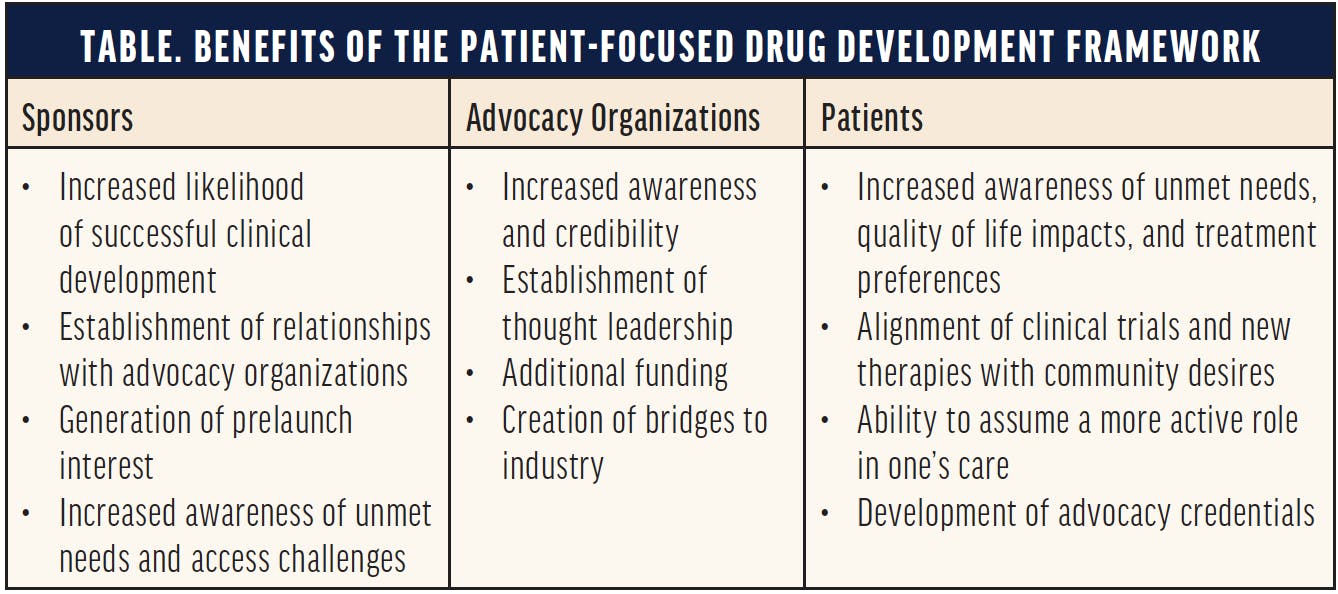
The FDA stopped conducting PFDD meetings after providing PAOs with the necessary framework to lead these meetings themselves. However, the FDA remains focused on ensuring that drug and device developers incorporate patients’ wants and needs into their clinical development plans. Several patient-driven mechanisms are available to capture patient preferences and provide this feedback to regulatory stakeholders. In addition to the large, comprehensive, externally led PFDD meetings, the FDA encourages PAOs to initiate listening sessions with a specific focus on certain aspects of disease with a smaller group of patients and caregivers. The agency also supports sponsors’ adding patient voices to their own agency meetings by allowing one or two patient testimonies to set the stage for a dialogue about a potential drug program (Table).
To initiate an externally led PFDD meeting, a PAO submits a letter of intent roughly 12 months before its proposed meeting. If the FDA accepts the letter of intent and high-level plans for the proposed externally led PFDD meeting, the PAO is off to the races, lining up industry partners, identifying speakers, drafting surveys, creating a website, and working to build awareness. This is no small feat for characteristically small but mighty PAOs that are strapped for time and resources.
Recently, I founded Canary Advisors, a boutique consultancy that works hand in glove with organizations set on patient-focused drug and device development. Seeing as there is no one-size-fits-all solution to advocacy, our services are tailor-made to match the needs of the patient communities our partners serve. Our approach to patient-focused drug and device development has four main components, all geared toward more effectively incorporating the patient perspective into the clinical development process and better meeting patient needs; these pillars are (1) early-stage patient advocacy, (2) regulatory patient advocacy, (3) access and reimbursement support, and (4) clinical trial patient support.

To learn more about how Canary Advisors helps to translate patient preferences into actionable insights, visit www.canaryadvisorsllc.com.
CONCLUSION
The Center for Drug Evaluation and Research made tremendous strides when it created the PFDD framework, a critically important initiative that continues to receive support via the FDA User Fee Reauthorization Act of 2022 and the sixth reauthorization of the Prescription Drug User Fee Act. Patient input received during PFDD meetings is utilized by FDA staff; it provides indication-specific insight as they conduct risk-to-benefit analyses for products under review. Despite their overwhelming benefits, there have been no PFDD meetings, externally led or otherwise, in the ophthalmic space. Because the FDA encourages engagement and collaboration with patient communities facilitated by organizations like Canary Advisors, abundant opportunities exist for those willing to embrace the challenge.