Eye drops or topical medications are typically first-line treatment for glaucoma, and a wide variety of effective drop options are available. Some of these medications are dosed once daily while others are dosed multiple times per day. However, as glaucoma providers know well, compliance is difficult, and up to 50% of patients are nonadherent to their glaucoma medication.1
Numerous studies correlate glaucomatous progression with poor treatment compliance. Older age, more severe visual field defect, lower educational level, and comorbidities such as arthritis can all increase a patient’s risk of failed adherence.2 Even patients who try to use their drops exactly as prescribed may have difficulty achieving full compliance, as several of the medications are dosed multiple times per day.
Eye drops can also cause significant side effects, including blurry vision, irritation, ocular redness, dry eye and ocular surface disease, and prostaglandin analogue (PGA)–associated periorbitopathy. These side effects can contribute to medication intolerance and potential of nonadherence to the medication.
An unmet need exists for a safe and effective method of sustained drug delivery to reliably improve patient compliance to their glaucoma treatment. This article reviews several extended ophthalmic drug delivery vehicles on the market and in development, and describes the potential of drug-eluting contact lenses to address these therapeutic challenges.
SUSTAINED-RELEASE GLAUCOMA SYSTEMS
Subconjunctival injections. Two systems for subconjunctival injection of latanoprost are in development: (1) the Eye-D latanoprost insert (Biolight Life Scientists) and (2) a liposomal latanoprost injection. In a phase 1/2a study, the Eye-D latanoprost insert was found to provide a 24% reduction in IOP for a 12-week period. The insert was to be inserted subconjunctivally in a quick, in-office procedure. In an investigation of the liposomal latanoprost injection, Wong et al3 found that 100 mL of latanoprost injected subconjunctivally provided a 49% reduction in IOP from baseline and was at least as effective as topical latanoprost.
Punctal plugs. The dexamethasone ophthalmic insert (Dextenza, Ocular Therapeutix) is a commercially available punctal plug that contains 0.4 mg of dexamethasone and is indicated for postoperative inflammation. Previously, a punctal plug containing travoprost was evaluated in a phase 3 investigation; however, it did not show superiority to eye drops and is therefore no longer in production.
Intracameral implants. One intracameral implant is available for the management of glaucoma, and two others are in development. The bimatoprost intracameral implant (Durysta, Allergan) was the first sustained-release drug delivery implant approved by the FDA; it contains 10 mcg of bimatoprost, which is continuously released over 4 months. The device is injected in the office. In the pipeline are (1) the XR-ENV 515 (Envisia Therapeutics) and the iDose (Glaukos). The XR-ENV 515 is an intracameral erodible travoprost platform that showed IOP lowering for up to 11 months in phase 2 investigations. The iDose is a titanium implant that contains a novel formulation of travoprost and is designed to continuously release therapeutic levels of the medication intracamerally; once all travoprost is released, the iDose TR is designed to be removed and replaced with a new iDose.
DRUG-ELUTING CONTACT LENSES
Contact lenses are used mainly to correct refractive error. Contacts are also used to correct glare from pupil or iris defects. Future uses, however, may soon include drug delivery, given the noninvasive, nonsurgical, and potentially reversible nature of this technology.
Ketotifen-eluting contact lens. In March, the FDA approved the first drug-eluting contact lens, the Acuvue Theravision with Ketotifen (Johnson & Johnson Vision). This daily disposable contact lens is indicated for the prevention of ocular itch due to allergic conjunctivitis and vision correction in patients who do not have red eyes, are suitable for contact lens wear, and who do not have more than 1.00 D of astigmatism. In phase 3 studies, the Acuvue Theravision with Ketotifen contact lens provided relief from ocular itching as quickly as 3 minutes after insertion; that therapeutic effect was found to last for up to 12 hours.4
Latanoprost-eluting contact lens. Latanoprost is a commonly prescribed first-line glaucoma drop, as it is dosed daily and has minimal side effects. One eye drop of latanoprost solution contains approximately 1.5 mcg of the drug. However, the eye can only absorb so much of that medication. The excess typically washes down the nasolacrimal duct or spills onto the cheek, where it can lead to side effects such as allergic blepharitis and contact dermatitis.
Further, topical PGAs demonstrate a U-shaped dose-response curve, meaning the maximum effect of the drop occurs at a certain concentration. Increasing that concentration can result in reduced IOP-lowering efficacy.5 In an animal study of the sustained-release intracameral bimatoprost implant, however, investigators did not observe the U-shaped dose-response curve typical of topical bimatoprost. Instead, they observed a more linear response, showing consistently greater IOP lowering at increasing dose strengths.5 It will be interesting to see whether sustained-release PGA delivery truly provides a more linear curve, with increasing dose strengths yielding increasing IOP-lowering efficacy.
At the Massachusetts Eye and Ear Infirmary, we are investigating a latanoprost-eluting contact lens developed by Joseph Ciolino, MD. This device is a hydrogel contact lens with a peripheral ring of latanoprost drug and a drug-polymer film that elutes the medication and provides controlled, modifiable-release kinetics (Figure). The contact lens is minimally invasive, and it can be made with or without refractive correction.
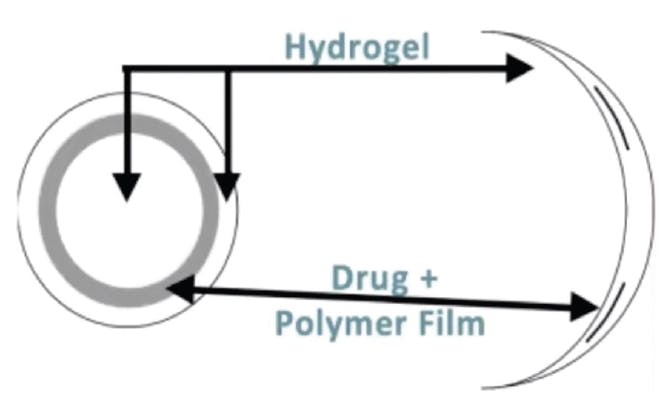
Figure. The latanoprost-eluting contact lens is made of hydrogel and contains a peripheral ring of latanoprost and a drug-polymer film that elutes the medication with controlled- release kinetics.
In an independent study conducted in glaucomatous monkey eyes,6 investigators found that sustained delivery of latanoprost by contact lenses was at least as effective as delivery with daily latanoprost ophthalmic solution. Both low-dose and high-dose contact lenses had greater IOP-lowering efficacy than drops, but the high-dose contact lens was especially more efficacious than both the drops and the low-dose contact lens (see Latanoprost-Eluting Contact Lenses in Glaucomatous Monkey Eyes).
LATANOPROST-ELUTING CONTACT LENSES IN GLAUCOMATOUS MONKEY EYES
In a study by Ciolino et al,6 latanoprost ophthalmic solution resulted in IOP reduction of 5.4 ±1.0 mm Hg on day 3 and peak IOP reduction of 6.6 ±1.3 mm Hg on day 5. A low-dose latanoprost-eluting contact lens reduced IOP by 6.3 ±1.0, 6.7 ±0.3, and 6.7 ±0.3 mm Hg on days 3, 5, and 8, respectively. A high-dose latanoprost-eluting contact lens lowered IOP by 10.5 ±1.4, 11.1 ±4.0, and 10.0 ±2.5 mm Hg on days 3, 5, and 8, respectively.
Our team at the Massachusetts Eye and Ear Infirmary will be conducting a first-in-human clinical trial of the latanoprost-eluting contact lens using one eye of five patients with primary open-angle glaucoma or ocular hypertension treated with latanoprost monotherapy. IOP will be measured before and after latanoprost washout. This trial is being conducted to establish that the lens has an acceptable safety profile, to establish patient tolerability and comfort of the lens, and to establish that the lens is a feasible treatment for glaucoma and is comparable to latanoprost drops. With regard to adverse events, we will be monitoring for ocular infection, corneal epithelial defects, cystoid macular edema, and anterior chamber reaction.
PREDICTIONS
Contact lenses are used by 140 million people worldwide. This technology provides a promising method for ophthalmic drug delivery with the potential to reduce patients’ treatment burden and therefore improve their adherence to their glaucoma medications. Drug-eluting contact lenses are a viable therapeutic option to combine refractive error correction and extended release of ophthalmic medications. For long-term use, risks of contact lenses—including keratitis, dry eye, and hypoxia—will need to be balanced. If lenses will be worn overnight, topical antibiotics must be used to prevent infection. In the future, antibiotics could potentially be loaded into the contact lens, along with other drugs.
Another consideration is patient acceptance. Elderly patients are likely to be less familiar with contact lenses than younger patients. Older patients may have dexterity issues that could make placing contact lenses difficult. There is no perfect solution for glaucoma treatment, but addressing problems with compliance is a good first step.
1. Newman-Casey PA, Blachley T, Lee PP, Heisler M, Farris KB, Stein JD. Patterns of glaucoma medication adherence over four years of follow-up. Ophthalmology. 2015;122(1):2010-2021.
2. Davis SA, Sleath B, Carpenter DM, Blalock SJ, Muir KM, Budenz DL. Drop instillation and glaucoma. Curr Opin Ophthalmol. 2018;29(2):171-177.
3. Wong TT, Novack GD, Natarajan JV, et al. Nanomedicine for glaucoma: sustained release latanoprost offers a new therapeutic option with substantial benefits over eyedrops. Drug Deliv Transl Res. 2014;4(4):303-309.
4. Pall B, Gomes P, Yi F, Torkildsen G. Management of ocular allergy itch with an antihistamine-releasing contact lens. Cornea. 2019;38(6):713-717.
5. Lee SS, Dibas M, Almazan A, Robinson MR. Dose-response of intracameral bimatoprost sustained-release implant and topical bimatoprost in lowering intraocular pressure. J Ocular Pharm Therapeutics. 2019;35(3):138-144.
6. Ciolino JB, Ross AE, Tulsan R, et al. Latanoprost-eluting contact lenses in glaucomatous monkeys. Ophthalmology. 2016;123(10):2085-2092.