The number of codes for MIGS has increased exponentially in the past decade.1 It can be challenging to understand how CMS payments for these procedures are determined, but physician awareness of the reimbursement landscape is important. This article reviews some of the recent changes in MIGS coding and projections for what lies ahead.
NEW TECHNOLOGY CODES
New Technology Ambulatory Payment Classification (APC) codes are designed for temporary use while claims data are collected. The CPT codes are typically transitioned to permanent APC codes within 2 to 3 years if a sufficient amount of data are collected. In 2022, two temporary CPT codes associated with MIGS procedures were retired, two new CPT codes were introduced, and a new temporary code for standalone MIGS procedures was assigned.
Device-intensive procedures such as MIGS are priced based on the cost of the devices in a hospital-based outpatient department (HOPD) setting. CMS relies on the hospital’s reporting of device costs to revenue code 278. Ambulatory surgery centers (ASCs), however, do not report the same way hospitals do; ASCs submit claims to Medicare on CMS 1500 forms, and no revenue code is reported. CMS uses hospital-reported data to determine payment in an ASC.
The Alternative Payment Conversion methodology is used to rescale HOPD rates to ASC rates for device-intensive procedures. This is designed to ensure that the device portion paid to the ASC is equal to the device portion paid to the HOPD, effectively removing the ASC scaling for the device portion of a particular APC. This is applicable for ASC-covered surgical procedures for which the estimated device offset percentage is greater than 30% of the procedure code’s mean cost.
APCS AND MIGS COMBINATION CODES
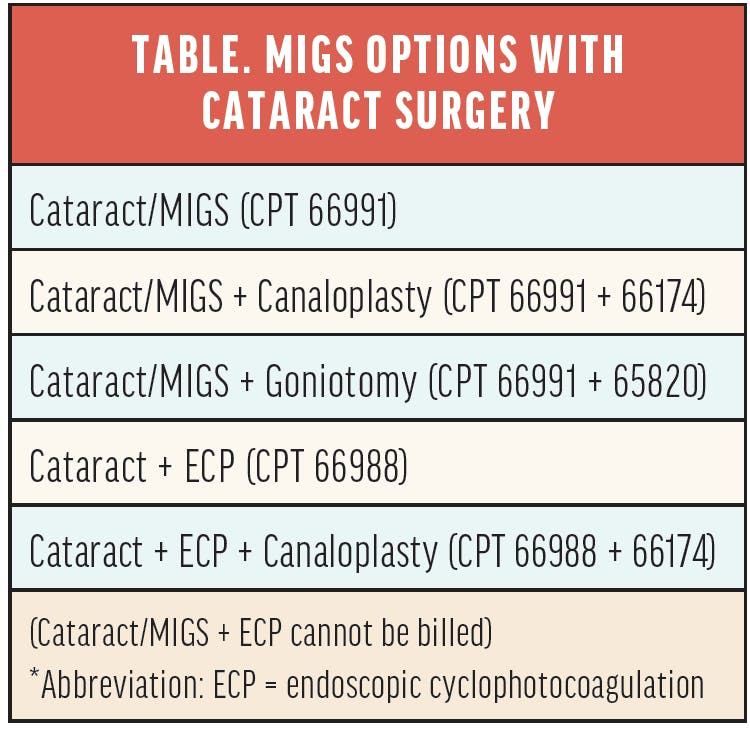
In 2021, the temporary category 3 CPT code 0191T was used for MIGS procedures as a separate line item with cataract surgery CPT code 66984. In 2022, CPT code 66989 was issued for complex cataract surgery with IOL placement and implantation of an aqueous drainage device, and CPT code 66991 was issued for routine cataract surgery with IOL placement and implantation of an aqueous drainage device (Table). Temporary CPT code 0671T has also been assigned for standalone insertion of an anterior segment aqueous drainage device into the trabecular meshwork, without extraocular reservoir and without concomitant cataract removal (one or more). CMS deleted the temporary CPT code 0191T for insertion of an aqueous drainage device into the trabecular meshwork and the temporary CPT code +0376T for each additional device insertion.
Initially, CMS’ proposed rule for 2022 issued a 25% reduction for these combined procedures when performed in an ASC. This occurred because the device-intensive component was erroneously set at 31% of the APC, even though CPT code 0191T had an established device-intensive percentage of 52%. CMS also valued the time and intensity of the procedure as equivalent to the cataract surgery group, without seeking additional input. The proposed 2022 ASC facility payment rate significantly reduced payment for MIGS combined with cataract surgery.
In 2021, the American Medical Association and Relative Value Scale Update Committee (RUC) sent a survey to a sample of ophthalmologists to determine the duration and complexity of MIGS trabecular bypass procedures at the time of cataract surgery. The survey results were used to change the relative value units (RVUs) assigned to these procedures; as a result, very few RVUs were assigned. In July 2021, CMS assigned a $34.26 incremental payment for the placement of a trabecular meshwork stent over standalone cataract surgery. After significant advocacy efforts by ophthalmic societies and individual ophthalmologists, CMS revalued the incremental payment to $134.73.
Ultimately, for cataract surgery plus a trabecular meshwork stent, an additional $138 is paid instead of $352. Although an improvement from the initial payment, this change still represented a significant reduction and made stents the lowest-reimbursed MIGS procedure despite a wealth of data supporting their benefit to patients. Reimbursement for canaloplasty also decreased.
From 2021 to 2022, physician fees decreased, some (eg, goniotomy and canaloplasty) more significantly than others. It is important to know the physician fee for each procedure because it is advisable to bill first for the fee that will have the least significant reduction when doing a second procedure. Additionally, it is important to consider the associated facility fee and device cost.
CMS AUDITS
In an article published in August 2022 on goniotomy claims, CPT Assistant reported that goniopuncture is not equivalent to goniotomy (CPT 65820), so there will be chart auditing on these claims. In 2022, CMS audits will also focus on cataract surgery with and without MIGS and complex cataract surgery with and without MIGS. Auditors will pay close attention to a frequent lack of documentation and/or coding errors and may focus on practices where support for claims is often weak or missing. These findings can lead to monetary recoveries by CMS.
PREDICTIONS
Having a fee that is not set has implications for overall health care costs and access to care. My clinical decision-making for MIGS has not changed significantly in recent years. What has changed is my prioritization of detailed documentation, my understanding of the RUC/RVU process and CMS surveys, my attention to proper coding and order of codes billed, and the importance of physician advocacy.
More than 85% of MIGS procedures have historically occurred in an ASC. Decreased facility payment in ASCs could push procedures to HOPDs, which would have implications for patient access and health care costs. More levels of surgery in ophthalmic APCs are needed to accommodate new technology, and physicians must evaluate the impact on their commercial contracts in their ASC.
There are many new MIGS devices, technologies, and procedures in the pipeline that will become available in the coming years. It is exciting to see such an expansion in the number of treatment strategies in this space and the possibilities for customizing MIGS procedures to the individual anatomy, pathology, level of IOP lowering needed, and stage of disease over the patient's lifetime while avoiding treatments with higher complication rates. Ophthalmologists must stay informed and diligent in monitoring the changing and often challenging reimbursement landscape while managing the outcomes of the valuation process by CMS for existing and new MIGS CPT codes as they strive to provide improved outcomes for patients with glaucoma.
1. Corcoran KJ. New MIGS CPT codes. MIGS is now a mainstream option. Glaucoma Physician. March 2022.