AT A GLANCE
- An “optic nerve stress test” was designed to track visual recovery after a reproducible IOP challenge in a mouse eye. The purpose was to examine the mechanisms underpinning functional loss and recovery in response to IOP elevation.
- Investigations have shown that functional loss occurs rapidly after a single acute IOP elevation and that retinal ganglion cells can remain nonresponsive to light-induced signaling for prolonged periods. Further, animal age is a key determinant of the speed and extent of recovery, and lifestyle interventions such as exercise and diet can substantially alter the speed and extent of recovery.
- Neurorecovery is a modifiable process and can lend itself to lifestyle and pharmacologic intervention.
Two recent pilot studies have demonstrated short-term (3 months) improvement in visual function in glaucoma patients taking nicotinamide (NAM) or nicotinamide together with pyruvate.
The first study, completed in Melbourne, was a randomized controlled, double-masked crossover trial of more than 50 patients with open-angle glaucoma.1 We found a subtle but statistically significant improvement in both visual field mean deviation value and inner retinal function measured with the photopic negative response of full-field electroretinography. Although the mean values for both parameters were significantly improved in patients taking NAM versus placebo, only a proportion of the patients (~25%) had a substantial improvement in visual function as measured by electroretinography or perimetry. Of note, similar levels of improvement were seen in our earlier study that looked at the effect of IOP lowering (by 30%), with about 25% of patients in the IOP-lowering group improving photopic negative response values beyond the 95% coefficient of repeatability.2
In the second study, conducted by researchers at Columbia University,3 32 patients with primary open-angle glaucoma were randomly assigned 2:1 to receive the combination of NAM and pyruvate or placebo. Twenty-two patients received the active treatment. The investigators found a statistically significant improvement in pattern standard deviation but no difference in mean deviation.
Both investigations were designed as pilot studies to help generate funding for more definitive, larger randomized controlled trials, which are now being initiated in a number of clinical centers in the United States, Europe, Asia, and Australia.
VISUAL RECOVERY AT THE CELLULAR LEVEL
Improvement in visual function in glaucomatous eyes in response to IOP lowering is not a new concept. Early case series documenting visual field improvement showed improvement in Goldmann visual fields in response to intravenous acetazolamide (Diamox).4 An accumulating body of evidence has since shown improvement in visual fields as well as electroretinography and contrast sensitivity.5 In general, vision improvement is more commonly seen in younger patients with early-stage disease. These findings raise several interesting questions, such as, what are the cellular processes underlying visual recovery, and how does this relate to longer-term treatment outcomes?
To investigate cellular mechanisms, we developed an “optic nerve stress test” that permits us to track visual recovery following a reproducible IOP challenge in the mouse eye (Figure). The purpose was to examine the mechanisms underpinning functional loss and recovery in response to IOP elevation. These studies have shown that functional loss occurs rapidly after a single acute IOP elevation and that retinal ganglion cells can remain nonresponsive to light-induced signaling for prolonged periods. Animal age is a key determinant of the speed and extent of recovery, and lifestyle interventions such as exercise and diet can substantially alter the speed and extent of recovery.6 More recently, unpublished work has demonstrated that the mechanisms that drive functional recovery are different between young and old mice and, perhaps more importantly, older mice that have delayed recovery are more vulnerable to neurodegeneration when exposed to a repeat IOP challenge. Neurorecovery is thus a modifiable process and can lend itself to lifestyle and pharmacologic intervention.
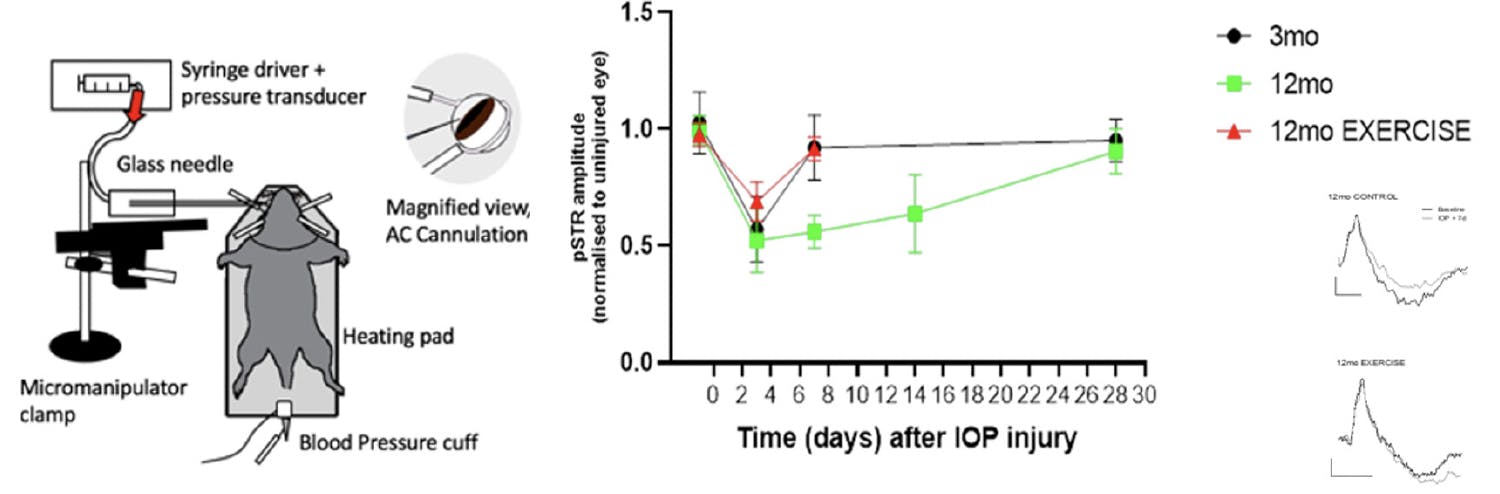
Figure. An IOP challenge is induced by raising IOP to 50 mm Hg for 30 minutes, and inner retinal function is monitored by electroretinography. Older mice (green) have a much slower recovery phase, but this can be modified by exercise (red) and other interventions.
The second important unanswered question is whether these short-term improvements in visual function are robust and whether they predict longer-term changes in glaucomatous progression. The answer to this will be key to developing more feasible and timely methods for testing neuroprotectants in clinical practice.
1. Hui F, Tang J, Williams PA, et al. Improvement in inner retinal function in glaucoma with nicotinamide (vitamin B3) supplementation: a crossover randomized clinical trial. Clin Exp Ophthalmol. 2020;48(7):903-914.
2. Tang J, Hui F, Hadoux X, et al. Short-term changes in the photopic negative response following intraocular pressure lowering in glaucoma. Invest Ophthalmol Vis Sci. 2020;61(10):16.
3. De Moraes CG, John SWM, Williams PA, Blumberg DM, Cioffi GA, Liebmann JM. Nicotinamide and pyruvate for neuroenhancement in open-angle glaucoma: a phase 2 randomized clinical trial. JAMA Ophthalmol. 2022;140(1):11-18.
4. Paterson G. Effect of intravenous acetazolamide on relative arcuate scotomas and visual field in glaucoma simplex. Proc Roy Soc Med. 1970;63:865-869.
5. Fry LE, Fahy E, Chrysostomou V, et al. The coma in glaucoma: retinal ganglion cell dysfunction and recovery. Prog Retin Eye Res. 2018;65:77-92.
6. Chrysostomou V, Kezic JM, Trounce IA, Crowston JG. Forced exercise protects the aged optic nerve against intraocular pressure injury. Neurobiol Aging. 2014;35(7):1722-1725.