AT A GLANCE
- AS-OCT provides objective, quantitative, and reproducible information about angle-closure eyes.
- Ocular biometrics appear to be strong predictors of angle-closure progression and could be used to identify eyes that might benefit from prophylactic laser peripheral iridotomy or closer monitoring after laser peripheral iridotomy.
- Additional longitudinal studies are required to evaluate the clinical utility of ocular biometrics as a diagnostic standard for personalizing the management of angle-closure eyes.
Primary angle-closure glaucoma (PACG) is a leading cause of permanent vision loss.1,2 Despite this, recent landmark studies have shown that, for most primary angle-closure suspects (PACSs), the risk of progressing to primary angle closure is low, even without treatment.3,4 However, the prevalence of PACG is expected to increase over the next 2 decades, so identifying patients at increased risk of developing the condition is a public health priority.2
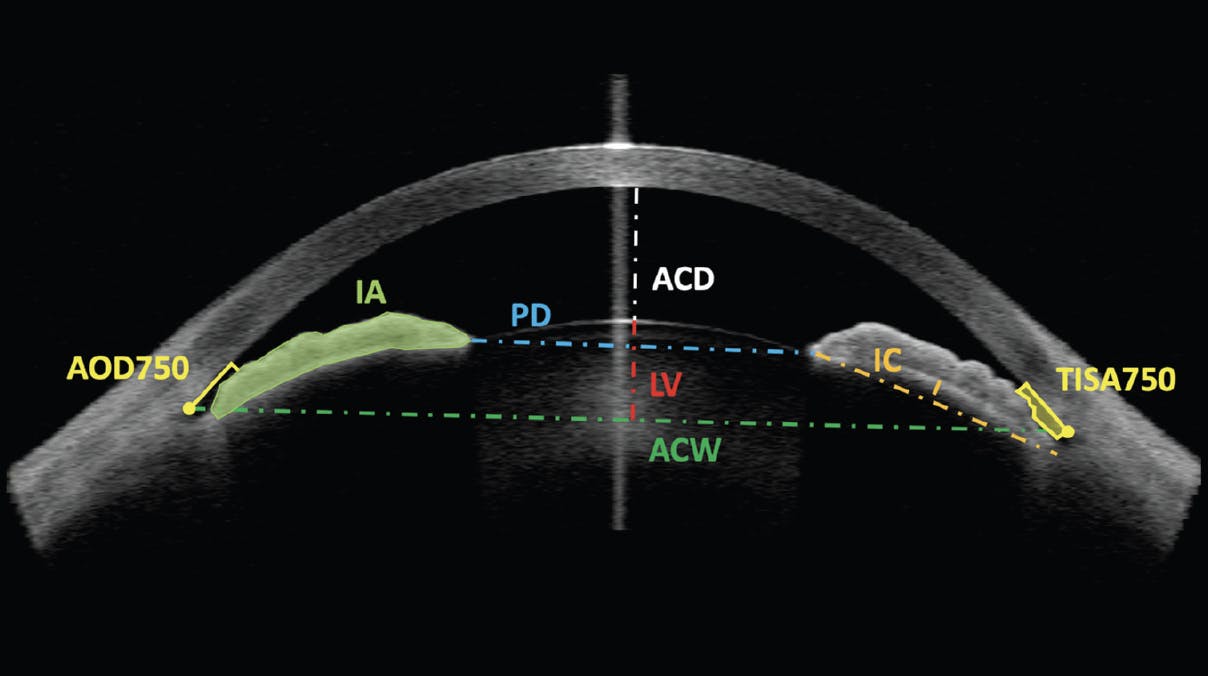
Anterior segment OCT (AS-OCT) is a convenient, high-resolution, noncontact method of imaging the anterior portion of the eye.5,6 Ocular biometrics parameters measured with AS-OCT (Figure) are well-established risk factors for angle closure,7-11 but the association between biometric measurements and the progression of angle-closure disease was characterized only recently.
PREDICTING PROGRESSION WITH OCULAR BIOMETRICS
In a recent study, we used ocular biometric measurements from the Zhongshan Angle Closure Prevention (ZAP) trial to identify parameters that were predictive of progression in untreated PACS eyes.12 Biometric measurements from 643 eyes (609 nonprogressors and 34 progressors) were included in logistic regression models. We found that a narrower baseline angle width—angle opening distance (AOD500) and trabecular iris space area (TISA500) at 500 µm from the scleral spur—and a flatter iris curvature conferred a higher risk of progression. Interestingly, the cumulative gonioscopy score (sum of gonioscopy grades) was not associated with progression. These findings highlight the potential of AS-OCT and ocular biometrics to identify untreated PACS eyes at increased risk of developing PACG.
RISK ASSESSMENT AFTER LASER PERIPHERAL IRIDOTOMY
In a follow-up study, we assessed biometric risk factors for progression in PACS eyes after laser peripheral iridotomy (LPI).13 We first developed Cox proportional hazard models using data from a mix of 878 treated and untreated eyes to demonstrate that the protective effect of LPI against progression is because of its angle-widening effect. Next, using data from treated PACS eyes only, we found that both angle width (AOD500 and TISA500) and cumulative gonioscopy score measured 2 weeks after LPI were predictive of progression. This finding suggests that angle width may be a better predictor in eyes with narrower angles (untreated eyes), whereas gonioscopy may be more useful in eyes with wide angles (after LPI). It also provides the first evidence of the clinical utility of AS-OCT imaging and gonioscopy after LPI for identifying patients at increased risk of angle-closure progression despite treatment.
FUTURE STUDIES
Although these results are promising, the statistical models developed were only moderately predictive of progression. We are therefore currently exploring new approaches to risk-stratifying angle-closure eyes with AS-OCT. For example, biometric measurements obtained outside of dark environments, where the angle is typically assessed, or under dynamic lighting conditions may provide additional information about progression. We hope that these novel approaches can deepen physicians’ understanding of PACG pathogenesis and its risk factors and eventually help clinicians deliver precision care to patients with angle closure.
CONCLUSION
AS-OCT provides objective, quantitative, and reproducible information about angle-closure eyes. In contrast, gonioscopy is subjective and appears to provide less prognostic information overall, although it is useful for detecting eyes at risk of developing PACG.14,15 Ocular biometrics, angle width in particular, appear to be strong predictors of angle-closure progression and could be used to identify eyes that might benefit from prophylactic LPI or closer monitoring after LPI. Additional longitudinal studies are required to evaluate the clinical utility of ocular biometrics as a diagnostic standard for personalizing the management of angle-closure eyes.
1. Quigley H, Broman AT. The number of people with glaucoma worldwide in 2010 and 2020. Br J Ophthalmol. 2006;90(3):262-267.
2. Tham YC, Li X, Wong TY, Quigley HA, Aung T, Cheng CY. Global prevalence of glaucoma and projections of glaucoma burden through 2040: a systematic review and meta-analysis. Ophthalmology. 2014;121(11):2081-2090.
3. Baskaran M, Kumar RS, Friedman DS, et al. The Singapore Asymptomatic Narrow Angles Laser Iridotomy Study: five-year results of a randomized controlled trial. Ophthalmology. 2022;129(2):147-158.
4. He M, Jiang Y, Huang S, et al. Laser peripheral iridotomy for the prevention of angle closure: a single-centre, randomised controlled trial. Lancet. 2019;393(10181):1609-1618.
5. Maram J, Pan X, Sadda S, Francis B, Marion K, Chopra V. Reproducibility of angle metrics using the time-domain anterior segment optical coherence tomography: intra-observer and inter-observer variability. Curr Eye Res. 2015;40(5):496-500.
6. Marion KM, Maram J, Pan X, et al. Reproducibility and agreement between 2 spectral domain optical coherence tomography devices for anterior chamber angle measurements. J Glaucoma. 2015;24(9):642-646.
7. Nongpiur ME, He M, Amerasinghe N, et al. Lens vault, thickness, and position in Chinese subjects with angle closure. Ophthalmology. 2011;118(3):474-479.
8. Aung T, Nolan WP, Machin D, et al. Anterior chamber depth and the risk of primary angle closure in 2 East Asian populations. Arch Ophthalmol. 2005;123(4):527-532.
9. Shan J, DeBoer C, Xu BY. Anterior segment optical coherence tomography: applications for clinical care and scientific research. Asia Pac J Ophthalmol (Phila). Published online April 25, 2019. doi:10.22608/APO.201910
10. Xu BY, Liang S, Pardeshi AA, et al. Differences in ocular biometric measurements among subtypes of primary angle closure disease: The Chinese American Eye Study. Ophthalmology Glaucoma. 2021;4(2):224-231.
11. Moghimi S, Vahedian Z, Fakhraie G, et al. Ocular biometry in the subtypes of angle closure: an anterior segment optical coherence tomography study. Am J Ophthalmol. 2013;155(4):664-673.e1.
12. Xu BY, Friedman DS, Foster PJ, et al. Ocular biometric risk factors for progression of primary angle closure disease: The Zhongshan Angle Closure Prevention Trial. Ophthalmology. 2022;129(3):267-275.
13. Bao YK, Xu BY, Friedman DS, et al. Biometric risk factors for angle closure progression after laser peripheral iridotomy. JAMA Ophthalmol. 2023;141(6):516-524.
14. Riva I, Micheletti E, Oddone F, et al. Anterior chamber angle assessment techniques: a review. J Clin Med. 2020;9(12):3814.
15. Yi JH, Lee H, Hong S, et al. Anterior chamber measurements by Pentacam and AS-OCT in eyes with normal open angles. Korean J Ophthalmol. 2008;22(4):242-245.