Choroidals After Tube Shunt Surgery
Arsham Sheybani, MD
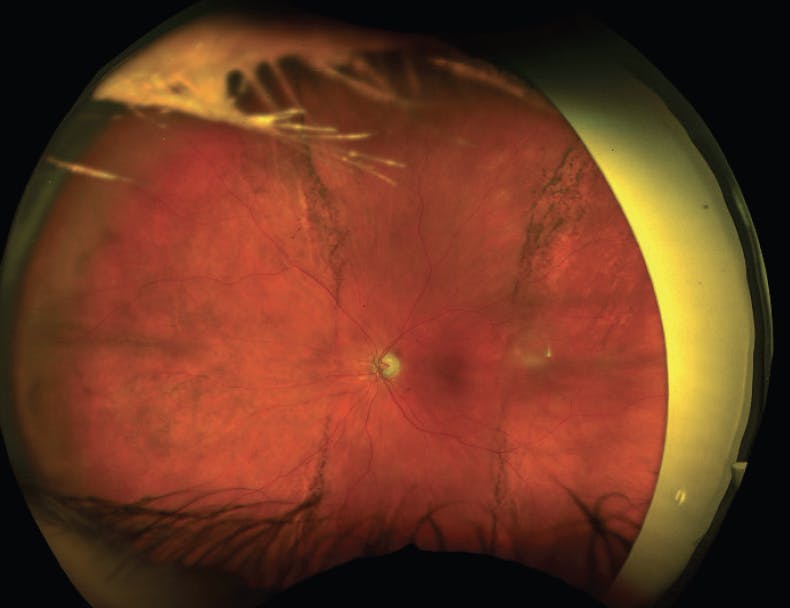
A 56-year-old patient presented with IOPs in the 30s mm Hg despite being on maximum tolerated medical therapy. I elected to first treat the left eye, which had more significant visual field loss than the right, with placement of a valved tube shunt. Postoperatively, the patient developed hemorrhagic appositional (kissing) choroidals, which were subsequently drained 1 week later. Ultimately, this left him with decreased vision due to demarcation lines, one of which crossed through the macula (Figure). A nontraditional subconjunctival surgery was elected for treatment of the patient’s right eye. Surgeries that carry a risk of severe hypotony (which can occur with any subconjunctival procedure) can have profound impacts on patients’ visual recovery.
Stent Misplacement
A patient was referred for an elevated IOP of 23 mm Hg despite being on three classes of medication after cataract surgery with iStent (Glaukos) implantation performed 4 months prior. The referring surgeon suspected that the patient’s IOP was unresponsive to the device, as it had seemingly provided no IOP-lowering effect.
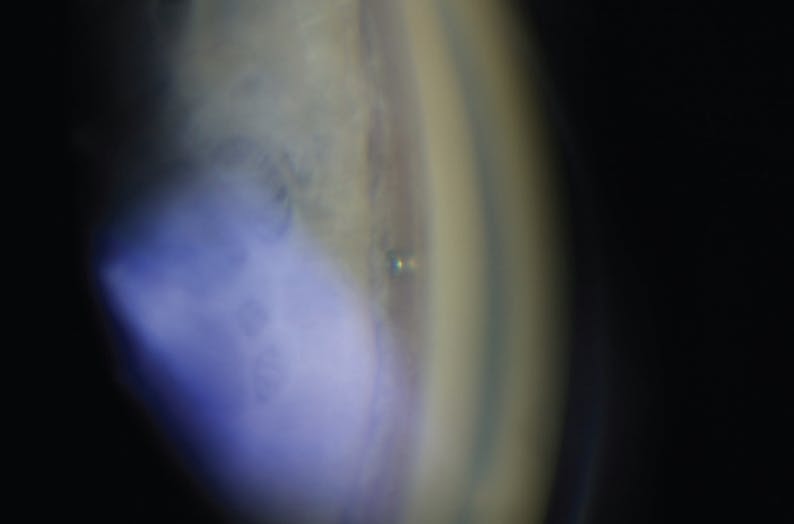
Upon examination, the iStents were found to be located in the ciliary body. I performed a 180° gonioscopy-assisted transluminal trabeculotomy in the right tissue plane. IOP decreased to the middle teens mm Hg postoperatively, confirming that the patient’s outflow pathway was functional and the problem was incorrect device placement (Figure).
Proper knowledge of anatomic landmarks is critical for MIGS success.
Stent Implantation and Reimplantation
Sydney Lance, BSc, and Billy Pan, MD
An 81-year-old woman with a history of traumatic glaucoma began experiencing significant side effects of drop use. She was already using all five classes of topical glaucoma medication and had developed notable injection and follicular conjunctivitis in the left eye. Given this, the decision was made to proceed with filtration surgery despite the high-risk status of this eye.
The patient had previously undergone superior scleral tunnel–based cataract surgery, and it was clear, during the initial conjunctival evaluation, that the earlier procedure would create problems at the 12 o’clock region. Attention was therefore turned to the superonasal conjunctiva, where dissection revealed scarring in all directions. A significant amount of this scarring was broken during dissection, and an adequate pocket was created for the creation of a bleb.
A sclerotomy was performed with a 27-gauge needle directed into the (anticipated) midanterior chamber. Due to the past trauma, this eye had a complete loss of superonasal iris tissue. Most of the iris was plastered up against the cornea chronically, creating essentially one large anterior chamber–sulcus space.
Placement of a Xen Gel Stent (Allergan/AbbVie) through the initial sclerotomy became problematic when the device encountered a significant amount of residual, traumatized, and broken fragments of iris tissue. The implant was removed, and a second needle tract was made adjacent to the initial one. This time, the 27-gauge needle tract was created with a slightly exaggerated posterior aim given the large amount of space available (Figure).
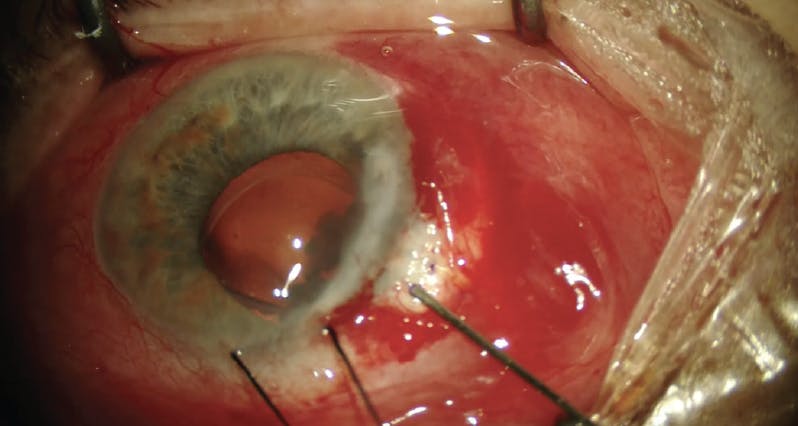
Figure. Placement of a Xen Gel Stent (Allergan/AbbVie) became problematic when the device encountered a significant amount of residual, traumatized, and broken fragments of iris tissue in an eye with traumatic glaucoma. A second sclerotomy tract was created using a 27-gauge needle, but insertion was still difficult.
It was difficult to place the hydrated Xen through the 27-gauge needle tract. Although possible, damage to the Xen can occur as continuous manipulation is performed. A 25-gauge needle was therefore used to enlarge the previously placed second 27-gauge needle tract. Even with this enlarged sclerotomy, threading the Xen Gel Stent through the tract was challenging.
Final placement of the implant was excellent. Internally, the Xen was in a large pocket of open space without any concern for potential blockage. Externally, it was mobile and fishtailed freely without incarceration within the Tenon tissue.
Descemet Detachment During Viscodilation
Leonard K. Seibold, MD
A 79-year-old White man presented with primary open-angle glaucoma and visually significant cataracts. Viscodilation was performed in an ab interno fashion after phaco cataract extraction and IOL implantation in the left eye. Toward the end of the OVD injection, a localized Descemet detachment was noted peripherally in the nasal quadrant (Figure 1).
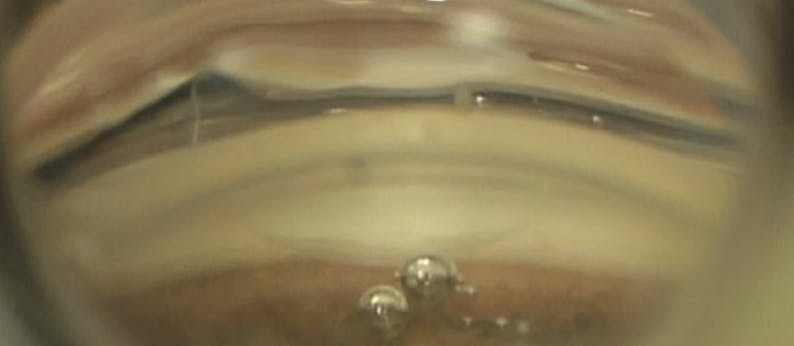
Figure 1. Ab interno viscodilation was performed after phaco cataract extraction and IOL implantation. Toward the end of an OVD injection, a localized Descemet detachment was noted peripherally in the nasal quadrant.
After the OVD was removed from the anterior chamber with irrigation and aspiration, the Descemet detachment was noted to be fairly peripheral in location and shallow (Figure 2). All corneal wounds were sealed, and the anterior chamber was filled with an air bubble to help tamponade the detachment and encourage reattachment. The patient was instructed to stay supine as much as possible for the rest of the day.
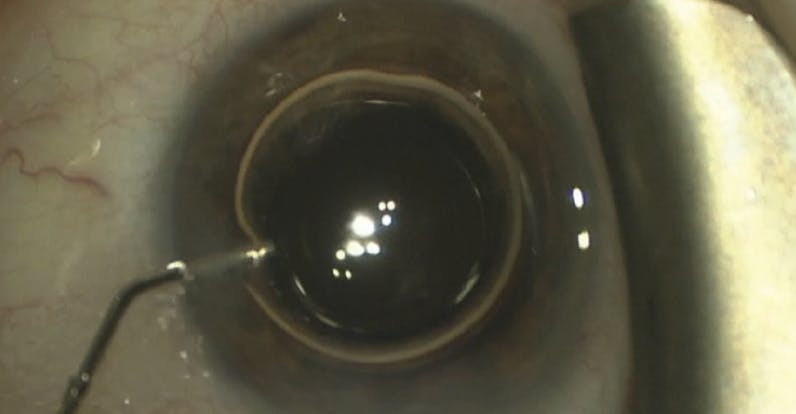
Figure 2. Once the OVD was removed from the anterior chamber with irrigation and aspiration, the Descemet detachment was noted to be peripherally located and shallow.
On postoperative day 1, the air bubble had been largely reabsorbed, and the Descemet detachment had become shallower (Figure 3). On high-magnification imaging, the detachment appeared to be less than one-half the corneal thickness. The patient’s UCVA was 20/40.
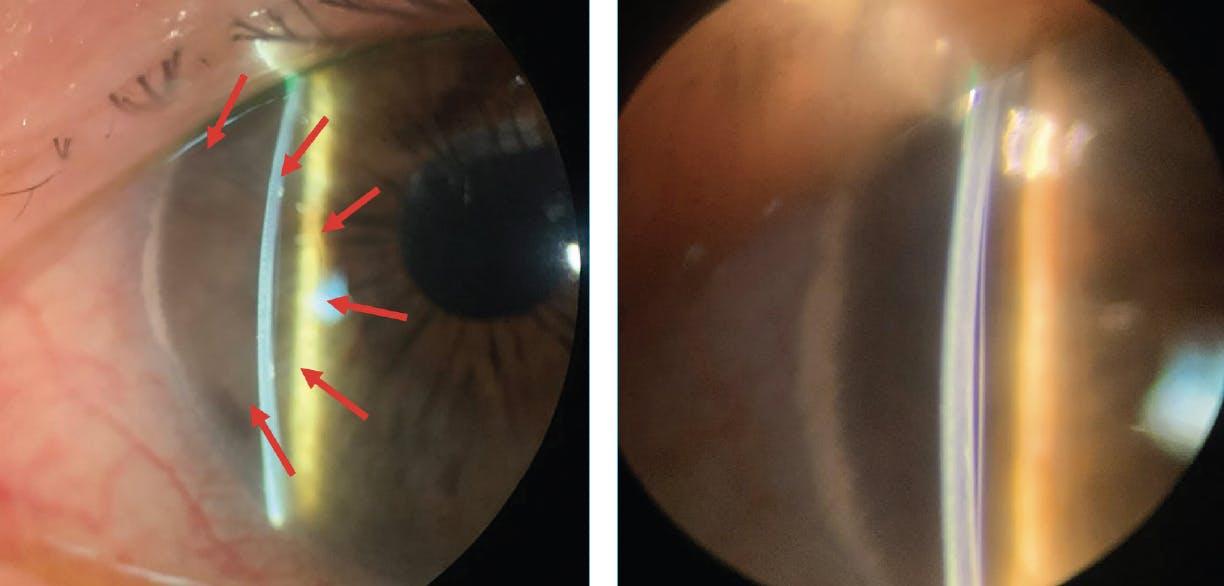
Figure 3. On postoperative day 1, the air bubble had been largely reabsorbed, and the Descemet detachment (red arrows) had shallowed.
At the 1-week postoperative visit, the Descemet detachment had resolved completely, and his UCVA was 20/20 with no residual corneal findings.
Microstent Redirection
Ticiana De Francesco, MD
A 62-year-old patient with mild glaucoma presented with an IOP of 19 mm Hg on two classes of glaucoma medications. I planned to perform cataract surgery and implantation of the Hydrus Microstent (Alcon) in the patient’s right eye.
To begin the stent implantation, I placed the injector cannula into the anterior chamber and used a Swan Jacob goniolens to visualize the angle. I incised the inner wall of Schlemm canal with the distal tip of the cannula, which was positioned slightly superficially. As I attempted to deploy the Hydrus Microstent into Schlemm canal, I realized that part of the device was going into the suprachoroidal space.
I retracted the device into the injector cannula, pointed its distal tip slightly more upward, and attempted to redeploy the device. However, the stent again went into the suprachoroidal space, so it was retracted. I pointed the distal tip of the cannula farther upward and slowly deployed the device into Schlemm canal. At this point, the stent was correctly positioned, with its three windows in the canal (Figure).
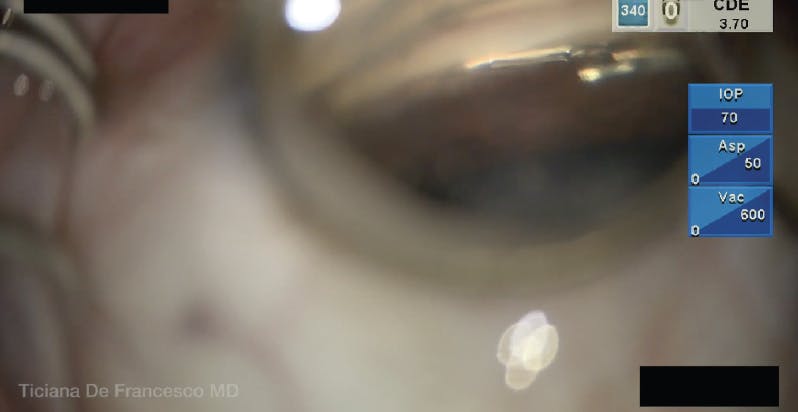
Figure. Correct placement of the Hydrus Microstent is confirmed, with the three windows of the device in Schlemm canal.
To implant a Hydrus Microstent successfully, the distal tip of the injector cannula should be angled to around 30° upward while the inner wall of Schlemm canal is incised and the device is deployed. It is important to avoid incising the inner wall of the canal too superficially. Before deploying the stent, I relax my hand to minimize stress on Schlemm canal. Then, I slowly deploy the Hydrus while watching to confirm that the whole microstent is entirely positioned in the canal.