With so many surgical options available to manage glaucoma, it is essential that graduating ophthalmology residents be armed with a breadth of skills. Trabeculectomy and tube shunt surgery used to be the gold standard glaucoma procedures, but since the 2010s, MIGS has been gaining popularity owing to the favorable safety profile of these interventions and the ability to use them earlier in the disease process.
This year, the Accreditation Council for Graduate Medical Education (ACGME) updated the glaucoma surgery minimum requirements for graduating ophthalmology residents to reflect the growing role of MIGS. Previously, residents were required to perform five filtering or shunting procedures as primary surgeon, and there was no separate category for MIGS. An analysis of a sample of graduating ophthalmology residents’ case logs from the class of 2018 revealed that the average number of traditional glaucoma surgeries performed by a graduating ophthalmology resident was nine, and the average number of MIGS procedures performed by a graduating ophthalmology resident was five, although the range was wide. Some programs were graduating residents with zero MIGS procedures performed.1 With the new requirements, all graduating ophthalmology residents will be required to perform five MIGS procedures as primary surgeon and to participate in five tube shunt surgeries and trabeculectomies as either primary surgeon or assistant surgeon.
This article discusses MIGS training from the perspectives of an ophthalmology chief resident and an academic glaucoma specialist and resident educator.
Jessie Wang, MD
From a resident standpoint, learning MIGS is an exciting and, initially, challenging task. To perform this class of surgeries, one must first gain a view into the anterior chamber angle. The structures in the anterior chamber angle are not visible on routine examination and require a mirrored gonioscopy lens. Thus, the first step to learning MIGS is knowing how to perform an adequate gonioscopic examination in clinic to precisely identify the microscopic structures in the angle.
The angle is a 3D structure. I have therefore found it helpful to be dynamic with a gonioprism and the slit lamp’s joystick, not push too hard on the cornea with the gonioprism (which can cause corneal striae and obstruct the examiner’s view), ensure that the patient is comfortable by instilling an ample amount of topical anesthetic, cross-check images of angle anatomy and pathology with reference sources so as to know what looks normal versus abnormal, and, of course, allow for a lot of practice.
Once the resident masters gonioscopy, the next step is to become familiar with the available MIGS devices and how best to select and utilize each. The University of Chicago’s department of ophthalmology employs a model of graduated independence when it comes to operating. Initially, residents are responsible only for operating with one hand: the attending holds the gonioprism, while we make the incision in the trabecular meshwork and control the footpedals for the operating microscope. Once we are comfortable with that process, we progress to operating independently with both hands. The nondominant hand holds the gonioscopy prism, and the dominant hand operates as described earlier (Figure).
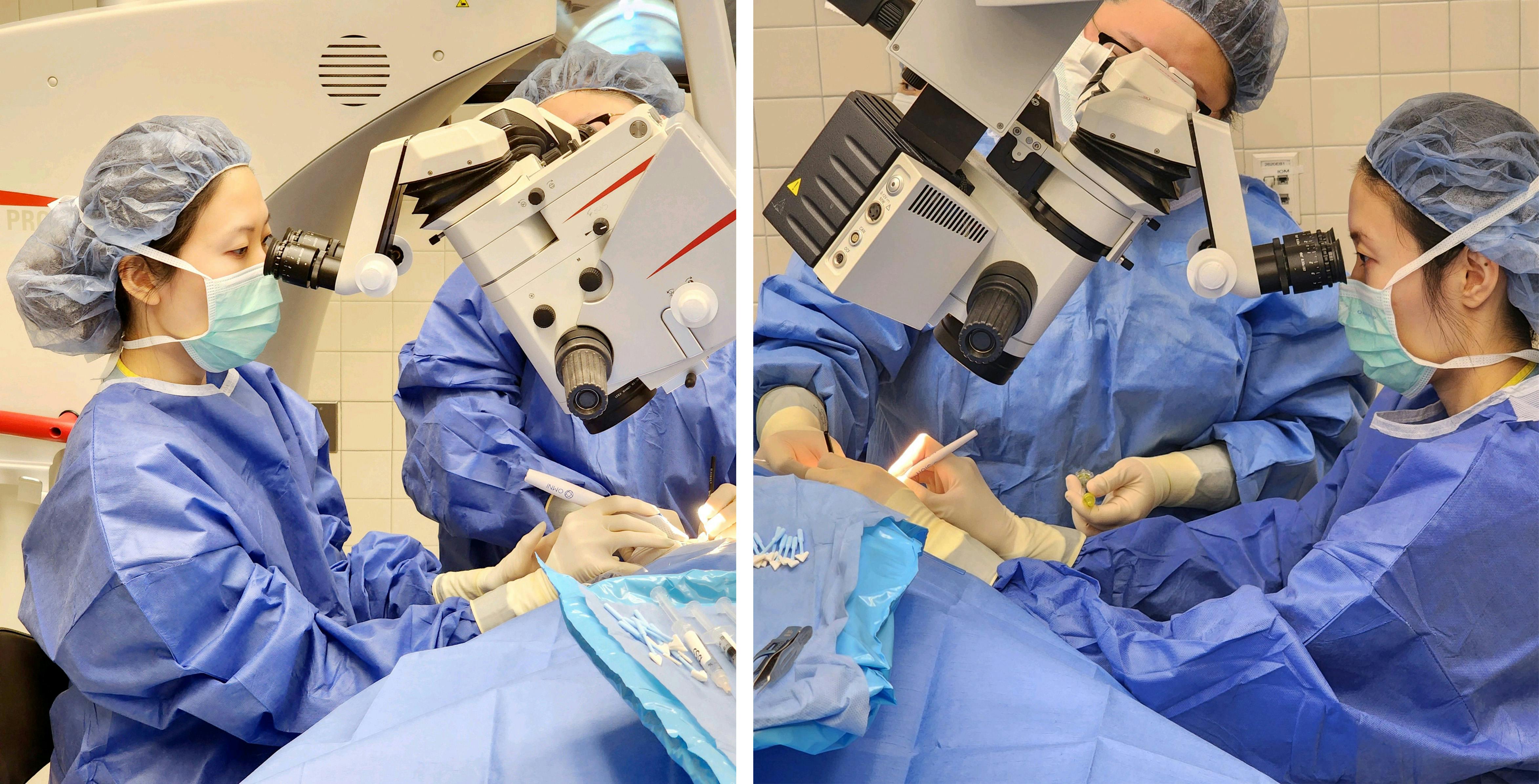
Figure. At the University of Chicago, ophthalmology residents are initially responsible only for operating with one hand: the attending holds the gonioprism, while the resident makes the incision and controls the footpedals for the operating microscope, as shown with senior resident Jessie Wang, MD, and her attending Mary Qiu, MD. (left). Once residents are comfortable with that process, they progress to operating independently with both hands (right).
There is definitely a learning curve, but now that I’ve performed more than 30 MIGS procedures, including goniotomy, canaloplasty, gonioscopy-assisted transluminal trabeculotomy, and endoscopic cyclophotocoagulation, I feel much more confident in the basic skill set I’ve acquired for working in the anterior chamber angle. I feel fortunate to have had such robust exposure to MIGS under the supervision of my attending and mentor, Mary Qiu, MD, and I am looking forward to my glaucoma fellowship next year at Duke Eye Center in Durham, North Carolina.
Mary Qiu, MD
During my residency, most of the MIGS procedures performed by trainees were done by the glaucoma fellows. Most of my own MIGS training took place during my glaucoma fellowship. When I started my faculty position at the University of Chicago in 2019, I was eager to teach MIGS to our residents, even though it was not yet an ACGME requirement. MIGS is increasingly being performed by comprehensive ophthalmologists and glaucoma specialists alike, so it is important that all graduating residents have a basic familiarity with these procedures, even if they do not pursue glaucoma fellowship.
I started by teaching the postgraduate year (PGY) 4 residents while advocating for transitioning the glaucoma rotation to be a PGY-3 rotation. I hoped that junior residents could start learning MIGS sooner and that the earlier hands-on experience could help them decide whether to pursue glaucoma fellowship, select a different fellowship, or enter directly into comprehensive practice. Now, PGY-3 residents at the University of Chicago spend 4 months on my glaucoma rotation.
I have adopted a stepwise approach to teaching MIGS in which the trainee initially does only the critical step; once they become comfortable with the critical step, we then introduce the other components in a stepwise fashion. This strategy allows the resident to focus on mastering one physical task while moving only one hand at a time, which enhances the safety of learning a new procedure.
Thanks to our program’s dedication to teaching residents, we have had the opportunity to use many of the latest MIGS tools, and our residents were the first in the country to use two of the most recently available instruments. One of our residents recently finished the PGY-3 glaucoma rotation with 49 MIGS procedures as primary surgeon, which is on par with many graduating glaucoma fellows.
I am pleased that the ACGME recently updated its requirements to require all graduating ophthalmology residents to perform at least five MIGS procedures as primary surgeon. This reflects the growing role of MIGS in the treatment algorithm for glaucoma, and I hope that this new requirement encourages academic ophthalmologists at teaching institutions to seek more opportunities to teach MIGS to their residents. Developing the MIGS curriculum for the University of Chicago residents has been one of the highlights of my career so far, and each year, I am proud to be sending our well-trained residents off to fellowship or comprehensive practice.
CONCLUSION
Becoming comfortable with MIGS during residency is beneficial for ophthalmology trainees, regardless of whether they plan to pursue glaucoma fellowship or comprehensive ophthalmology. A stepwise approach to teaching MIGS can help educators navigate trainees’ learning curve so that they can become proficient in MIGS fundamentals by the end of their ophthalmology residency.
1. Qiu M, Woreta FA, Boland MV. Microinvasive glaucoma surgery in US ophthalmology residency: surgical case log cross-sectional analysis and proposal for new glaucoma procedure classification. J Glaucoma. 2021;30(7):621-628.