Genetic factors contribute to the development of all forms of early- and adult-onset glaucoma, and recent studies have identified gene variants for every form of disease.1 In coming years, this genetic information will likely have a role in clinical glaucoma care (and ophthalmology and medicine in general), so it is important to be familiar with the basics.
The vision for this field is to one day be able to collect a blood sample from any given patient who presents to clinic and run a gene panel to identify the gene mutations or risk variants they carry. For early-onset forms of glaucoma, such as congenital glaucoma and juvenile open-angle glaucoma, testing could identify the causal gene mutation responsible for disease development. First-degree relatives could then be screened for that gene mutation to determine if they are also carriers and therefore warrant close monitoring. Ultimately, it may also be possible to offer these patients targeted gene therapies.
For adult-onset forms of glaucoma, such as primary open-angle glaucoma (POAG), angle closure, and exfoliation glaucoma, many genes are associated with small increases in disease risk. These gene variants can be assessed in aggregate by deriving a polygenic risk score (PRS), which can provide information on an individual’s glaucoma risk relative to the general population. This may allow personalized risk assessment, monitoring, and therapy for patients with glaucoma and glaucoma suspects. In addition, understanding the specific genetic drivers for a given patient may enable us to classify them into disease subtypes.
EARLY-ONSET GLAUCOMA
For early-onset forms of glaucoma (patient age at onset ≤ 40 years), a single gene mutation is sufficient for disease development. The inheritance is typically autosomal dominant, where one mutant copy is needed, or autosomal recessive, where two mutant copies are needed. Thirteen causal gene mutations have been identified for the various forms of early-onset glaucoma (Table), and additional genes will likely be identified in the near future.1
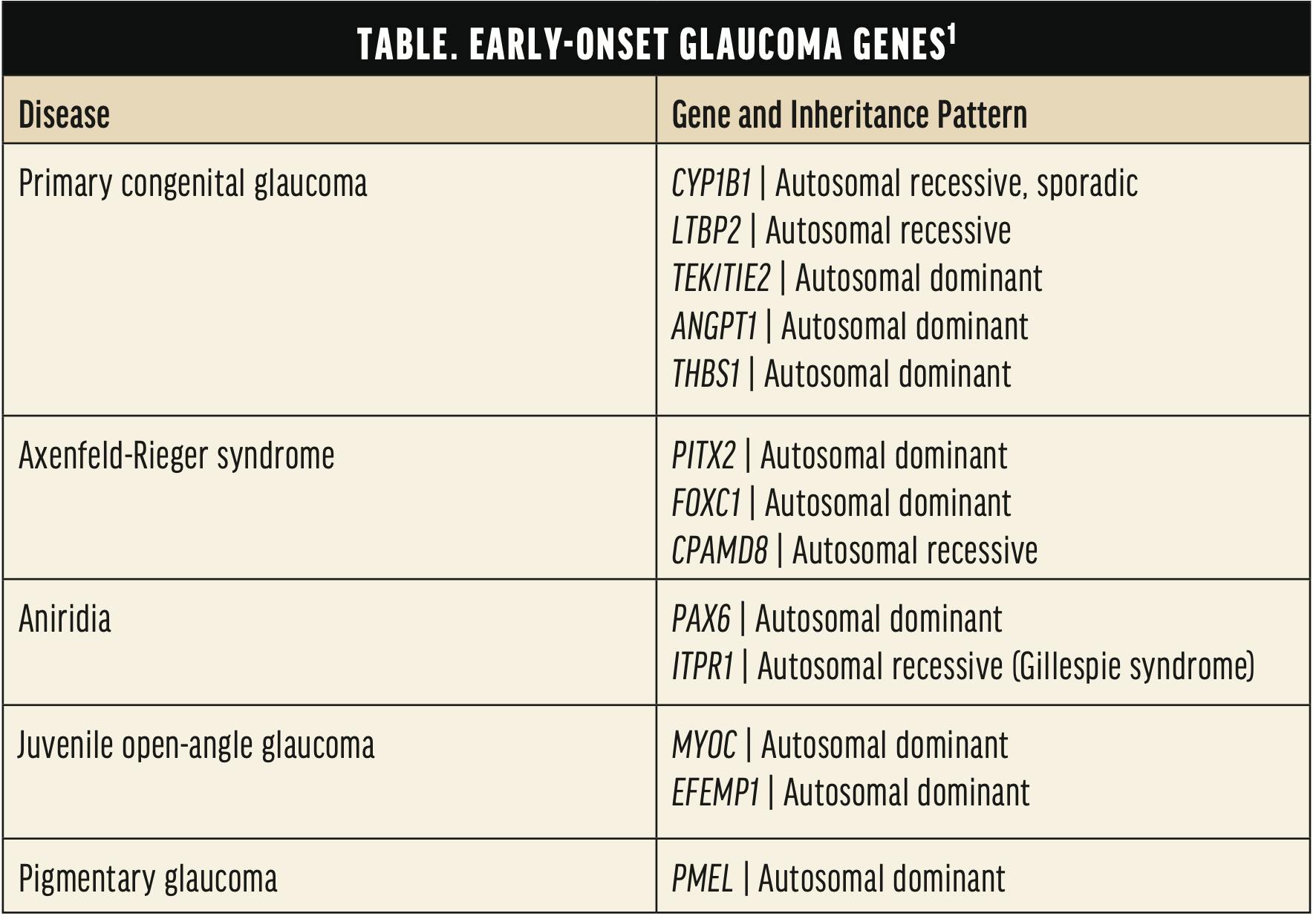
Gene-based panels are already available for most early-onset glaucoma genes. When ordering these tests, it is crucial to ensure that the lab performing them has Clinical Laboratory Improvement Amendments (or CLIA) certification. Referral to a genetic counselor can also be considered to aid in the interpretation of test results.
These tests are also useful for screening first-degree relatives. Carriers of a causal mutation warrant close surveillance, whereas the risk for noncarriers is relatively similar to that of the general population.
The early-onset forms of glaucoma that are caused by single gene mutations may be amenable to targeted therapy in the future. In a study using a mouse model and ex vivo human eyes, for example, CRISPR-Cas9–based gene editing of the juvenile open-angle glaucoma gene myocilin (MYOC) lowered IOP and halted disease progression.2 Such therapies have not yet been tested in human patients, however.
ADULT-ONSET GLAUCOMA
Adult-onset forms of glaucoma (patient age at onset > 40 years) have complex inheritance, with multiple gene variants and gene-environment interactions influencing disease development. More than 120 genes are known to be associated with POAG, 10 genes with primary angle-closure glaucoma, and eight genes with exfoliation glaucoma.
PRSs enable evaluation of the cumulative effect of all glaucoma-associated gene variants in aggregate. Put simply, a glaucoma PRS for a given individual can be calculated by adding up the number of risk alleles they have in all glaucoma-associated genes across the genome. Then, looking at the population distribution of scores, that individual can be classified into a low, medium, or high genetic risk group (Figure).
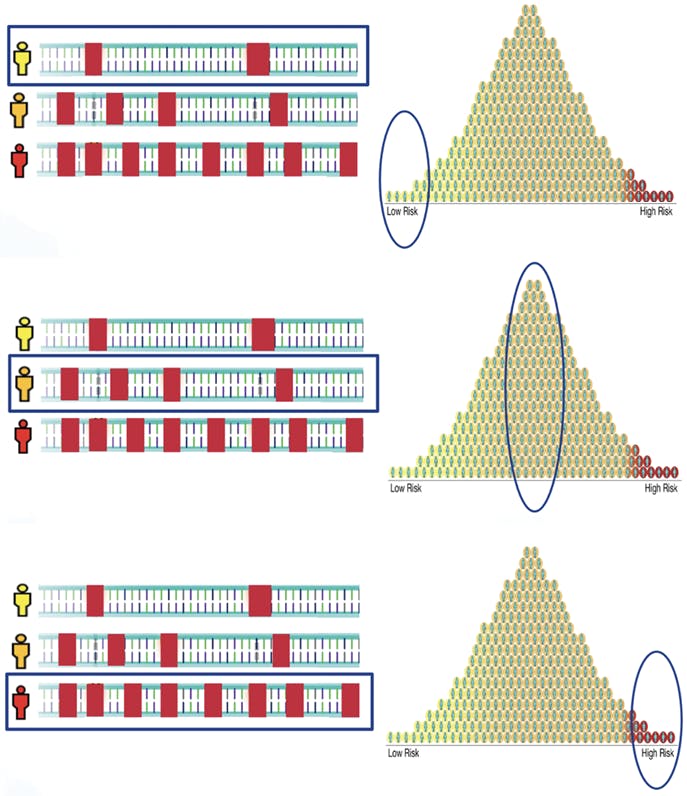
Figure. In simplified terms, a glaucoma PRS for a given individual is calculated by summing the number of risk alleles they have in all glaucoma-associated genes across the genome. Then, looking at the population distribution of scores, a given individual can be classified into a low, medium, or high risk genetic group.
Studies using large datasets with genetic and clinical information have assessed the clinical impact of PRSs for glaucoma. Craig et al3 compared the clinical outcomes among individuals in each decile of PRS and found that those in the highest deciles of genetic risk had higher odds of glaucoma development, earlier age at disease diagnosis, lower retinal nerve fiber layer thickness on OCT, and greater need for incisional surgery. In an Australian cohort of suspect and early glaucoma, a higher PRS for POAG was associated with faster visual field progression4 and earlier initiation and escalation of treatment.5
It is also possible to create "partitioned" PRSs using specific glaucoma-associated genes to assess their clinical impact. Our group recently conducted a study to investigate a mitochondrial PRS consisting of variants in two glaucoma-associated genes that directly influence levels of nicotinamide adenine dinucleotide phosphate (NADP) in the mitochondria.6 Interestingly, nicotinamide also directly functions in this pathway. We found that, among glaucoma cases in the NEIGHBORHOOD Consortium dataset, those in the highest percentile of mitochondrial PRS had higher IOP and a much higher prevalence of paracentral field defects. This suggests that POAG driven by mitochondrial genetic risk may be a distinct disease subtype and, importantly, this subtype may also be particularly amenable to treatment with nicotinamide.

Genetics: Now or Later
Inas Aboobakar, MD
FUTURE DIRECTIONS
Gene panels are already available for early-onset glaucoma and have utility for screening first-degree relatives for a causal mutation. Further, targeted gene therapies that directly address the underlying molecular defect may one day be a reality. For adult-onset glaucoma, PRSs will likely aid in risk stratification in the near future. Characterizing specific genetic drivers for a given patient’s disease may ultimately enable personalized monitoring and therapy.
1. Aboobakar IF, Wiggs JL. The genetics of glaucoma: disease associations, personalised risk assessment and therapeutic opportunities—a review. Clin Exp Ophthalmol. 2022;50(2):143-162.
2. Jain A, Zode G, Kasetti RB, et al. CRISPR-Cas9-based treatment of myocilin-associated glaucoma. Proc Natl Acad Sci U S A. 2017;114(42):11199-11204.
3. Craig JE, Han X, Qassim A, et al. Multitrait analysis of glaucoma identifies new risk loci and enables polygenic prediction of disease susceptibility and progression. Nat Genet. 2020;52(2):160-166.
4. Marshall HN, Mullany S, Han X, et al. High polygenic risk is associated with earlier initiation and escalation of treatment in early primary open-angle glaucoma. Ophthalmology. 2023;130(8):830-836.
5. Siggs OM, Qassim A, Han X, et al. Association of high polygenic risk with visual field worsening despite treatment in early primary open-angle glaucoma. JAMA Ophthalmol. 2022;141(1):73-77.
6. Aboobakar IF, Kinzy TG, Zhao Y, Wiggs JL, et al; NEIGHBORHOOD Consortium. Mitochondrial TXNRD2 and ME3 genetic risk scores are associated with specific primary open-angle glaucoma phenotypes. Ophthalmology. 2023;130(7):756-763.