CASE PRESENTATION
A 34-year-old woman with a history of juvenile open-angle glaucoma (JOAG) presents for a consultation. She is a former patient of mine whom I last saw in 2019 before she moved 6.5 hours away. She has a history of severe glaucoma in her right eye that has been relatively stable since a trabeculectomy I performed when she was 17 years old.
The patient has driven to see me because the IOP in her left eye became elevated after 1 week of treatment with oral steroids and has remained above target since the therapy was discontinued 1 month ago. Her ocular discomfort has also persisted. The IOP has been fluctuating and recently reached a high of 28 mm Hg. She has sought me out because her local doctor chose to wait another month before intervening and the patient is concerned that her vision is getting worse.
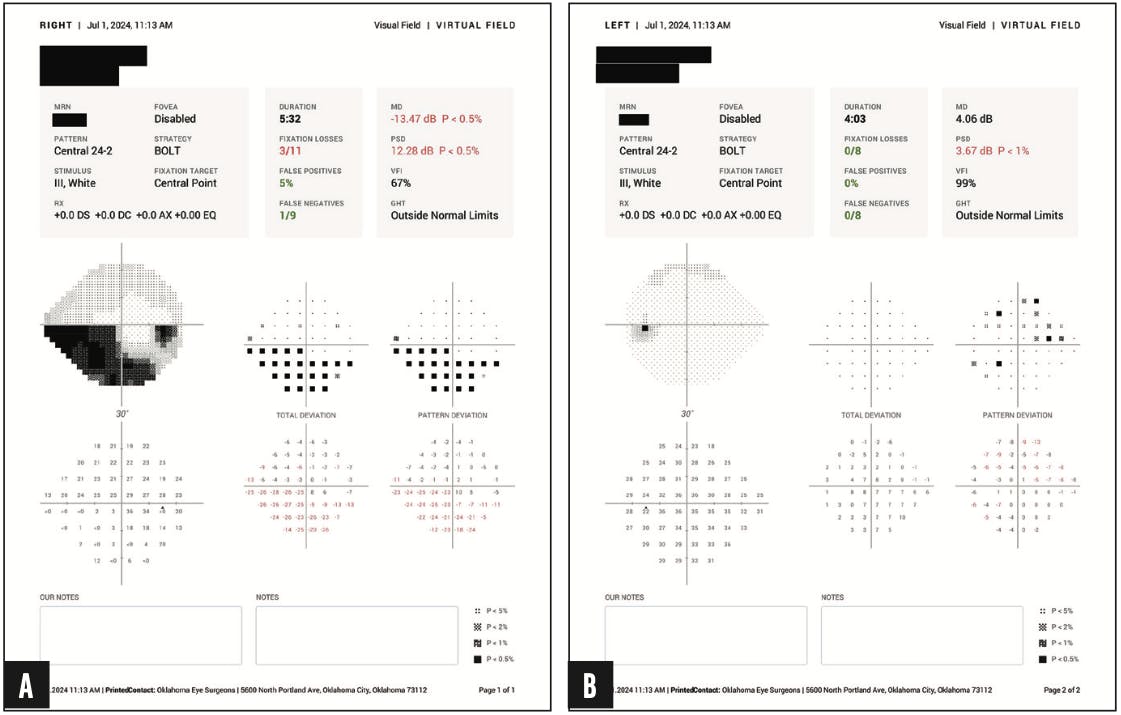
Figure 1. Visual field testing reveals a dense inferior arcuate scotoma in the right eye (A) and new superior field loss in the left eye (B).
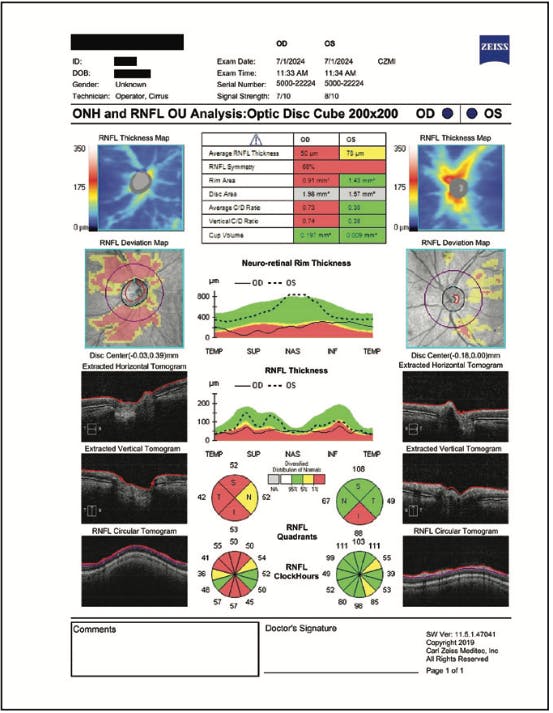
Figure 2. OCT imaging shows stable RNFL thinning in the right eye and inferior RNFL thinning commensurate with the new visual field loss in the left eye.
On examination, her IOP is 20 mm Hg OD and 18 mm Hg OS. Visual field testing shows progression in the left eye from 2019 and matching new retinal nerve fiber layer (RNFL) loss. The right eye exhibits stability, but the IOP is above target for the severity of her glaucoma (Figures 1 and 2). In each eye, the crystalline lens is clear, corneal thickness measurements are normal, the angle is open with a normal iris insertion, and the trabecular meshwork is lightly pigmented.
The patient is historically noncompliant with prescribed topical medical therapy due to intolerability.
How would you proceed with each eye?
—Case prepared by Steven R. Sarkisian Jr, MD
JELLA AN, MD
This young patient has severe but stable glaucoma in her right eye and mild but unstable glaucoma in her left eye. Both eyes are at high risk of disease progression.
Visual field testing would be repeated to ensure that the progression identified on the most recent Humphrey visual field tests (Carl Zeiss Meditec) and OCT scans is reproducible. The reason for her recent treatment with oral steroids and whether she may need future steroid treatment would be clarified. If the therapy was a one-time event and no significant progression is confirmed, a month of observation to allow the steroid effect to wash out fully would be a justifiable approach because her current IOP is within a reasonable range.
Given the patient’s concerns about worsening vision in her better- seeing eye, however, and her history of drug intolerance, strategies to improve her adherence to prescribed medical therapy are critical. Options include selective laser trabeculoplasty (SLT) and the placement of a bimatoprost implant (Durysta, AbbVie) in each eye. If she needs more than one or two medications, however, or a lower target IOP, surgical intervention is likely required to get her off all medications.
The severe disease in the right eye could be addressed through a bleb revision with an antifibrotic agent, whether through in-office needling or open-conjunctival revision in the OR. If a bleb cannot be raised or there are concerns about hypotony, the implantation of a Xen Gel Stent (AbbVie) would be an appropriate alternative.
In the left eye, a standalone angle procedure such as a goniotomy or canaloplasty or a canal-based stent such as the iStent Infinite (Glaukos) or a travoprost intracameral implant 75 µg (iDose TR, Glaukos) could be a reasonable initial approach before more invasive surgical options are considered. Micropulse transscleral laser therapy might serve as a bridge, particularly if the patient is reluctant to undergo incisional surgery or needs a quicker recovery.
LAUREN S. BLIEDEN, MD
This interesting case highlights several avenues for intervention in a unique form of glaucoma—JOAG. There is no question that this young patient needs improved pressure control. The question is how to achieve it without limiting her future options.
The availability of netarsudil ophthalmic solution 0.02%(Rhopressa, Alcon) has influenced my decision-making in cases like this, even when I know a patient cannot tolerate the therapy for the long term. Rho kinase inhibitors target the natural outflow system—the trabecular meshwork and episcleral venous outflow. If this patient responds to treatment with netarsudil, a goniotomy or gonioscopy-assisted transluminal trabeculotomy would be performed on the patient’s worse-seeing right eye first. There is also solid evidence that patients with JOAG, particularly those with MYOC mutations, respond well to angle-based surgery.
If the patient does not respond to netarsudil, then the existing bleb in the right eye would be needled, and adjunctive mitomycin C would be administered. Studies have reported a 70% success rate out to 2 years for bleb needling with an injection of mitomycin C.1,2 This intervention could delay her need for tube shunt surgery. The left eye would be monitored, and I would have a low threshold for proceeding to angle surgery.
EVA DEVIENCE, MD
The JOAG is advanced in the patient’s right eye and moderate in her left eye. Because disease progression occurred in the left eye when the IOP was 18 mm Hg, reasonable adjusted targets would be the low teens in the right eye and midteens in the left eye. Given her age and JOAG severity, the patient may ultimately require a full range of treatment: medication, laser therapy, and incisional surgery.
First, the reasons for the prior intolerability of topical medication would be identified. Might she have success with a preservative-free option such as tafluprost ophthalmic solution 0.0015% (Zioptan, Théa Pharma)?
I would emphasize to the patient that multiple lifelong treatments are likely necessary to prevent further vision loss and blindness. I would encourage her to undergo SLT in the left or both eyes. This procedure can be an effective treatment for steroid-induced glaucoma. If SLT alone does not achieve the target IOP in her right eye, I would consider a MIGS procedure. Given the starting IOP of 20 mm Hg, an iStent Infinite would be an option. It was approved by the FDA as a standalone MIGS device in eyes with OAG uncontrolled by prior incisional surgery or maximum tolerated medical therapy. A clinical trial demonstrated the safety and efficacy of this approach, with the IOP endpoint reached in 73.4% of eyes.3 A goniotomy or canaloplasty with the Omni Surgical System (Sight Sciences) would be reasonable MIGS alternatives.
Options for filtering surgery in the right eye include trabeculectomy revision with antimetabolites or the placement of an Ahmed ClearPath (New World Medical).
WHAT I DID: Steven R. Sarkisian Jr, MD
The patient’s young age and eye pain made this case unique. Pain is rare at these IOP levels. In my experience, however, when it occurs concomitant to elevated IOP and all other sources of pain (ocular surface disease, episcleritis, uveitis, etc.) have been ruled out, it is important to lis- ten to the patient. A doctor’s inability to explain something does not make it untrue.
I also felt that enough time had passed for the patient’s IOP to have stabilized after her brief use of corticosteroids. Adding topical IOP-lowering medications was not an option because of her history of intolerance, and the long distance she must travel to see me made multiple visits impractical. I was concerned, moreover, about her significant loss of optic nerve tissue and visual field decline.
No appropriate MIGS procedures had been available at the time of the trabeculectomy on the patient’s right eye. By this time, however, many options were available. Because there is likely a measure of trabeculodysgenesis in JOAG, a 360º trabeculotomy in this setting can be effective.4
An ab interno goniotomy and viscodilation with the Omni Surgical System were performed in the patient’s left eye almost immediately after the initial evaluation. Her IOP subsequently decreased to 14 mm Hg OS, and her pain disappeared.
One week after surgery, we discussed the options for her better-seeing right eye. Given the success of surgery on her left eye and the risk of hypotony in her right eye posed by bleb revision, she elected to undergo a 360º goniotomy and viscodilation. Postoperatively, the IOP decreased to 12 mm Hg OD.
The patient has maintained IOPs in the low to midteens in both eyes for the several months since surgery, and I plan to monitor her closely. Next steps may include the placement of a sustained-release drug delivery system, and a bleb revision remains an option for the right eye if necessary.
1. Del Noce C, Vagge A, Traverso CE. Bleb needling with mitomycin C as adjunctive therapy in failing blebs: a retrospective study. Ophthalmic Res. 2019;62(1):55-60.
2. Anand N, Khan A. Long-term outcomes of needle revision of trabeculectomy blebs with mitomycin C and 5-fluorouracil: a comparative safety and efficacy report. J Glaucoma. 2009;18(7):513-520.
3. Sarkisian SR Jr, Grover DS, Gallardo MJ, et al; iStent infinite Study Group. Effectiveness and safety of iStent Infinite trabecular micro-bypass for uncontrolled glaucoma. J Glaucoma. 2023;32(1):9-18.
4. Dao JB, Sarkisian SR Jr, Freedman SF. Illuminated microcatheter-facilitated 360-degree trabeculotomy for refractory aphakic and juvenile open-angle glaucoma. J Glaucoma. 2014;23(7):449-454.
_1754918026.png?auto=compress,format)