Home blood glucose meters became widely available in the early 1980s and continuous glucose monitoring systems in the late 1990s, greatly contributing to improved diabetes control and reducing complications from the disease. Continuous IOP monitoring for patients with glaucoma, however, has yet to become routine practice. Technological advances are poised to change this landscape, bringing continuous IOP monitoring closer to becoming a standard of care.
A Groundbreaking System for Continuously Monitoring IOP
More than 70 years after its introduction, the Goldmann applanation tonometer (GAT) remains the gold standard for measuring IOP, but the device has several limitations:
- GAT measurements are influenced by corneal properties;
- Only trained personnel may operate the GAT;
- Patients must visit the office for GAT measurements; and
- GAT readings are isolated snapshots of IOP taken a few times per year.
Although rebound tonometers such as the iCare Home (Icare USA) enable self-monitoring, these instruments are also affected by corneal biomechanics, they can be challenging for some patients to use, and the devices cannot measure habitual IOP continuously, particularly during undisturbed sleep. No widely used instrument reliably measures habitual IOP throughout the day, which limits eye care professionals’ ability to evaluate how well therapy is controlling a patient’s IOP.
The Eyemate system (Implandata Ophthalmic Products) is designed for continuous, long-term monitoring of habitual IOP, offering a unique approach to glaucoma management. The technology has been extensively validated and approved for clinical use in Europe. In 2021, the system received the FDA Breakthrough Device Designation, which recognizes the technology’s potential to provide significant clinical benefits. It has not yet been approved or become commercially available in the United States.
Principle of Operation
The Eyemate system features a bio-compatible microsensor equipped with integrated capacitive pressure sensors designed to measure absolute IOP in mm Hg. The Eyemate-IO microsensor is placed in the ciliary sulcus during cataract surgery, and the Eyemate-SC is placed in the supraciliary space during glaucoma surgery. The implant is intended to remain within the patient’s eye indefinitely.
The microsensor is powered externally, and data are retrieved via a patient-operated radio frequency identification reader. The company plans to integrate radio frequency identification electronics into smart glasses in the future to enable fully automated data acquisition. The Eyemate system transmits IOP measurements to a secure database for storage and analysis, facilitating remote disease monitoring through a dashboard that can be integrated seamlessly into existing electronic health record systems. In the future, patients will be able to monitor their own IOP via a dedicated smartphone app.
Dashboard for Remote Patient Monitoring
To facilitate remote patient monitoring and management, Implandata has developed a pilot version of a browser-based dashboard for the presentation and analysis of IOP and other relevant clinical data (Figure 1). The goal is to help eye care specialists analyze circadian IOP trends on a daily, weekly, monthly, or quarterly basis or for any specified time frame.
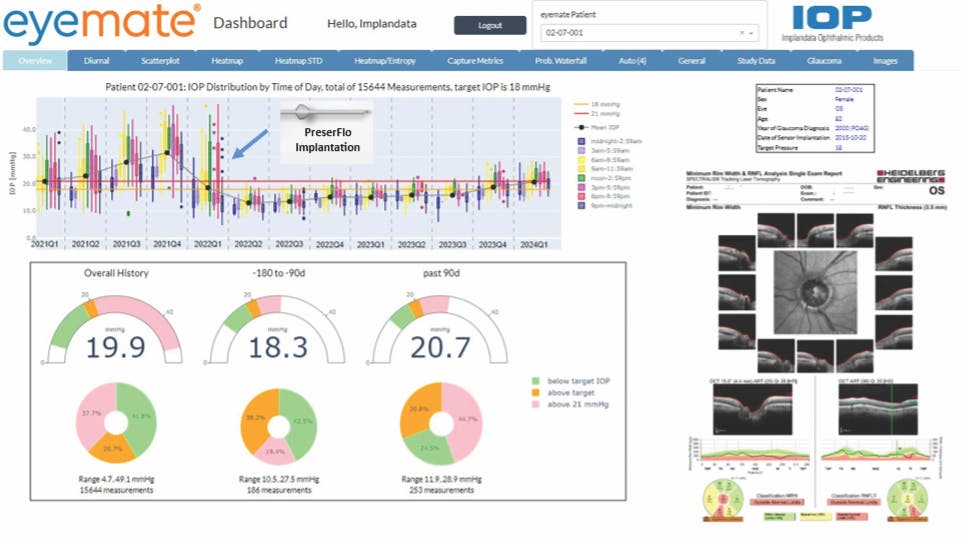
Figure 1. The Eyemate system dashboard presents IOP readings and other relevant clinical data. A graph shows more than 15,600 habitual IOP measurements for a single patient that were collected over a span of 3 years.
The platform can integrate other diagnostic parameters and facilitates the entry of applied therapies. Automated alerts may be set to notify clinicians when a patient’s IOP exceeds target thresholds, signaling that therapy is not effective and allowing timely adjustments to prevent disease progression.
Safety and Performance
Several long-term clinical studies have validated the Eyemate sensor implants. The ARGOS-01, ARGOS-02, and ARGOS-03 studies demonstrated the safety and performance of the Eyemate-IO sulcus sensor.1-4 Long-term studies have also provided compelling safety and performance data for the Eyemate-SC supraciliary sensor.5-7 Additional research has shown that continuous IOP monitoring with the Eyemate system can help improve disease management by providing more IOP data. For instance, patients who are unable to attend regular clinic visits can send their IOP data to their physicians and obtain remote assessment of their disease status. Research performed by my colleagues and I, which has not yet been published, shows that the increased availability of IOP data through the Eyemate system can also predict the risk of glaucoma progression.8-14
Outlook
AI-Assisted Data Processing
Current office-based IOP measurements provide a limited number of data points, whereas the Eyemate system offers thousands—potentially tens of thousands—over time. Implandata is developing advanced AI-assisted data processing to transform the information obtained by the Eyemate system into actionable insights. By integrating IOP measurements with other disease parameters, treatment regimens, and patient behavior, AI could be used to automate and streamline glaucoma management, enhance objectivity, simplify decision-making, and ultimately improve personalized care.
Miniaturized Sensors
Implandata is working to miniaturize the next generation of Eyemate sensors to allow less invasive implantation during a wider range of procedures, including glaucoma, cataract, and corneal surgeries, and possibly permit standalone, injection-based placement (Figure 2). This leap in design could enhance patient comfort and broaden the technology’s applicability.
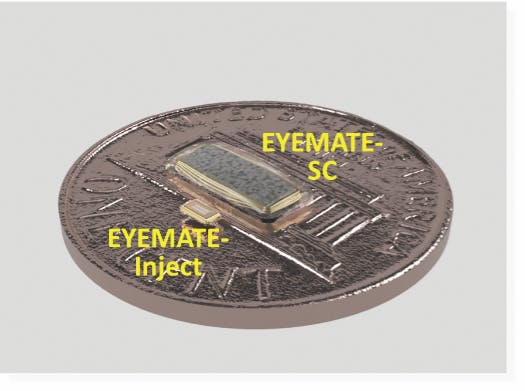
Figure 2. Pictured on a penny are the Eyemate-SC supraciliary implant (right), which has the CE Mark, and the next-generation miniaturized Eyemate-Inject (left).
In addition, thanks to technological advances that enable significant miniaturization of IOP sensors, their integration into glaucoma therapeutic devices or smart IOLs could soon become a reality. The concept of an automated, IOP-responsive, closed-loop therapeutic system—where the sensor triggers a pressure-lowering mechanism via a microvalve or an implantable drug delivery system—no longer seems futuristic.
Conclusion
The Eyemate system represents a potentially transformative advance in the continuous measurement of habitual IOP and remote monitoring of patients with glaucoma. The importance of home-based monitoring for patients with chronic conditions such as diabetes is well established. It is only a matter of time before the benefits of continuous, habitual IOP monitoring are broadly recognized. This breakthrough could transform glaucoma management, enable clinicians to deliver more precise and personalized care, improve patient outcomes, and increase long-term efficiency.
1. Koutsonas A, Walter P, Roessler G, Plange N. Implantation of a novel telemetric intraocular pressure sensor in patients with glaucoma (ARGOS study): 1-year results. Invest Ophthalmol Vis Sci. 2015;56(2):1063-1069.
2. Koutsonas A, Walter P, Roessler G, Plange N. Long-term follow-up after implantation of a telemetric intraocular pressure sensor in patients with glaucoma: a safety report. Clin Exp Ophthalmol. 2018;46(5):473-479.
3. Schmidt I, Plange N, Walter P, Koutsonas A. Telemetric non-contact intraocular pressure monitoring with an implanted sensor in patients with glaucoma: long-term safety report and monitoring data. Br J Ophthalmol. 2023;107(8):1098-1103.
4. Choritz L, Mansouri K, van den Bosch J, et al. Telemetric measurement of intraocular pressure via an implantable pressure sensor-12-month results from the ARGOS-02 Trial. Am J Ophthalmol. 2020;209:187-196.
5. Szurman P, Mansouri K, Dick HB, et al. Safety and performance of a suprachoroidal sensor for telemetric measurement of intraocular pressure in the Eyemate-SC trial. Br J Ophthalmol. 2023;107(4):518-524.
6. Szurman P, Gillmann K, Seuthe AM, et al. Eyemate-SC trial: twelve-month safety, performance, and accuracy of a suprachoroidal sensor for telemetric measurement of intraocular pressure. Ophthalmology. 2023;130(3):304-312.
7. Englisch CN, Boden KT, Szurman P, et al. Long-term astigmatism after intraocular pressure sensor implantation and nonpenetrating glaucoma surgery: Eyemate-SC trial. J Cataract Refract Surg. 2024;50(9):899-905.
8. Rüfer F, Gillmann K, Choritz L, Thieme H, Weinreb RN, Mansouri K. The value of intraocular pressure telemetry in monitoring the therapeutic effect of glaucoma medications. J Glaucoma. 2020;29(6):e38-e40.
9. Mansouri K, Gillmann K, Rao HL, Weinreb RN; ARGOS–2 Study Group. Weekly and seasonal changes of intraocular pressure measured with an implanted intraocular telemetry sensor. Br J Ophthalmol. 2021;105(3):387-391.
10. Mansouri K, Rao HL, Weinreb RN; ARGOS-02 Study Group. Short-term and long-term variability of intraocular pressure measured with an intraocular telemetry sensor in patients with glaucoma. Ophthalmology. 2021;128(2):227-233.
11. Mansouri K, Kersten-Gomez I, Hoffmann EM, Szurman P, Choritz L, Weinreb RN. Intraocular pressure telemetry for managing glaucoma during the COVID-19 pandemic. Ophthalmol Glaucoma. 2021;4(5):447-453.
12. Saxby E, Mansouri K, Tatham AJ. Intraocular pressure monitoring using an intraocular sensor before and after glaucoma surgery. J Glaucoma. 2021;30(10):941-946.
13. Gassel CJ, Dzhelebov DN, Voykov B. Detailed intraocular pressure curve by telemetric tonometry with an implanted pressure sensor before and after PreserFlo MicroShunt implantation: a case report. Ther Adv Ophthalmol. 2023;15:25158414221149927.
14. van den Bosch JJON, Pennisi V, Rao HL, et al. Reproducibility of consecutive automated telemetric noctodiurnal IOP profiles as determined by an intraocular implant. Br J Ophthalmol. 2024;108(11):1527-1534.