From the early days of their medical training, physicians learn the principle to do no harm and are encouraged to avoid conducting invasive procedures unless they are medically necessary. The default approach is, in the absence of an acute emergency, to rely on medical management first before turning to surgery. Since the advent of selective laser trabeculoplasty (SLT), however, the traditional glaucoma treatment paradigm has been shifting.
SLT is being established as a viable, if not preferred, first-line treatment for open-angle glaucoma and ocular hypertension (OHT). The Laser in Glaucoma and Ocular Hypertension (LIGHT) trial is a pivotal study investigating patient outcomes with SLT. Six-year data showed that, compared with IOP-lowering drops, SLT was associated with lower rates of visual field progression, a reduced need for trabeculectomy, and improved scores on the Glaucoma Symptoms Scale.1 SLT is supported by level 1 evidence as a safe and effective method of IOP control as well as a more cost-effective and less burdensome option than drops.2-4
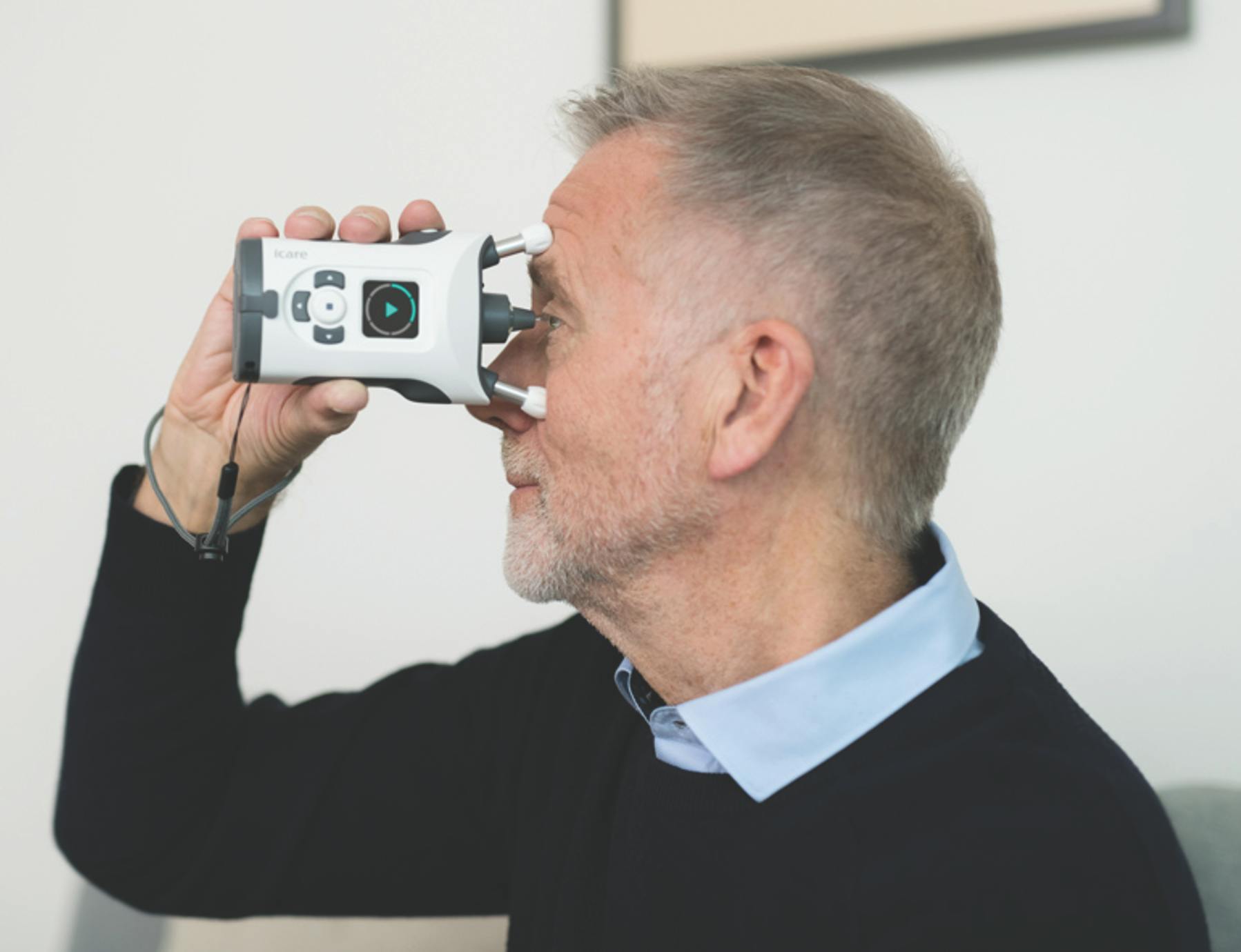
Determining whether an intervention such as SLT effectively improves IOP, however, can be difficult. For example, if a patient’s IOP in the clinic decreases from 24 to 18 mm Hg on timolol therapy but continues to spike in the early morning hours, has their IOP control truly improved? In a retrospective study of patients monitoring their IOP with an iCare Home remote tonometer (Icare USA; Figure 1), IOP spikes occurred outside standard clinic hours (8:00 am–5:00 pm) on 50% of the days assessed. Furthermore, 30% of the self-measured maximum IOP values that patients recorded remotely exceeded their historic maximum values recorded in clinic.5 Studies have found a significant association between short-term IOP fluctuation and visual field progression and have shown that greater diurnal IOP fluctuation is a poor prognostic factor for the development of glaucoma in patients with OHT.6-9 Understanding how SLT affects diurnal fluctuation is therefore an important part of assessing its efficacy.
Diurnal IOP Fluctuation Before and After SLT
In a study conducted at the Moran Eye Center of the University of Utah, 32 patients monitored their IOP with an iCare Home2 tonometer before and after undergoing SLT. Study eyes (n = 52) had been diagnosed with open-angle glaucoma or OHT and were scheduled for a 360º SLT procedure. Within 4 months of their scheduled SLT, patients monitored their IOP for 7 consecutive days at six targeted times: 6:00 am, 9:00 am, 12:00 pm, 3:00 pm, 6:00 pm, and 9:00 am. After SLT, patients repeated the 7 days of measurements at the postoperative 6 week, 3-month, and 6-month timepoints (Figure 2).
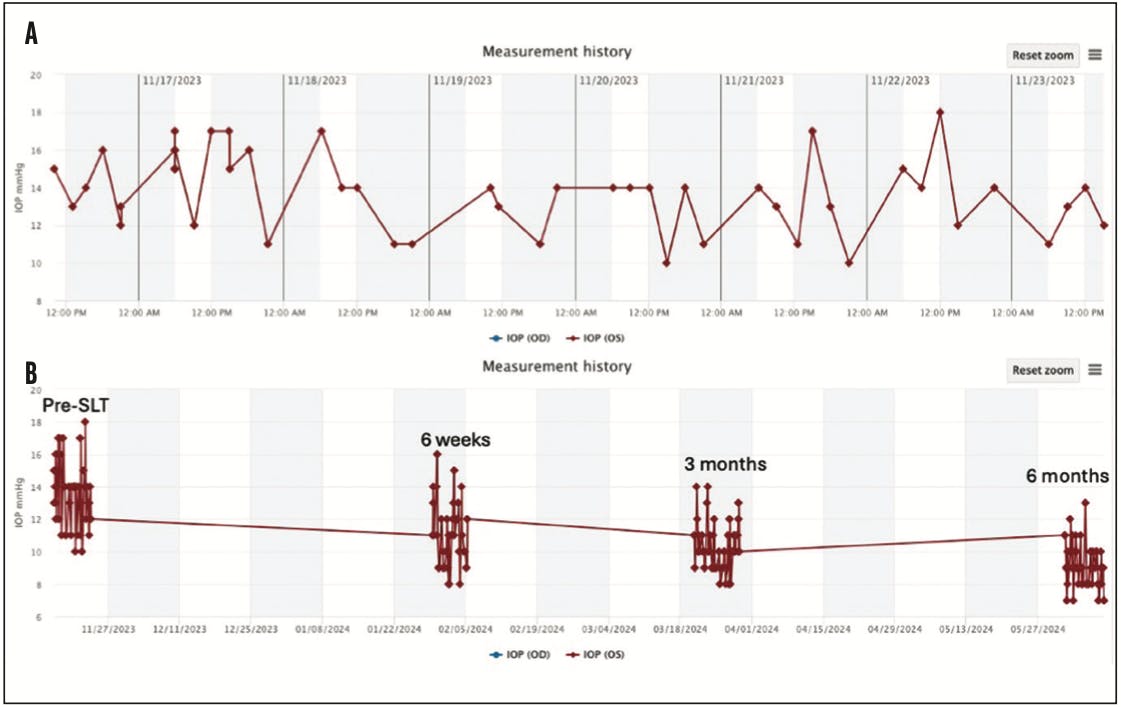
Figure 2. The iCare Home measurements for the left eye of a 71-year-old man with primary open-angle glaucoma. The patient had no history of ocular surgery and was not taking IOP-lowering medication. He underwent SLT in his left eye in December 2023. The patient’s 7-day course of IOP measurements before SLT is shown in (A), where red dots represent individual IOP measurements. His IOP measurements spanning the study course at the pre-SLT and post-SLT (6 weeks, 3 months, and 6 months) timepoints are shown in (B).
IOP-lowering drop regimens remained consistent throughout the study, and a post-SLT regimen of NSAIDs dosed four times daily for 4 days was prescribed. Pre- and post-SLT IOP measurements were compared with respect to the maximum, minimum, mean, range, and standard deviation of measurements taken during the 7-day period.
Overall, SLT resulted in a significantly lower maximum IOP, mean IOP, IOP range, and IOP standard deviation compared to baseline through 6 months postoperatively. Compared with baseline measurements, at 6 months on average, the mean IOP decreased by 1.6 mm Hg (95% CI: -2.2, -1.1), the maximum IOP decreased by 3.4 mm Hg (95% CI: -4.3, -2.5), the IOP range decreased by 2.3 mm Hg (95% CI: -3.2, -1.4), and the standard deviation decreased by 0.48 (-0.66, -0.30). These findings corroborate those of prior studies observing a reduction in IOP fluctuation after SLT,10-12 and they show a sustained IOP-lowering effect with SLT, supporting the LIGHT trial outcomes. Collection of 12-month post-SLT data is underway to determine whether this significant effect persists and when a repeat SLT procedure may be warranted.
Implications of Home Tonometry in Research
The majority (83%) of pre-SLT IOP spikes that occurred in the Moran study (representing the maximum IOP value measured over the 7-day period) were recorded outside standard clinic hours. This trend was also observed by McGlumphy et al5 and suggests that a full picture of patients’ IOP fluctuation is not captured in the clinic.
The literature shows that the iCare Home is relatively easy to use, with studies reporting that, with brief training, 73% to 94% of patients were able to take precise measurements.13 In the Moran study, 96% of patients were able to use the iCare Home2 successfully.
Ultimately, home tonometry devices pave the way for myriad studies that can help guide glaucoma providers, for example, by monitoring IOP fluctuations perioperatively and after various surgical procedures. These studies could benefit providers and patients by offering more immediate and tangible feedback on whether an intervention is successful and providing perspective on how to mitigate future disease progression.
Conclusion
SLT significantly reduces common parameters of IOP fluctuation for at least 6 months postoperatively, rein- forcing the findings from the LIGHT trial that support the use of SLT as a first-line treatment for glaucoma. Home tonometers such as the iCare Home2 can provide valuable information on IOP fluctuation before and after SLT.
1. Gazzard G, Realini T. Selective laser trabeculoplasty: physiology and effects of SLT. In: Gillmann K, Mansouri K, eds. The Science of Glaucoma Management. Elsevier; 2023:209-216.
2. Gazzard G, Konstantakopoulou E, Garway-Heath D, et al. Selective laser trabeculoplasty versus eye drops for first-line treatment of ocular hypertension and glaucoma (LiGHT): a multicentre randomised controlled trial. Lancet. 2019;393(10180):1505-1516.
3. Keenan JD. Cost of selective laser trabeculoplasty vs topical medications for glaucoma. Arch Ophthalmol. 2012;130(4):529.
4. Takusagawa HL, Hoguet A, Sit AJ, et al. Selective laser trabeculoplasty for the treatment of glaucoma. Ophthalmology. 2024;131(1):37-47.
5. McGlumphy EJ, Mihailovic A, Ramulu PY, Johnson TV. Home self-tonometry trials compared with clinic tonometry in patients with glaucoma. Ophthalmol Glaucoma. 2021;4(6):569-580.
6. Cvenkel B, Atanasovska Velkovska M. Self-monitoring of intraocular pressure using Icare Home tonometry in clinical practice. Clin Ophthalmol. 2019;13:841-847.
7. Matlach J, Bender S, König J, Binder H, Pfeiffer N, Hoffmann EM. Investigation of intraocular pressure fluctuation as a risk factor of glaucoma progression. Clin Ophthalmol. 2018;13:9-16.
8. Asrani S, Zeimer R, Wilensky J, Gieser D, Vitale S, Lindenmuth K. Large diurnal fluctuations in intraocular pressure are an independent risk factor in patients with glaucoma. J Glaucoma. 2000;9(2):134-142.
9. Grippo TM, Liu JHK, Zebardast N, Arnold TB, Moore GH, Weinreb RN. Twenty- four–hour pattern of intraocular pressure in untreated patients with ocular hypertension. Invest Ophthalmol Vis Sci. 2013;54(1):512.
10. Awadalla MS, Qassim A, Hassall M, Nguyen TT, Landers J, Craig JE. Using Icare Home tonometry for follow‐up of patients with open‐angle glaucoma before and after selective laser trabeculoplasty. Clin Exp Ophthalmol. 2020;48(3):328-333.
11. Lee JWY, Fu L, Chan JCH, Lai JSM. Twenty-four-hour intraocular pressure related changes following adjuvant selective laser trabeculoplasty for normal tension glaucoma. Medicine (Baltimore). 2014;93(27):e238.
12. Nagar M, Luhishi E, Shah N. Intraocular pressure control and fluctuation: the effect of treatment with selective laser trabeculoplasty. Br J Ophthalmol. 2009;93(4):497-501.
13. Liu J, De Francesco T, Schlenker M, Ahmed II. Icare Home tonometer: a review of characteristics and clinical utility. Clin Ophthalmol. 2020;14:4031-4045.