When I decided to pursue training in ophthalmology, my father (a professor of internal medicine at McGill University) urged me to continue to read the general medical literature. Only by doing so, he advised, could I remain aware of the trends across medicine that might impact my own field. Because of him, every week I read the table of contents, commentaries, and abstracts of the Journal of the American Medical Association (JAMA) and the New England Journal of Medicine.
Over the past 2 decades, medicine has begun to focus on the linked problems of overdiagnosis and overtreatment—concepts that have largely been ignored by ophthalmology. I believe it is time we start paying attention to these issues before they overtake our field.
OVERDIAGNOSIS AND OVERTREATMENT: DEFINITIONS, DRIVERS, AND EXAMPLES
The term overdiagnosis refers to the diagnosis of a condition that, if unrecognized, would not cause symptoms in or harm a patient during their lifetime. The term overtreatment refers to interventions that do not benefit the patient or that pose a risk of harm likely to outweigh any benefit that the patient might receive.
Broad concerns about overdiagnosis and overtreatment emerged about 25 years ago, first in oncology but eventually across medicine. In 2010, Welch and Black1 performed a meta-analysis of large cancer trials and estimated a rate of overdiagnosis of prostate cancer as high as 60% when based on serum prostate-specific antigen testing.
Perhaps the best-documented story of overdiagnosis and overtreatment comes from Korea, where in 1999 cancer screening was added as a benefit to the country’s single-payer system. Thyroid cancer screening was not part of this program, but some providers began offering thyroid scans for a small copay. The incidence of thyroid cancer subsequently rose in the regions with a high penetration of ultrasound-based screening.2,3 Nearly 95% of the increase, however, was attributed to small asymptomatic tumors, yet many of these patients underwent thyroidectomy. The wider use of more sensitive screening technologies had no impact on cancer mortality in the Korean population over the subsequent decades.
Many drivers of overdiagnosis and overtreatment have been identified across medicine. Those relevant to glaucoma are the changing and broadening of disease definitions, increasingly sensitive diagnostic technologies, as in the example from Korea, and a failure of clinicians to recognize the low benefit of treatment or the adverse impact of treatment on patients’ quality of life and well-being.
Simply changing the definition of a disease affects the number of patients who are subjected to a new diagnosis and treatment. In the United States, the prevalence of diabetes, hypertension, hyperlipidemia, and osteoporosis exploded after expert groups changed the diagnostic criteria for these disorders (Table).4
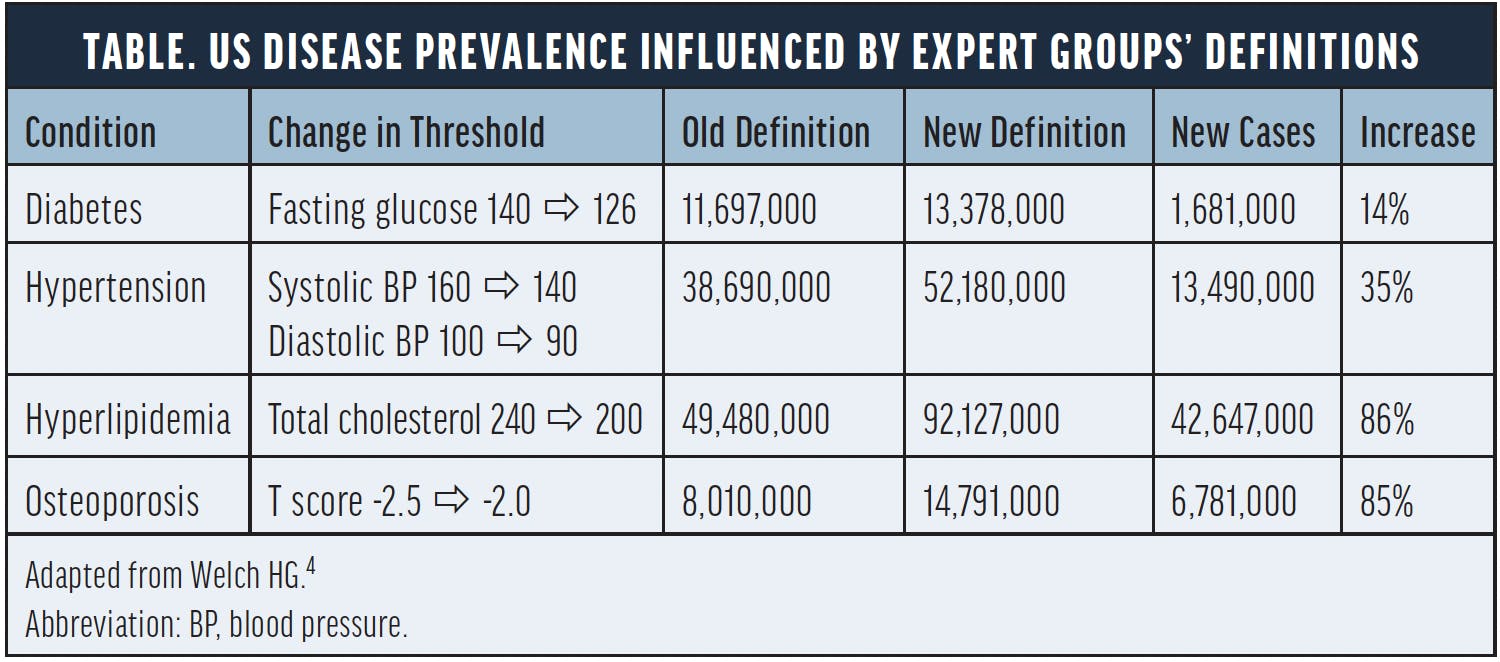
Additionally, simply changing the cutoffs for diagnosing actionable hypertension increased the population for whom treatment was indicated by more than 35%.5 A more recent analysis showed that changes in blood pressure cutoffs for treatment drove a dramatic increase in the number of US adults being treated.6 At the same time, increasingly aggressive treatment goals caused more patients to experience iatrogenic hypotension, which we deal with as ophthalmologists caring for individuals with normal-tension glaucoma.
Analogous to the impact of central corneal thickness on tonometry and thus glaucoma screening,7,8 Ishigami et al9 recently showed that blood pressure cuff size is an important confounder of sphygomanometry—something long known but rarely considered in routine clinical practice. The use of a standard-sized cuff in large individuals was found to result in an overestimation of blood pressure of nearly 20 mm Hg. Are many thousands, perhaps millions, being overtreated for systemic hypertension? Probably.
The OVERDIAGNOSIS OF GLAUCOMA
To date, only one article on the overdiagnosis of glaucoma at the patient level has been published.10 In this 2018 investigation, ophthalmologists conducted a cross-sectional population-based survey of incident eye disease in northern Greece. Of the patients who reported receiving a prior diagnosis of glaucoma (n = 57), 60% (n = 34) were overdiagnosed. Nearly two-thirds of patients (n = 20), however, were being treated with IOP-lowering medications, 15% (n = 5) had undergone laser therapy, and 24% (n = 8) had undergone incisional glaucoma surgery.
Although it is difficult to develop a consensus on when to start glaucoma treatment, it is unlikely that every patient with ocular hypertension (OHT) or preperimetric disease must start treatment immediately. We have good risk models to identify those who will not benefit from treatment, yet few clinicians are using them.
The landmark Ocular Hypertension Treatment Study (OHTS)11 was designed to answer two fundamental questions in glaucoma:
1. Are topical ocular hypotensive medications safe and effective in preventing or delaying the onset of visual field loss and/or optic nerve damage in patients with OHT at moderate risk of developing primary open-angle glaucoma (POAG)?
2. Is it possible to identify baseline factors that predict which patients with OHT are most likely to develop visual field loss and/or optic nerve damage due to POAG?
The OHTS proceeded in three phases: OHTS 1 (1994–2002), OHTS 2 (2002–2009), and OHTS 3 (2016–2019). Preliminary answers to the questions outlined earlier came at the end of OHTS 1. The investigators concluded that the risk of developing POAG over 5 years was reduced by nearly 60% among patients randomly assigned to receive medication12 and baseline predictive factors, most notably central corneal thickness, were able to identify those patients at highest risk of developing glaucomatous visual field loss and/or optic nerve damage.13 The original OHTS risk model was externally validated using the placebo group of the European Glaucoma Prevention Study (EGPS), and the two studies’ data were then merged to create the current OHTS-EGPS model.14 Thus, OHTS 1 confirmed that medications reduced the risk of POAG and provided validated tools to identify the patients most likely to benefit from treatment.
In OHTS 2, patients in the original observation group were offered treatment. The investigators found that this group paid little penalty for a 5-year delay in treatment. Further, the predictive model was validated out to 10 years and showed clearly that the highest-risk patients reaped the greatest benefit from treatment, intermediate-risk patients received a marginal benefit, and lowest-risk patients experienced no benefit.15
In OHTS 3, it was determined that most patients (75%) did not develop visual field loss during 2 decades of follow-up. Furthermore, the OHTS-EGPS prediction model performed well in stratifying risk, and the benefit of treatment was confirmed to be greatest in the high-risk group.16,17
The original OHTS-EGPS prediction model was based on baseline measurements among the observation (unmedicated) patients, and it was highly accurate in predicting the observed outcomes. Could the same five-component model use treated IOP to predict a patient’s future risk continuously? Leshno et al18 recently showed that using the treated IOP among the medicated patients in the OHTS was useful in predicting disease progression and mirrored the value of the original model. This has implications for real-time, dynamically updated, ongoing decision support built into electronic health record (EHR) systems.
The OHTS-EGPS model has excellent positive predictive value (PPV) for identifying increased risk among patients, but what about the model’s negative predictive value (NPV)? Could the model help identify patients who do not have glaucoma or who are at such low risk that they do not need to be treated or excessively monitored? Many practices are filled with patients who follow up regularly for years for glaucoma surveillance yet are extremely unlikely to develop glaucoma-related disability during their lifetime. With the early detection of preperimetric damage enhanced by increasingly sensitive imaging, that figure is growing.
Information about the overdiagnosis of glaucoma in the United States is sparse. The Sight Outcomes Research Collaborative (SOURCE) is a collaboration of academic centers that share EHR data as well as structural and functional data from OCT imaging and visual field testing. Recently, approximately 2,200 eyes were identified in SOURCE as having diagnosed OHT and were linked to all five components of the OHTS-EGS predictive model. Nearly 25% of patients in the lowest-risk group were receiving treatment, and, worryingly, nearly 50% of patients in the highest-risk group were not (data shared by Joshua D. Stein, MD, MS, in January 2024). It is apparent that clinicians are not using the guidelines from OHTS and other studies. As more imaging and visual field information is entered into SOURCE, the ability to quantify these data and understand what drives clinician behavior should improve.
THE ADVERSE IMPACT OF THE OVERTREATMENT AND OVERDIAGNOSIS OF GLAUCOMA
Overdiagnosis and overtreatment have consequences not only for patients but also for medical practices and health care systems. Many ophthalmology practices are filled with the “worried well”—patients who either do not have glaucoma or are being monitored intensively for preperimetric disease unlikely to lead to disability during their lifetime. This trend of overtesting, overdiagnosis, and overtreatment uses resources that could be better used elsewhere, and policymakers are paying attention.
At the patient level, the true impact of overdiagnosis includes not only cost and side effects but also anxiety and depression. Fear of blindness can be triggered just by hearing the word glaucoma. In a survey-based study of nearly 600 patients, Odberg et al found that more than 80% of respondents experienced negative emotions upon learning that they had glaucoma.19,20 One-third of patients were afraid of going blind, even though most had normal binocular visual fields. About 70% of patients believed they would go blind if their glaucoma was not treated.
ADDRESSING the OVERDIAGNOSIS AND OVERTREATMENT OF GLAUCOMA
Digital overdiagnosis is increasingly recognized across medicine as a problem that will worsen in the era of home-based testing.21,22 The glaucoma space will be dealing with this soon enough with home tonometry, perimetry, and someday optic nerve imaging. In my opinion, there are several ways in which clinicians and researchers can begin to address the growing problems of the overdiagnosis and overtreatment of glaucoma before we are overwhelmed with more of the “worried well” filling our clinics and offices.
Study the Overdiagnosis of Glaucoma
The overdiagnosis of glaucoma must be better studied. Over the past 2 decades, more than 6,000 articles on overdiagnosis across medicine have been published, but only one studies the problem in glaucoma.10 The growth of datasets such as SOURCE and others that integrate EHR data with structural and functional data is opening a window that should help us quantify and understand the problem and its drivers.
Educate Colleagues and Trainees
Once the scope and drivers of overdiagnosis in glaucoma are better understood, it will be important to educate clinicians on the subject, as other fields of medicine have done. In 2012, the American Board of Internal Medicine launched the Choosing Wisely initiative to advance dialogue on how to avoid unnecessary testing and procedures. Additionally, the Less Is More series was launched by JAMA Internal Medicine to document the ways that the overuse of medical care fails to improve outcomes, harms patients, and wastes resources.
Evidence-based initiatives by medical societies can also make a difference. In 2014, a coalition of Korean medical and surgical societies urged providers to stop unnecessary screening for thyroid cancer. This initiative quickly reduced the number of unnecessary thyroidectomies and had no impact on thyroid cancer mortality.23
Improve Glaucoma Risk Models
Another initiative to reduce the overdiagnosis and overtreatment of glaucoma involves improving the NPV of risk models by incorporating genomics in the form of polygenic risk scores (PRSs). In oncology, PRS-based stratification is used to focus resources on patients with high PRSs and simply monitor those with low PRSs; this is now an established approach in screening for thyroid,24 breast,25 and lung26 cancers. We should do the same in ophthalmology.
In glaucoma, a high burden of POAG risk variants (thus a high PRS) has been shown to lead to earlier disease onset and severity, is associated with the earlier initiation of treatment in mild disease, and helps identify patients at greater risk of rapidly progressing disease.27-30
In an investigation of 1,056 patients from the OHTS, Singh et al found that a high PRS increased the risk of conversion to glaucoma during the 20 years of follow-up31; combining PRSs with the OHTS model improved the prediction of disease onset in the OHTS cohort over 2 decades. Recently, Sekimitsu and colleagues found that adding PRSs to the OHTS model significantly improved its NPV,32 highlighting the potential to use PRSs to not only identify high-risk patients but also to reduce overdiagnosis and overtreatment among glaucoma suspects and patients with OHT.
Develop and Deploy Real-Time Decision Support
Ultimately, it will be essential to develop and deploy real-time decision support to integrate all clinical, functional, structural, and genomic data and better distinguish which patients require close observation and treatment. Clinician demand can help encourage diagnostic and EHR companies to expedite the development and deployment of these capabilities.
CONCLUSION
Overdiagnosis and overtreatment are growing problems in glaucoma. Other fields of medicine have stopped regarding every patient as a disease suspect and scaled back unnecessary treatment. Given that many patients with OHT and early disease are unlikely to be impaired by glaucoma in their lifetime, it would be wise for the glaucoma community to consider adopting a similar approach. Without proper attention to these problems and appropriate guidance on their solutions, greater forces in medicine will come calling.
1. Welch HG, Black WC. Overdiagnosis in cancer. J Natl Cancer Inst. 2010;102(9):605-613. doi:10.1093/jnci/djq099
2. Ahn HS, Kim HJ, Welch HG. Korea’s thyroid-cancer “epidemic”—screening and overdiagnosis. N Engl J Med. 2014;371(19):1765-1767. doi:10.1056/NEJMp1409841
3. Park S, Oh C-M, Cho H, et al. Association between screening and the thyroid cancer “epidemic” in South Korea: evidence from a nationwide study. BMJ. 2016;355:i5745. doi:10.1136/bmj.i5745
4. Welch HG, Schwartz L, Woloshin S. Overdiagnosed: Making People Sick in the Pursuit of Health. 1st ed. Beacon Press; 2011:248.
5. Bell KJL, Doust J, Glasziou P. Incremental benefits and harms of the 2017 American College of Cardiology/American Heart Association high blood pressure guideline. JAMA Intern Med. 2018;178(6):755-757. doi:10.1001/jamainternmed.2018.0310
6. Doust JA, Bell KJL, Glasziou PP. Potential consequences of changing disease classifications. JAMA. 2020;323(10):921-922. doi:10.1001/jama.2019.22373
7. Brandt JD. Central corneal thickness, tonometry, and glaucoma risk—a guide for the perplexed. Can J Ophthalmol. 2007;42(4):562-566. doi:10.3129/can.j.ophthalmol.i07-095
8. Brandt JD, Beiser JA, Kass MA, Gordon MO. Central corneal thickness in the Ocular Hypertension Treatment Study (OHTS). Ophthalmology. 2001;108(10):1779-1788. doi:10.1016/s0161-6420(01)00760-6
9. Ishigami J, Charleston J, Miller ER, Matsushita K, Appel LJ, Brady TM. Effects of cuff size on the accuracy of blood pressure readings: the cuff(sz) randomized crossover trial. JAMA Intern Med. 2023;183(10):1061-1068. doi:10.1001/jamainternmed.2023.3264
10. Founti P, Coleman AL, Wilson MR, et al. Overdiagnosis of open-angle glaucoma in the general population: the Thessaloniki Eye Study. Acta Opththalmol. 2018;96(7):e859-e864. doi:10.1111/aos.13758
11. Gordon MO, Kass MA. The Ocular Hypertension Treatment Study: design and baseline description of the participants. Arch Ophthalmol. 1999;117(5):573-583. doi:10.1001/archopht.117.5.573
12. Kass MA, Heuer DK, Higginbotham EJ, et al. The Ocular Hypertension Treatment Study: a randomized trial determines that topical ocular hypotensive medication delays or prevents the onset of primary open-angle glaucoma. Arch Ophthalmol. 2002;120(6):701-713; discussion 829. doi:10.1001/archopht.120.6.701
13. Gordon MO, Beiser JA, Brandt JD, et al. The Ocular Hypertension Treatment Study: baseline factors that predict the onset of primary open-angle glaucoma. Arch Ophthalmol. 2002;120(6):714-720; discussion 829. doi:10.1001/archopht.120.6.714
14. Ocular Hypertension Treatment Study Group; European Glaucoma Prevention Study Group; Gordon MO, Torri V, Miglior S, et al. Validated prediction model for the development of primary open-angle glaucoma in individuals with ocular hypertension. Ophthalmology. 2007;114(1):10-19. doi:10.1016/j.ophtha.2006.08.031
15. Kass MA, Gordon MO, Gao F, et al. Delaying treatment of ocular hypertension: the ocular hypertension treatment study. Arch Ophthalmol. 2010;128(3):276-287. doi:10.1001/archophthalmol.2010.20
16. Kass MA, Heuer DK, Higginbotham EJ, et al. Assessment of cumulative incidence and severity of primary open-angle glaucoma among participants in the Ocular Hypertension Treatment Study after 20 years of follow-up. JAMA Ophthalmol. 2021;139(5):558. doi:10.1001/jamaophthalmol.2021.0341
17. Gordon MO, Heuer DK, Higginbotham EJ, et al. Visual field progression in the Ocular Hypertension Treatment Study. Am J Ophthalmol. 2025;271:360-370. doi:10.1016/j.ajo.2024.11.017
18. Leshno A, De Moraes CG, Cioffi GA, Kass M, Gordon M, Liebmann JM. Risk calculation in the medication arm of the Ocular Hypertension Treatment Study. Ophthalmol Glaucoma. 2023;6(6):592-598. doi:10.1016/j.ogla.2023.06.005
19. Odberg T, Jakobsen JE, Hultgren SJ, Halseide R. The impact of glaucoma on the quality of life of patients in Norway. I. Results from a self-administered questionnaire. Acta Ophthalmol Scand. 2001;79(2):116-120.
20. Odberg T, Jakobsen JE, Hultgren SJ, Halseide R. The impact of glaucoma on the quality of life of patients in Norway. II. Patient response correlated to objective data. Acta Ophthalmol Scand. 2001;79(2):121-124. doi:10.1034/j.1600-0420.2001.079002121.x
21. Capurro D, Coghlan S, Pires DEV. Preventing digital overdiagnosis. JAMA. 2022;327(6):525-526. doi:10.1001/jama.2021.22969
22. Armstrong N. Overdiagnosis and overtreatment as a quality problem: insights from healthcare improvement research. BMJ Qual Saf. 2018;27(7):571-575. doi:10.1136/bmjqs-2017-007571
23. Ahn HS, Welch HG. South Korea’s thyroid-cancer “epidemic”—turning the tide. N Engl J Med. 2015;373(24):2389-2390. doi:10.1056/NEJMc1507622
24. Pozdeyev N, Dighe M, Barrio M, et al. Thyroid cancer polygenic risk score improves classification of thyroid nodules as benign or malignant. J Clin Endocrinol Metab. 2024;109(2):402-412. doi:10.1210/clinem/dgad530
25. Roberts E, Howell S, Evans DG. Polygenic risk scores and breast cancer risk prediction. Breast. 2023;67:71-77. doi:10.1016/j.breast.2023.01.003
26. Duncan MS, Diaz-Zabala H, Jaworski J, et al. Interaction between continuous pack-years smoked and polygenic risk score on lung cancer risk: prospective results from the Framingham Heart Study. Cancer Epidemiol Biomarkers Prev. 2024;33(4):500-508. doi:10.1158/1055-9965.EPI-23-0571
27. Fan BJ, Bailey JC, Igo RP, et al. Association of a primary open-angle glaucoma genetic risk score with earlier age at diagnosis. JAMA Ophthalmol. 2019;137(10):1190-1194. doi:10.1001/jamaophthalmol.2019.3109
28. Craig JE, Han X, Qassim A, et al. Multitrait analysis of glaucoma identifies new risk loci and enables polygenic prediction of disease susceptibility and progression. Nat Genet. 2020;52(2):160-166. doi:10.1038/s41588-019-0556-y
29. Marshall HN, Mullany S, Han X, et al. High polygenic risk is associated with earlier initiation and escalation of treatment in early primary open-angle glaucoma. Ophthalmology. 2023;130(8):830-836. doi:10.1016/j.ophtha.2023.03.028
30. Marshall HN, Hollitt GL, Wilckens K, et al. High polygenic risk is associated with earlier trabeculectomy in patients with primary open-angle glaucoma. Ophthalmol Glaucoma. 2023;6(1):54-57. doi:10.1016/j.ogla.2022.06.009
31. Singh RK, Zhao Y, Elze T, et al. Polygenic risk scores for glaucoma onset in the Ocular Hypertension Treatment Study. JAMA Ophthalmol. 2024;142(4):356-363. doi:10.1001/jamaophthalmol.2024.0151
32. Sekimitsu S, Ghazal N, Aziz K, et al. Primary open-angle glaucoma polygenic risk score and risk of disease onset: a post hoc analysis of a randomized clinical trial. JAMA Ophthalmol. 2024;142(12):1132-1139. doi:10.1001/jamaophthalmol.2024.4376