Bleeding is a vexing challenge that can arise during angle-based glaucoma procedures. This article suggests surgical approaches to preventing and navigating the complication.
‘GOOD’ HEME/'BAD’ HEME
It is not uncommon for blood thinners to be considered a relative contraindication for MIGS. The presumption is that anticoagulants increase the risk of hemorrhagic complications. However, in a recent retrospective study, Shalaby et al found that antithrombotic therapy did not increase the risk of a hemorrhagic complication in patients who underwent the placement of an iStent (Glaukos) or Hydrus Microstent (Alcon).1
With these findings in mind, it may be useful to distinguish between “good” heme and “bad” heme. Good heme refers to the desired heme reflux that occurs within Schlemm canal. Whether they involve stripping the trabecular meshwork or placing a microshunt, the goal of angle procedures is to create a pathway to minimize resistance to episcleral venous flow. As such, a modest amount of heme reflux is anticipated and even desired because it confirms appropriate treatment positioning.
Bad heme occurs when surgery inadvertently disrupts tissue other than the trabecular meshwork, including the ciliary body or iris. Such tissue damage may be a product of poor intraoperative visualization (ie, inadequate en face view, corneal edema if performed after cataract removal, etc), poor anterior chamber maintenance, wound construction/placement, or other factors.
The good heme/bad heme framework may help surgeons better contextualize the following tips for managing intraoperative bleeding in angle procedures.
POSITIONING
Reverse Trendelenburg
Patient positioning is one factor to consider. A simple method by which to limit intraoperative (or postoperative) heme reflux is the reverse Trendelenburg position. The patient is supine, and the operating table is tilted so that their head is elevated higher than their feet. This nondependent position limits gravity’s influence on retrograde venous blood flow.
Anterior Chamber Shallowing Prevention
Surgical instrument positioning is another factor to consider. A general principle that facilitates consistent chamber maintenance is to operate in the iris plane. Keeping all instrumentation parallel to the iris helps the surgeon avoid burping OVD (ie, by pressing too firmly on the anterior or posterior wound lip) and thereby reduces the amount of heme reflux that can occur when the IOP decreases. Care must be taken to minimize pressure from the gonioprism, often controlled by the nondominant hand, to avoid similar OVD loss.
OVD UTILIZATION
Sideways Softshell Technique
Angle-based procedures are often performed in combination with cataract surgery. For this reason, surgeons may tend to use a dispersive OVD alone if performing the angle procedure before cataract removal. A softshell technique can both protect the corneal endothelium and tamponade any heme reflux that may occur during angle-based surgery. With a standard softshell technique, however, gonioscopic visualization may be distorted by the interface between the two OVDs. A sideways softshell technique can avoid this problem.
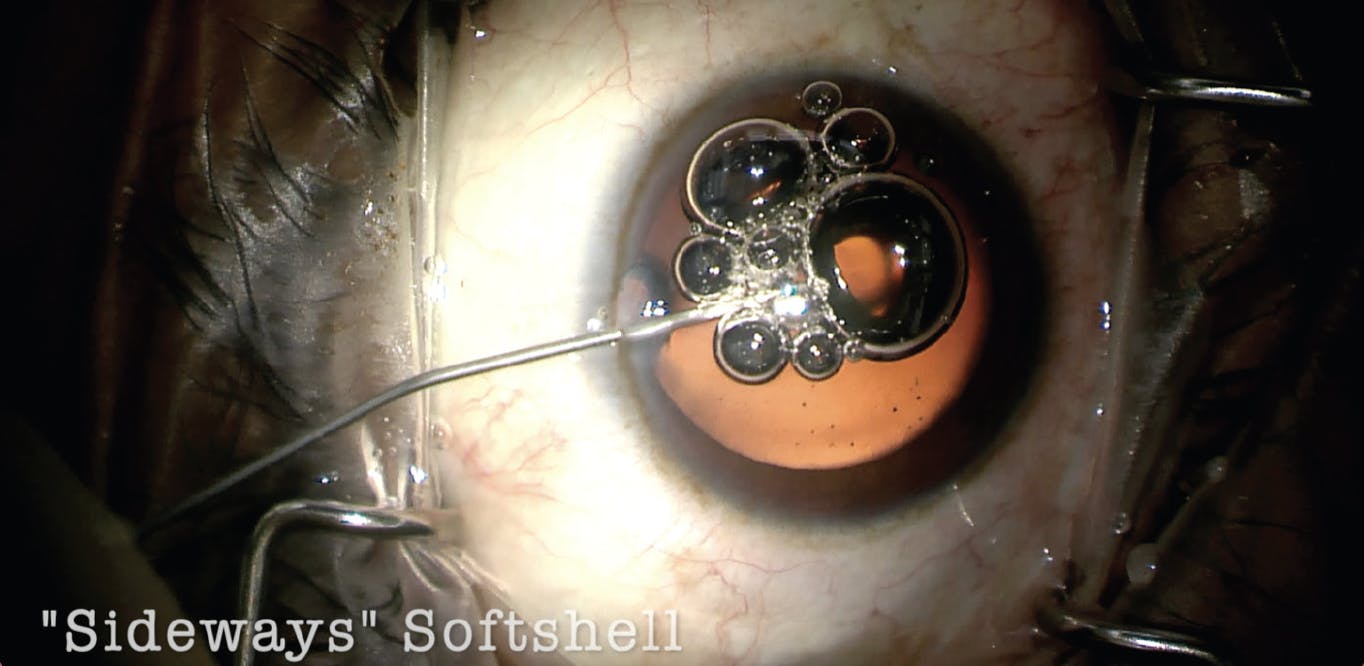
First, the anterior chamber is partially filled with a dispersive OVD. Then, a bolus of a cohesive OVD is instilled in the nasal angle. As shown in the videos, no disruptive interface is seen at the junction of the two OVDs with this technique, and heme tamponade is achieved by the cohesive OVD.
Cohesive OVD Sweep
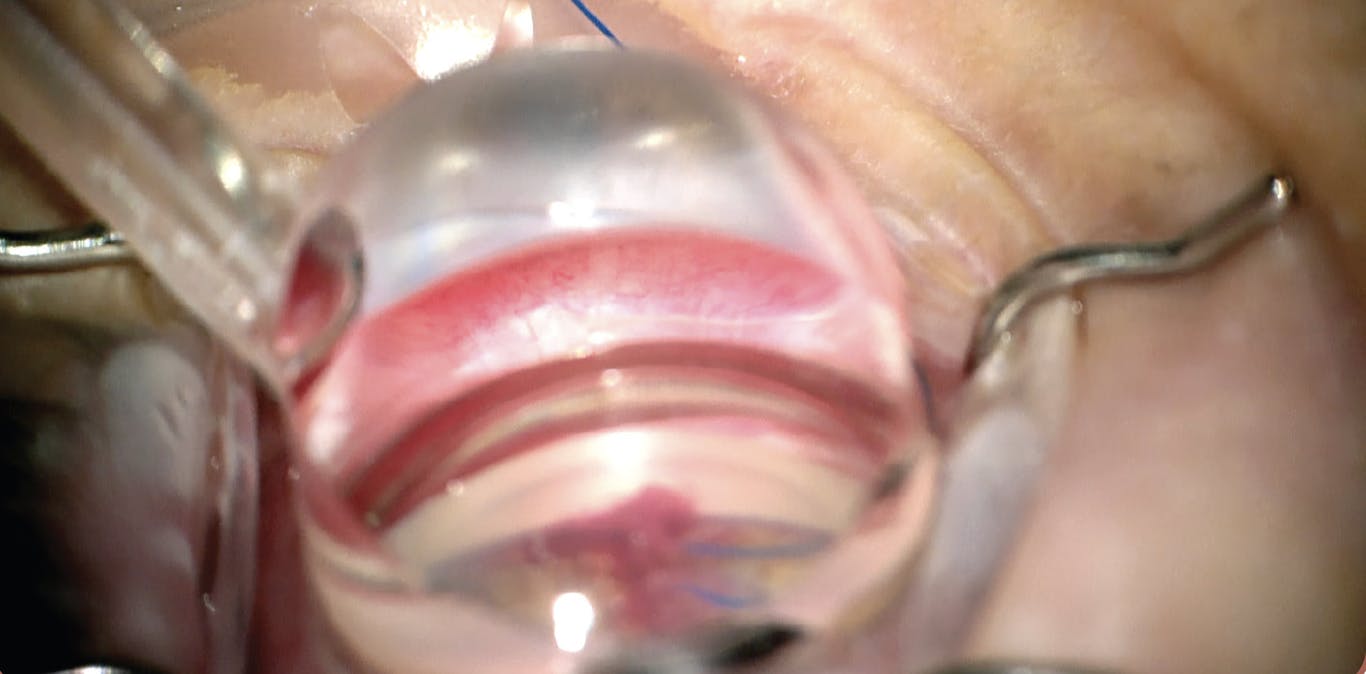
Even with an adequate softshell technique, if the OVD is burped (as described earlier) and the chamber begins to shallow, heme reflux can still occur. This can be addressed by injecting a cohesive OVD directly adjacent to the area of heme to sweep it in the opposite direction. A way to remember this concept is to envision a leaf blower. In the case shown in the video, heme reflux makes the distal end of a 5-0 polypropylene suture (Prolene, Ethicon) difficult to visualize during a gonioscopy-assisted transluminal trabeculotomy procedure. The heme is swept away with a cohesive OVD to create adequate visualization for successful suture retrieval.
1. Shalaby WS, Patel S, Lam SS, et al. Hemorrhagic complications following trabecular bypass microstent surgery in the setting of antithrombotic therapy. J Glaucoma. 2023;32(5):389-395.