There are some alternate surgical techniques I find useful when performing cataract surgery on eyes with extremely narrow angles, such as in patients with a history of treatment for retinopathy of prematurity or those with nanophthalmos.
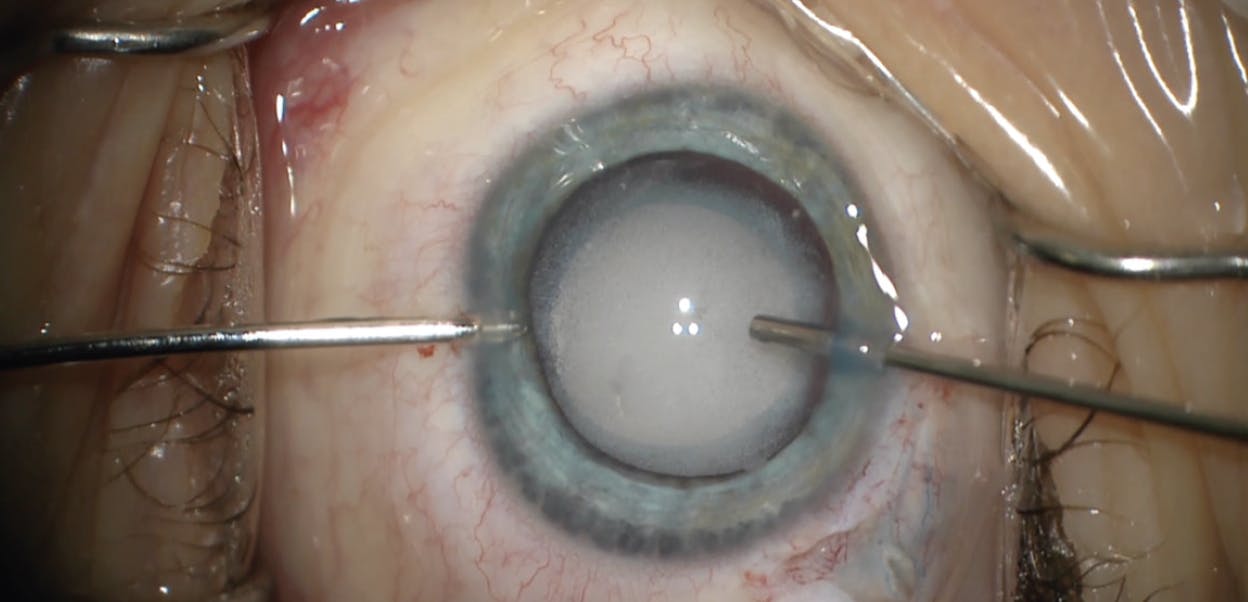
The video shows my preferred approach to cataract surgery in a nanophthalmic (14.3-mm) eye. A small peritomy and scleral cutdown have already been made. The capsule is stained with trypan blue, and a viscoadaptive OVD is injected to maintain stability in the setting of posterior pressure. For the capsulorhexis, a bimanual technique using a disposable 25-gauge Grieshaber Maxgrip Forceps (Alcon) is employed through a peripheral paracentesis incision. In my experience, this capsulorhexis technique helps to maintain a highly stable anterior chamber and prevent iris prolapse (shown at the end of the video once the main wound has been created). If the lens is soft enough, then bimanual handpieces or even a bimanual vitrector can be used to debulk or remove the lens material.
Because this patient has nanophthalmos and is thus at high risk of developing aqueous misdirection syndrome, I use a vitrector to create a primary posterior capsulotomy and perform a core vitrectomy before placing a three-piece IOL. As shown in the video, this patient experiences aqueous misdirection as the triamcinolone floats up into the anterior chamber when the posterior capsule is ruptured.