ITRACK ADVANCE: LIGHTING THE PATH FOR CANALOPLASTY
Inadvertent cyclodialysis cleft creation and entry into the suprachoroidal space are one potential early and late intraoperative complication of ab interno canaloplasty performed with any device. As shown in the video, the lighted tip of the iTrack Advance (Nova Eye Medical) helps to identify this problem immediately, allowing the surgeon to take a different approach. This also helps to avoid additional problems such as cyclodialysis cleft enlargement and the injection of an OVD into the suprachoroidal space.
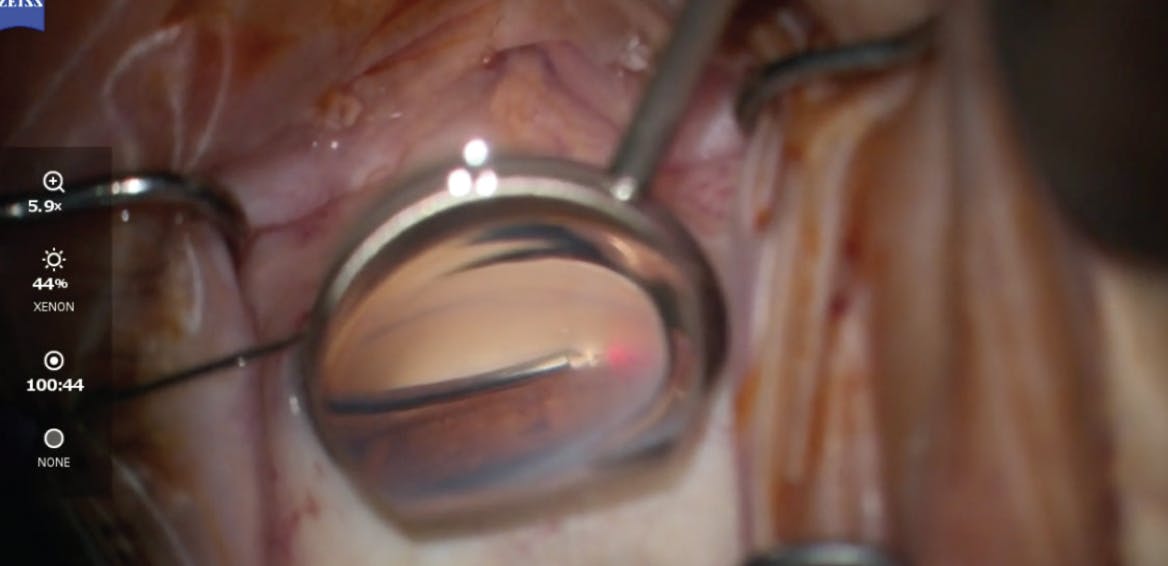
In this case, I noticed early diving of the catheter and immediately attempted to bypass the false passage by extending the opening into Schlemm canal while utilizing the lighted tip to ensure the instrument was traveling parallel along the canal afterward. Catheter entry into false passages can also occur later in a case, after the tip has left the gonioscopic view; this would be identified by the disappearance of the lighted tip from view during the threading process. In this scenario, the solution would be to retract the catheter fully back into the handpiece and rethread the catheter in the opposite direction to attempt to bypass the false passage.
Descemet detachments can occur while using any device for viscodilation of Schlemm canal, but pressurized delivery devices pose a higher risk of larger detachments. The video demonstrates techniques for minimizing this risk by continuously retracting the catheter while an OVD is delivered by a surgical assistant and applying mild downward force on the cornea with the gonioscopy lens to pressurize the anterior chamber. In the unlikely event of a Descemet detachment, it may be necessary to drain the OVD from underneath Descemet membrane through a paracentesis wound with manual aspiration utilizing a blunt cannula.
VIA360: TIPS FOR A SUCCESSFUL SINGLE-USER EXPERIENCE
The VIA360 (New World Medical), the newest device for viscodilation, allows single-user delivery of a pressurized OVD into Schlemm canal. As with all angle-based surgeries, a good en face view of the nasal angle is essential to ensure entry into the correct anatomic structure. With any canaloplasty device capable of threading 360º in a single thread, I prefer performing the procedure using a paracentesis wound rather than a temporal keratome incision; I find that this decreases the risk of early cyclodialysis cleft creation. This approach also helps to maintain anterior chamber stability and allows me to manipulate the eye to achieve a good en face view of the nasal angle without compromising anterior chamber pressurization.
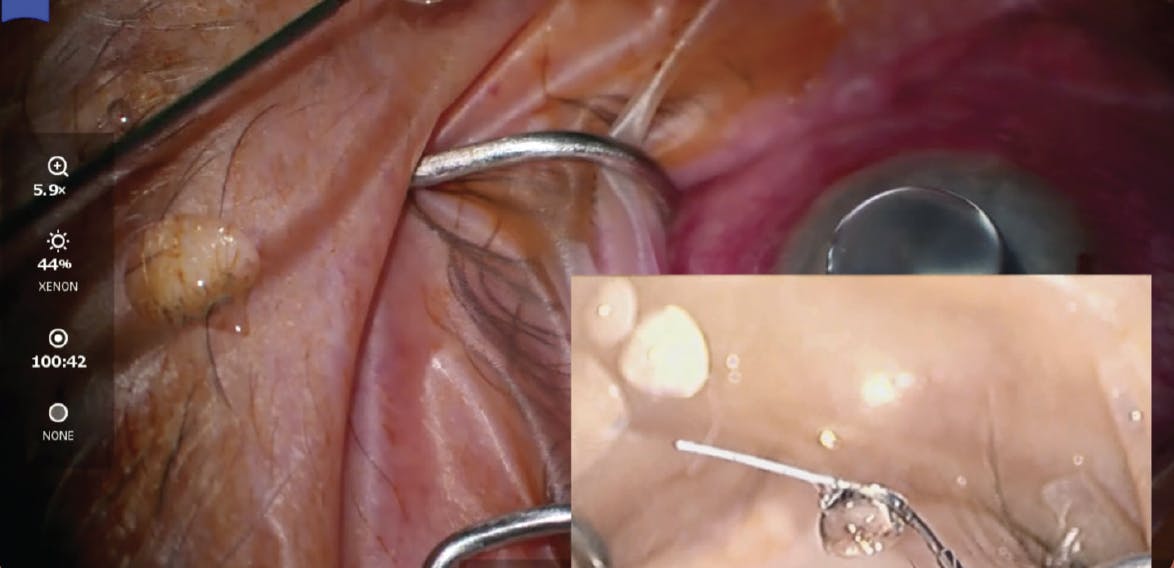
An OVD is delivered in a pressurized manner, directed parallel to Schlemm canal as well as perpendicularly into the trabecular meshwork and collector channels. This enhances outflow across all points in the conventional outflow pathway, as shown by the marked rapid blanching of the perilimbal vasculature during the procedure. The OVD can be injected around once every clock hour while threading the catheter to open the canal for easier entry.
Because the VIA360 device is fully surgeon-controlled, I can titrate the amount of OVD delivered during the procedure. I typically deliver a bolus of a cohesive OVD such as ProVisc (Alcon) or Healon Pro (Johnson & Johnson Vision) every half to one turn of the dial, depending on disease severity. The use of supercohesive OVDs such as Healon GV Pro (Johnson & Johnson Vision) may be more likely to cause Descemet detachments and hinder proper functionality of devices such as the VIA360 that deliver a pressurized OVD. For those who prefer these OVDs, I recommend being mindful of these potential issues and adjusting the frequency of the products' use to minimize the risk of complications.