During the past 20 years, the number of tube shunt surgeries performed for glaucoma management has increased fourfold.1 Although glaucoma drainage implants (GDIs) can lower IOP and preserve patients’ vision, the devices carry a unique risk of tube erosion owing to the insertion of a foreign body.
The term tube erosion refers to the thinning and degradation of conjunctival tissue over the tube due to inflammation and mechanical pressure. The complication may occur months to years postoperatively. In contrast, tube exposure is caused by conjunctival retraction or wound dehiscence over the tube during the early postoperative period.
Symptoms of tube erosion include persistent hyperemia, foreign body sensation, discharge, and changes in vision. Many patients are asymptomatic, however, and should be monitored for the development of symptoms.
Left unaddressed, tube erosion can lead to serious sequelae such as endophthalmitis.2 Understanding the risk factors for tube erosion, strategies for prevention, and repair techniques is essential.
RATES OF EROSION
Before the development of contemporary reinforcement techniques, tube erosion rates were as high as 30%.3 The use of preserved donor sclera has reduced the 5-year incidence of tube erosion to 1% to 3% for an Ahmed Glaucoma Valve (New World Medical)4 and approximately 5% with an Ahmed ClearPath (New World Medical) and a Baerveldt glaucoma implant (Johnson & Johnson Vision).5,6 Although most prospective trials have reported erosion rates in this range, rates of 6.6% to 8.3% have also been reported,7,8 potentially related to prior mitomycin C use and preexisting uveitis.
Given these findings, reinforcement is now standard practice, and various materials and techniques are available.
RISK FACTORS
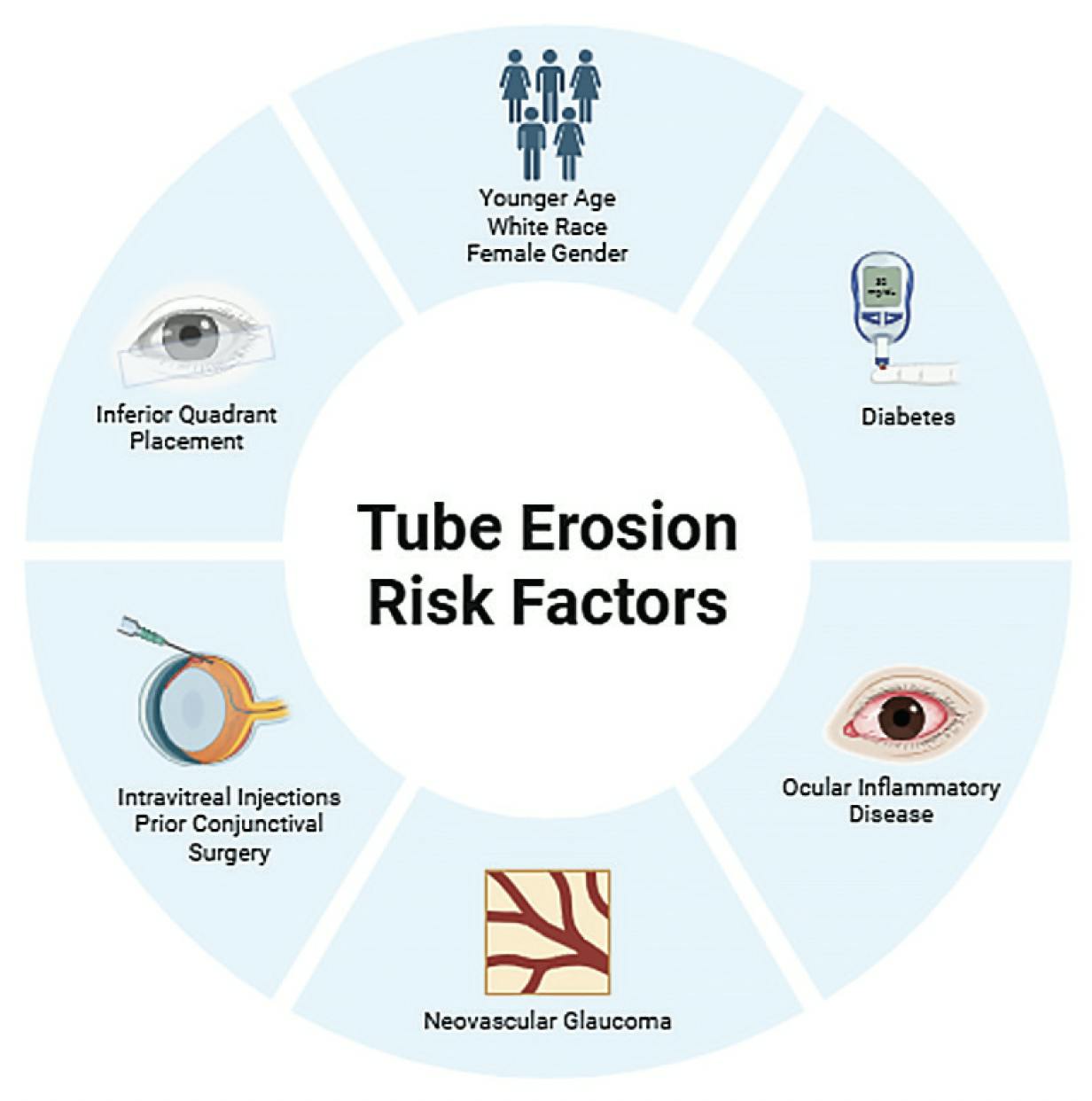
Most patients develop tube erosion within the first 5 years after GDI placement.9-12 Retrospective studies have identified ocular inflammatory disease, prior conjunctival surgery, diabetes, neovascular glaucoma, young age, and White race as significant risk factors for tube erosion. In addition, women have a twofold higher risk of tube erosion than men.9,13
Intravitreal anti-VEGF injections are associated with higher rates of tube erosion in patients who have age-related macular degeneration, especially those receiving serial injections.14 This finding highlights the importance of considering comorbid eye conditions when planning surgery.
The type of patch graft influences the incidence of tube erosion. Specifically, single-layer pericardium may carry a higher risk of erosion than double-layer pericardium.9 Comparative studies of various patch graft materials are currently limited. Selection should be tailored to the patient and the surgeon’s experience and preference.
No significant difference in the risk of tube erosion has been found among GDIs,9,15,16 but the positions of the tube and plate are factors. Ahmed Glaucoma Valves placed in the inferior quadrant were found to have a high incidence of erosion (Figure 1).16,17 In another study, the risk of erosion was lower for tubes placed in the sulcus compared to the anterior chamber,18 although a subsequent study found similar rates of erosion with anterior chamber, sulcus, and pars plana placement.19
Several repair methods and materials were associated with a low rate or absence of reerosion in small studies. The methods included the use of a hinged scleral flap, a conjunctival pedicle flap, a double layer of amniotic membrane supplemented with autologous serum tears, a corneal patch graft repair with and without oral buccal mucous membrane, and an acellular dermis graft.20-24 The corneal lamellar patch graft covered by a buccal mucous membrane graft was associated with a 13.1% rate of reerosion and a 95.7% success rate after one or two buccal mucous membrane graft repairs with 3 years of follow-up.25 Further research with more extensive longitudinal analysis is required to determine the most effective repair material for reducing the risk of tube reexposure, given that initial exposure may occur years after GDI placement.
PREVENTION
Most studies comparing the performance of different types of heterologous grafts (eg, donor sclera, human pericardium, and corneal tissue) have not shown statistically significant differences in the incidence of tube erosion. The use of bovine pericardium, however, was halted owing to a higher incidence of erosion linked to graft melt.26 In contrast, autologous tissue carries a minimal immunologic risk.
Long scleral tunnel and rotational scleral flap techniques are associated with lower erosion rates compared to heterologous grafts.27-29 Long scleral tunnels in particular offer greater safety and cost-effectiveness than heterologous grafts, but the former can be technically challenging to create and require adequate Tenon capsule tissue.
Long-term research is required to determine the optimal graft strategy and identify best practices in surgical planning based on patient risk factors.
MANAGEMENT
Overview
As many as 67% to 100% of GDI recipients diagnosed with endophthalmitis present with tube erosion.2,15,30 Therapy with topical antibiotics is insufficient to prevent this type of infection; endophthalmitis has occurred despite prophylactic treatment in patients awaiting tube repair.31 The identification and prompt surgical revision of tube erosion are therefore important.
Surgical Approach
The first step toward determining the appropriate repair strategy is to evaluate the type of tube, the location of the plate, the position of the tip of the tube, the location and size of the erosion, the status of the anterior chamber angle, and the presence or absence of infection. Additional considerations include risk factors for recurrent erosion, comorbid conditions such as anterior uveitis and cystoid macular edema, glaucoma severity and current strategies for its management, and the patient’s visual potential and goals.
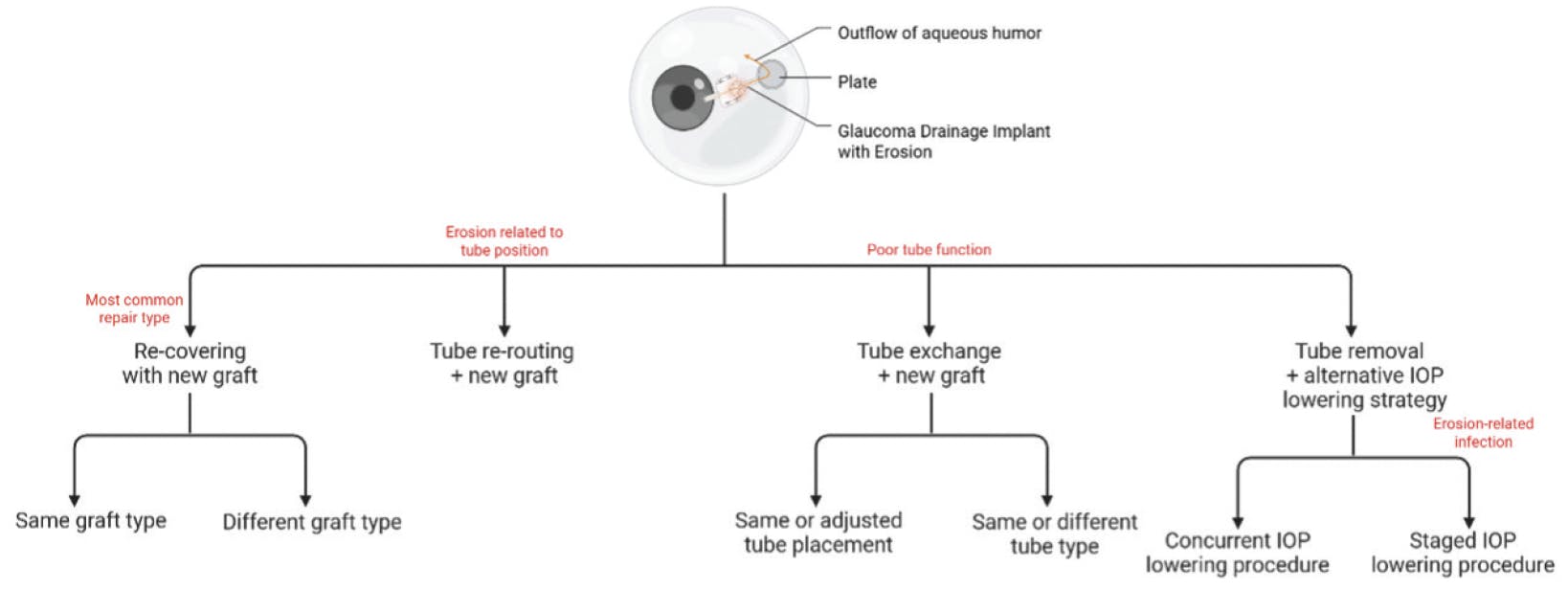
Strategy No. 1: Re-covering the tube. The most common repair strategy is to re-cover the tube with a new donor patch graft. The approach is quick and technically straightforward but can be associated with a high risk of reerosion depending on the location of the existing GDI.32,33
Strategy No. 2: Rerouting the tube. Rerouting the tube and placing a new patch graft address the risk of erosion due to the tube’s position. For instance, a tube located in the temporal quadrant may be moved more superiorly to avoid mechanical irritation by the upper lid margin.
Strategy No. 3: Exchanging the tube. If tube erosion has occurred and the GDI is not functioning well, an exchange for a new tube in the same quadrant before the placement of a new graft may improve IOP control. For example, a nonvalved GDI may be exchanged for a valved GDI in a hypotonous eye.32,34
Strategy No. 4: Removing the tube. Removing the current GDI and placing a new device in a different quadrant can address weakened conjunctiva in the original quadrant.35 In addition, depending on the patient’s goals or if an infection related to tube erosion has developed, the GDI may be removed, and an alternative IOP-lowering procedure may be performed, either concurrently or as a staged procedure (Figure 2).33,36
Graft Material
When addressing tube erosion, some ophthalmologists employ a different type of patch graft than was used during the initial surgery. The hypothesis is that prior graft dissolution might have been caused by an immunologic reaction.
As discussed earlier, the use of autologous patch graft materials may reduce the risk of inflammation.37 Because capsule autografts are quickly incorporated into periocular tissue, they can provide durability, excellent cosmesis, and a nonimmunogenic, cost-effective alternative to donor grafts.38 Capsule autografts can improve the function of established or poorly functioning GDIs through capsule excision. This patch material may be used for the exchange, repositioning, revision, or replacement of a valved or nonvalved GDI and for the placement of an additional implant.32,34,35 When capsule grafts are used with a nonvalved device, religation is essential to prevent postoperative hypotony.35
CONCLUSION
Tube erosion is a serious complication of GDI placement that requires prompt surgical management to prevent vision-threatening complications. During surgical planning, important considerations include the type of GDI, the positions of the plate and tube, risk factors for erosion, the presence of infection or other complications, the severity of glaucoma, and IOP control. There are various approaches for repairing an eroded tube. Early recognition, appropriate surgical intervention, and consideration of long-term risk factors are key to optimizing outcomes.
1. Arora KS, Robin AL, Corcoran KJ, Corcoran SL, Ramulu PY. Use of various glaucoma surgeries and procedures in Medicare beneficiaries from 1994 to 2012. Ophthalmology. 2015;122(8):1615-1624.
2. Gedde SJ, Scott IU, Tabandeh H, et al. Late endophthalmitis associated with glaucoma drainage implants. Ophthalmology. 2001;108(7):1323-1327.
3. Heuer DK, Budenz D, Coleman A. Aqueous shunt tube erosion. J Glaucoma. 2001;10(6):493-496.
4. Budenz DL, Feuer WJ, Barton K, et al; Ahmed Baerveldt Comparison Study Group. Postoperative complications in the Ahmed Baerveldt Comparison Study during five years of follow-up. Am J Ophthalmol. 2016;163:75-82.e3.
5. Gedde SJ, Schiffman JC, Feuer WJ, Herndon LW, Brandt JD, Budenz DL; Tube Versus Trabeculectomy Study Group. Treatment outcomes in the Tube Versus Trabeculectomy (TVT) study after five years of follow-up. Am J Ophthalmol. 2012;153(5):789-803.e2.
6. Shalaby WS, Reddy R, Wummer B, et al. Ahmed ClearPath vs. Baerveldt Glaucoma Implant: a retrospective noninferiority comparative study. Ophthalmol Glaucoma. 2024;7(3):251-259.
7. Wishart PK, Choudhary A, Wong D. Ahmed glaucoma valves in refractory glaucoma: a 7-year audit. Br J Ophthalmol. 2010;94(9):1174-1179.
8. Trubnik V, Zangalli C, Moster MR, et al. Evaluation of risk factors for glaucoma drainage device-related erosions: a retrospective case-control study. J Glaucoma. 2015;24(7):498-502.
9. Chaku M, Netland PA, Ishida K, Rhee DJ. Risk factors for tube exposure as a late complication of glaucoma drainage implant surgery. Clin Ophthalmol. 2016;10:547-553.
10. Byun YS, Lee NY, Park CK. Risk factors of implant exposure outside the conjunctiva after Ahmed Glaucoma Valve implantation. Jpn J Ophthalmol. 2009;53(2):114-119.
11. Geffen N, Buys YM, Smith M, et al. Conjunctival complications related to Ahmed Glaucoma Valve insertion. J Glaucoma. 2014;23(2):109-114.
12. Huddleston SM, Feldman RM, Budenz DL, et al. Aqueous shunt exposure: a retrospective review of repair outcome. J Glaucoma. 2013;22(6):433-438.
13. Muir KW, Lim A, Stinnett S, Kuo A, Tseng H, Walsh MM. Risk factors for exposure of glaucoma drainage devices: a retrospective observational study. BMJ Open. 2014;4(5):e004560.
14. Liu KC, Gomez-Caraballo M, Challa P, Asrani SG. Recurrent tube erosions with anti-vascular endothelial growth factor therapy in patients with age-related macular degeneration. Ophthalmol Glaucoma. 2020;3(4):295-300.
15. Al-Torbak AA, Al-Shahwan S, Al-Jadaan I, Al-Hommadi A, Edward DP. Endophthalmitis associated with the Ahmed Glaucoma Valve implant. Br J Ophthalmol. 2005;89(4):454-458.
16. Pakravan M, Yazdani S, Shahabi C, Yaseri M. Superior versus inferior Ahmed Glaucoma Valve implantation. Ophthalmology. 2009;116(2):208-213.
17. Levinson JD, Giangiacomo AL, Beck AL, et al. Glaucoma drainage devices: risk of exposure and infection. Am J Ophthalmol. 2015;160(3):516-521.e2.
18. Alobaida IA, Malik R, Ahmad S. Comparison of surgical outcomes between sulcus and anterior chamber implanted glaucoma drainage devices. Saudi J Ophthalmol. 2020;34(1):1-7.
19. Samuel S, Chang EK, Gupta S, et al. Outcomes of anterior chamber, sulcus, and pars plana glaucoma drainage device placement in glaucoma patients. J Ophthalmol. 2022;2022:5947992.
20. Lee ES, Kang SY, Kim NR, et al. Split-thickness hinged scleral flap in the management of exposed tubing of a glaucoma drainage device. J Glaucoma. 2011;20(5):319-321.
21. Godfrey DG, Merritt JH, Fellman RL, Starita RJ. Interpolated conjunctival pedicle flaps for the treatment of exposed glaucoma drainage devices. Arch Ophthalmol. 2003;121(12):1772-1775.
22. Ainsworth G, Rotchford A, Dua HS, King AJ. A novel use of amniotic membrane in the management of tube exposure following glaucoma tube shunt surgery. Br J Ophthalmol. 2006;90(4):417-419.
23. Singh M, Chew PT, Tan D. Corneal patch graft repair of exposed glaucoma drainage implants. Cornea. 2008;27(10):1171-1173.
24. Rootman DB, Trope GE, Rootman DS. Glaucoma aqueous drainage device erosion repair with buccal mucous membrane grafts. J Glaucoma. 2009;18(8):618-622.
25. Einan-Lifshitz A, Belkin A, Mathew D, et al. Repair of exposed Ahmed Glaucoma Valve tubes: long-term outcomes. J Glaucoma. 2018;27(6):532-536.
26. Wishart PK, Choudhary A, Wong D. Ahmed glaucoma valves in refractory glaucoma: a 7-year audit. Br J Ophthalmol. 2010;94(9):1174-1179.
27. Kugu S, Erdogan G, Sevim MS, Ozerturk Y. Efficacy of long scleral tunnel technique in preventing Ahmed Glaucoma Valve tube exposure through conjunctiva. Semin Ophthalmol. 2015;30(1):1-5.
28. Gdih G, Jiang K. Graft-free Ahmed valve implantation through a 6 mm sclera tunnel. Can J Ophthalmol. 2017;52(1):85-91.
29. Ollila M, Falck A, Airaksinen PJ. Placing the Molteno implant in a long scleral tunnel to prevent postoperative tube exposure. Acta Ophthalmol Scand. 2005;83(3):302-305.
30. Morad Y, Donaldson CE, Kim YM, Abdolell M, Levin AV. The Ahmed drainage implant in the treatment of pediatric glaucoma. Am J Ophthalmol. 2003;135(6):821-829.
31. Kalenak JW. Revision for exposed anterior segment tubes. J Glaucoma. 2010;19(1):5-10.
32. Joos KM, Laviña AM, Tawansy KA, Agarwal A. Posterior repositioning of glaucoma implants for anterior segment complications. Ophthalmology. 2001;108(2):279-284.
33. Armstrong M, Wang J, Gorla M, Qiu M. Same-quadrant tube exchange and multiple-layer closure for recurrent tube erosion: surgical technique description and preliminary results. Am J Ophthalmol Case Rep. 2024;36:102138.
34. Alawi A, AlBeshri A, Schargel K, Ahmad K, Malik R. Tube revision outcomes for exposure with different repair techniques. Clin Ophthalmol. 2020;14:3001-3008.
35. Kim IJ, Wang J, Qiu M. Same-quadrant Baerveldt Glaucoma Implant-250 to Baerveldt Glaucoma Implant-350 exchange. Am J Ophthalmol Case Rep. 2023;33:101975.
36. Qiu M. Aqueous shunt revision with autologous capsular patch graft: surgical technique description and preliminary results. Ophthalmol Glaucoma. 2021;4(6):646-648.
37. Puustjärvi T, Rönkkö S, Teräsvirta M. A novel oculoplastic surgery for exposed glaucoma drainage shunt by using autologous graft. Graefes Arch Clin Exp Ophthalmol. 2007;245(6):907-909.
38. Islam YFK, Blake CR, Gibran SK. Management of endophthalmitis related to glaucoma drainage devices: review of the literature and our experience. Eye (Lond). 2021;35(7):1850-1858.