The financial burden associated with medical education has risen exponentially in the past few decades, with recent medical school graduates declaring that finances are often an important factor as they consider specialty choice and training location.1-4 During the residency application process, however, salary and other benefits information are often less emphasized than other factors as programs face the challenge of conveying extraordinary amounts of information in an already jam-packed interview day.
As such, applicants often must do their own research regarding resident compensation, benefits information, and cost-of-living expenses for programs throughout the United States. To better consolidate this information, our team conducted a research study to evaluate the association between cost-of-living metrics and annual stipends of US ophthalmology residents.5 We also attempted to discern which program characteristics, such as location, affiliation, and rank, were associated with (1) greater resident net incomes and (2) the availability of housing benefits.
STUDY METHODS
We accumulated stipend information for 116 residency programs for the 2023–2024 academic year. We also compiled information on which programs had housing benefits and, when applicable, the monetary value of the housing benefit. To approximate cost-of-living expenses, we used the Massachusetts Institute of Technology Living Wage Calculator, which provides an estimate of the required annual income (RAI) to reside in a given locale. The RAI is calculated based on food, housing, transportation, medical, and other civic expenses while also accounting for income taxes within the specified location.
For each program, we calculated two different annual income surpluses: one based solely on the resident’s stipend and one based on the resident’s stipend plus housing benefit, if applicable. The stipend income surplus (SIS) was defined as the resident’s stipend minus the RAI for the respective residency program location. The stipend plus benefit income surplus (SPBIS) was calculated as the resident’s stipend plus housing benefit minus the RAI for the respective residency program location.
RESULTS
The average annual stipend for a postgraduate year 1 (PGY-1) ophthalmology resident was $65,249. After adjusting for the cost of living, the average SIS for a PGY-1 resident was $26,771. As expected, the average resident stipend varied by region, with programs in the West averaging the highest stipend ($72,557) and programs in the South averaging the lowest stipend ($60,095). Interestingly, no regional differences in SISs for PGY-1 residents were observed.
Of all the ophthalmology residency programs included in the study, only nine (7.8%) advertised a housing benefit for residents. All nine programs were in the West and Northeast, the two regions with the highest cost-of-living expenses. When housing benefits were accounted for, there were statistically significant regional differences in annual SPBIS, varying by as much as $6,283 between the regions with the highest (West) and lowest (South) SPBISs (Figure). The states with the highest SPBISs were Connecticut ($39,058), New Hampshire ($35,085), and California ($33,868), whereas territories/states with the lowest average SPBISs were Washington, DC ($17,706); Mississippi ($20,601); and South Carolina ($20,787).
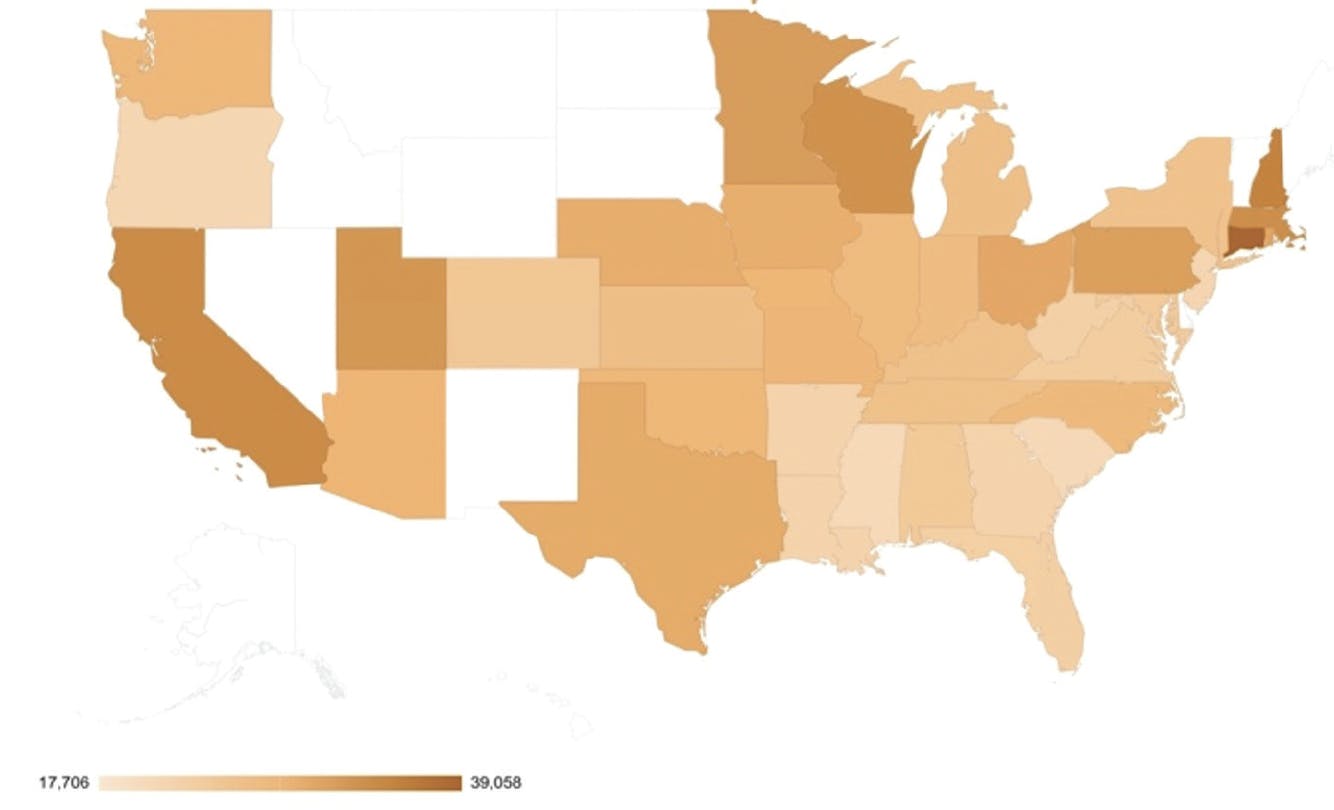
Figure. A heat map of the United States illustrates the annual SPBIS by state for PGY-1 ophthalmology residents.
DISCUSSION
Surprisingly, some of the programs in the locations with the highest costs of living were also the programs with the highest SPBISs, due to a combination of a high annual stipend and a housing benefit. Applicants may therefore consider housing and other benefits when assessing cost-of-living expenses, as opposed to ruling out a particular geographic region due to a presumed higher cost of living. Furthermore, there are tremendous intra- and interregional differences in SPBISs. Programs in the same state, and even the same city, often had vastly different stipends and subsequently SPBISs, demonstrating the importance of a close examination of benefits packages when comparing geographically similar residency programs.
CONCLUSION
As residency programs increasingly unionize across the country, the topic of resident compensation will remain relevant. Further discussions regarding how to optimize resident compensation and benefits may help enhance resident well-being and career satisfaction.
1. Rohlfing J, Navarro R, Maniya OZ, Hughes BD, Rogalsky DK. Medical student debt and major life choices other than specialty. Med Educ Online. 2014;19:25603.
2. Phillips JP, Petterson SM, Bazemore AW, Phillips RL. A retrospective analysis of the relationship between medical student debt and primary care practice in the United States. Ann Fam Med. 2014;12(6):542-549.
3. Kovar A, Carmichael H, Harms B, Nehler M, Tevis S. Overworked and underpaid: how resident finances impact perceived stress, career choices, and family life. J Surg Res. 2021;258:82-87.
4. Ngatuvai M, Yeager M, Newsome K, et al. Analysis of surgical residents’ salaries and associated funding during eight residency training cycles: toward improving future residents’ benefits and compensation. J Surg Res. 2023;281:70-81.
5. Cohen SA, Sridhar J, Tseng VL. Geographic trends in ophthalmology resident physician compensation and cost-of-living expenses. JAMA Ophthalmol. 2024;142(8):761-767.