Primary congenital glaucoma, previously referred to as trabeculodysgenesis or goniodysgenesis, is a rare disease. Developmental abnormalities in the trabecular meshwork and anterior chamber angle without systemic anomalies cause IOP-related damage to the eye.1 Prompt diagnosis and treatment can minimize visual impairment.1
The parents of children with congenital glaucoma may observe a triad of signs—tearing, blepharospasm, and photophobia. Ophthalmologists may detect elevated IOP, corneal enlargement and haze, breaks in Descemet membrane called Haab striae, optic disc cupping, increasing axial length, and progressive myopia. Increasing corneal diameter and axial length are hallmarks of elevated IOP before 3 years of age. Serial measurements of corneal diameter, axial length, and refractive error can therefore be a valuable tool for diagnosing congenital glaucoma as well as for monitoring disease progression and a patient’s response to treatment.1
Treatment is typically stepwise, often starting with goniotomy or trabeculotomy; if gonioscopy is precluded by corneal opacity, trabeculotomy is preferred.2 A multivariate linear regression analysis of 452 eyes undergoing goniotomy or trabeculotomy for primary congenital glaucoma found that 56% of the goniotomy patients and 30% of the trabeculotomy patients had inadequate IOP control (IOP > 18 mm Hg) or needed further surgery during the 3-year retrospective review.2 Additional surgeries for IOP control include trabeculotomy combined with trabeculectomy, trabeculectomy with adjunctive mitomycin C, and the implantation of various glaucoma drainage devices (GDDs).3-6 Information on the long-term outcomes of GDDs for the treatment of primary congenital glaucoma is lacking for several reasons, including the difficulty of conducting studies of rare diseases, a lack of reliable data for comparing outcomes, ethical concerns precluding prospective studies, and insufficient follow-up.7,8
This article discusses the challenges of GDD surgery in primary congenital glaucoma and adjustments that can be made in the pre-, peri-, and postoperative approaches to pediatric patients.
PHYSIOLOGIC CHALLENGES OF THE PEDIATRIC EYE
The sclera remains highly elastic until 3 years of age.9 GDD implantation is therefore challenging because pediatric eyes can expand with increasing IOP and contract with decreasing IOP. This contraction of the globe can cause the tube of a GDD to extend farther into the anterior segment. If the sclera is not stiff enough to maintain the tube’s position and keep it parallel to the iris, moreover, the tube may rotate anteriorly.7,8 Both extension and rotation can cause the tip of a tube that was well placed intraoperatively to contact the corneal endothelium postoperatively.
Physiologic axial elongation with age may gradually shorten the tube within the anterior chamber—occasionally to the point that the tip retracts out of the anterior chamber.
Ultimately, these factors make operative decisions about tube length and positioning challenging and contribute to the risk of postoperative corneal injury.
COMPLICATIONS
Certain complications of GDD implantation are more common in the pediatric population. Unsurprisingly, tube malposition, migration, and retraction occur more frequently.7,11 Tube-cornea touch from anterior tube migration or extension is also more common in children, particularly those with buphthalmic eyes, and has been found to necessitate surgical intervention in up to 32.3% of pediatric eyes.7,8,10-14 Close postoperative observation and providing parents with a detailed list of return precautions can help prevent severe corneal damage.
Erosion and infection may occur more often in pediatric versus adult patients who receive GDDs. Tube erosion has been reported in 1.2% to 11.1% of children compared to 1% to 3% of adults.7,11,13-17 In addition, the reported incidence of endophthalmitis ranges from 1.3% to 10.0% across valved and nonvalved implants in pediatric glaucoma patients.11,12,14-16,18 Although tube erosion is an independent risk factor for endophthalmitis, postoperative behavioral challenges and a less robust immune system in very young children are additional contributing factors. Persistent eye rubbing has been considered, though not explicitly assessed, as a risk factor for tube erosion and GDD-associated endophthalmitis in pediatric patients. These statistics demonstrate the importance of long-term surveillance and aggressive surgical management of tube erosion.
Strabismus and motility limitations are more common after GDD implantation in children than in adults, with reported rates ranging from 1.9% to 57.0% of pediatric cases.16,18 Further studies are necessary to determine how implants contribute to strabismus because the limitation may be mechanical and possibly dependent on the implant’s size. It is important to note that early diplopia after GDD implantation may be transient owing to extraocular muscle and orbital tissue edema. Permanent motility limitations may be secondary to a GDD mass effect, a posterior fixation suture, the incorporation of extraocular muscles in the implant capsule, fat adherence to the implant, or iatrogenic trauma to the extraocular muscles.19,20 Children with refractory glaucoma have additional risk factors for postoperative strabismus, including anatomic abnormalities, decreased visual potential, and higher risk of GDD failure requiring multiple GDDs.21
PREOPERATIVE CONSIDERATIONS
Taking into account the duration of disease before surgery, the patient’s age, and their buphthalmic status may help physicians predict the likelihood of postoperative tube migration (Figure). Gonioscopy, often requiring an exam under anesthesia, should be performed at least once when possible; it is critical to diagnosis and may identify anatomy that would benefit from goniotomy or trabeculotomy before GDD implantation.
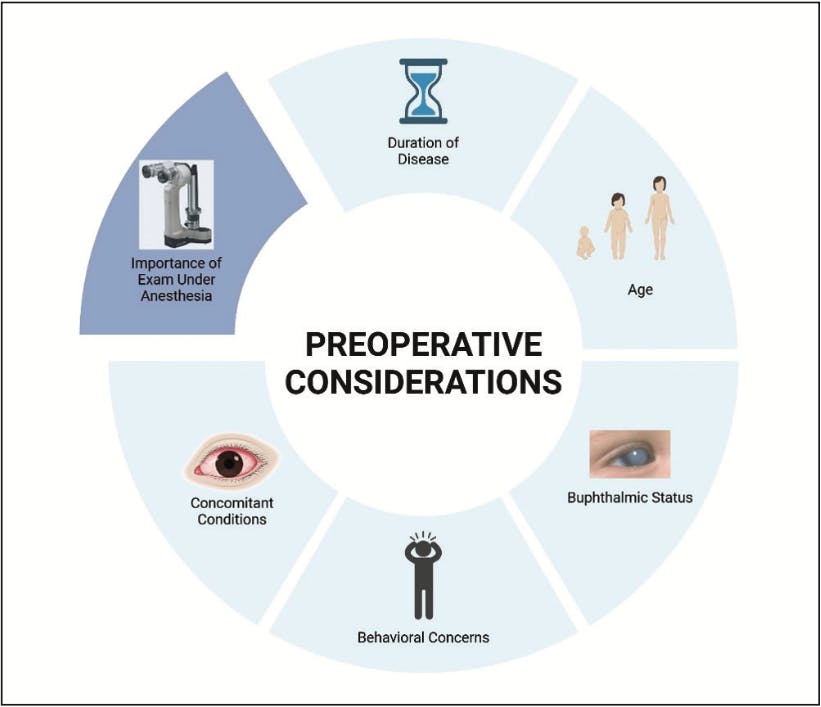
Figure. Taking certain preoperative considerations into account may help physicians predict the likelihood of postoperative tube migration and optimize postoperative healing.
It is essential to address behavior such as eye rubbing that could complicate postoperative healing. Concomitant conditions, moreover, such as keratoconjunctivitis, may require treatment before surgery. For example, children of Saudi Arabian descent have a higher rate of vernal keratoconjunctivitis.22 Patients with glaucoma are at increased risk of ocular surface disease from the use of topical medication and, sometimes, a history of multiple ocular surgeries.23 Continuous ocular inflammation, eye rubbing, and a compromised ocular surface increase the risk of friction against the eyelids, melting, and subsequent implant exposure.22-24 Again, it is crucial to establish with patients and their families the importance of close postoperative follow-up and long-term surveillance.
SURGICAL CONSIDERATIONS
A retrospective study found that pediatric GDD implantation in the superotemporal quadrant had a higher success rate than inferonasal implantation, as measured by IOP reduction and the final number of IOP-lowering medications. Inferonasal implantation was also associated with a higher failure rate and higher incidences of tube exposure and endophthalmitis.25 As discussed earlier, determining appropriate tube length and position in the anterior chamber is challenging owing to the elasticity of the pediatric eye and softness of the sclera. Given the eye’s tendency to shrink postoperatively, a conservative approach to tube length or posterior tube placement without iris indentation might reduce the risk of tube malposition and extrusion.16
Dyscoria has been reported in more than 20% of pediatric patients undergoing the placement of a Baerveldt glaucoma implant (Johnson & Johnson Vision) as a result of peripheral iris entrapment in the tube track.26 To avoid entrapment, it can be helpful to position the tube parallel to the iris and away from the pupillary margin, but evidence on how to prevent this complication in pediatric eyes is limited. The authors have avoided dyscoria with pars plana vitrectomy and pars plana tube placement, but this approach requires aphakia or pseudophakia and is not practical in many situations.
Other consequences of pediatric scleral and corneal elasticity include increased wound gaping and leakage, which can prevent incisions from self-sealing. A rapid loss of aqueous during the creation of a scleral tunnel can make it difficult to position the tube accurately between the iris and cornea. Compared to adult eyes, moreover, pediatric eyes are more prone to increased inflammation and fibrin formation, which can further compromise wound integrity and increase the risk of complications if closure is inadequate.27 For this reason, it is frequently necessary to suture incisions.
Surgical decision-making must balance the benefits of IOP reduction against the risks of corneal damage, erosion, infection, and strabismus.
POSTOPERATIVE CONSIDERATIONS
Pediatric cases present several challenges postoperatively, ranging from difficulty examining patients' eyes in the clinic to controlling eye rubbing. GDDs may function effectively for years but not necessarily decades.27 The duration of disease control needed for pediatric patients necessitates early conversations regarding the importance of consistent follow-up. It is also vital that parents be made aware of symptoms that may signal a complication, such as erosion or corneal touch, and the likelihood of future surgery.
Target pressures are higher in children than adults with glaucoma; normal- or low-tension disease has not been reported in the pediatric population.1 Children with GDDs may also have more cosmetic concerns than adults. For instance, pediatric patients may experience dyscoria from iris adherence at the tube entry site, large blebs that are visible to other children, and preexisting buphthalmos. Cosmetic issues can result in social challenges, including bullying, as patients progress through grade school. Peer acceptance has been found to be significantly poorer for children with glaucoma than for those with amblyopia despite comparable visual acuity and age.28 This has been attributed to appearance, including cloudy corneas and buphthalmos, the impact of impaired visual function on physical activity such as during physical education classes, and impaired psychological development resulting from feelings of inferiority and limited communication with peers.28
Given the risk of amblyopia in children with binocular vision and unilateral eye weakness due to glaucomatous damage or changes in ocular motility, it is crucial to coordinate care with a pediatric ophthalmologist and aggressively manage refractive errors.
CONCLUSION
Many of the techniques discussed in this article are also applicable to GDD implantation for the treatment of other pediatric glaucomas, including aphakic, inflammatory, traumatic, syndromic, aniridic, and juvenile open-angle glaucoma. Addressing the complex surgical and postoperative challenges inherent to pediatric glaucoma management is crucial to improving outcomes. The unique physiologic and anatomic features of the pediatric eye complicate GDD implantation and contribute to higher rates of complications. The challenges underscore the importance of increasing pediatric glaucoma training, continuing research, improving surgical interventions, and assessing outcomes to reduce the risk of visual impairment from childhood glaucoma.
1. Weinreb RN, Grajewski AL, Papadopoulos M, Grigg J, Freedman SF. Childhood Glaucoma: The 9th Consensus Report of the World Glaucoma Association. Kugler Publications; 2013.
2. El Sayed Y, Esmael A, Mettias N, El Sanabary Z, Gawdat G. Factors influencing the outcome of goniotomy and trabeculotomy in primary congenital glaucoma. Br J Ophthalmol. 2021;105(9):1250-1255.
3. Zetterberg M, Nyström A, Kalaboukhova L, Magnusson G. Outcome of surgical treatment of primary and secondary glaucoma in young children. Acta Ophthalmol. 2015;93(3):269-275.
4. Essuman VA, Braimah IZ, Ndanu TA, Ntim-Amponsah CT. Combined trabeculotomy and trabeculectomy: outcome for primary congenital glaucoma in a West African population. Eye (Lond). 2011;25(1):77-83.
5. Giampani J Jr, Borges-Giampani AS, Carani JC, Oltrogge EW, Susanna R Jr. Efficacy and safety of trabeculectomy with mitomycin C for childhood glaucoma: a study of results with long-term follow-up. Clinics (Sao Paulo). 2008;63(4):421-426.
6. Chen A, Yu F, Law SK, Giaconi JA, Coleman AL, Caprioli J. Valved glaucoma drainage devices in pediatric glaucoma: retrospective long-term outcomes. JAMA Ophthalmol. 2015;133(9):1030-1035.
7. Nassiri N, Nouri-Mahdavi K, Coleman AL. Ahmed Glaucoma Valve in children: a review. Saudi J Ophthalmol. 2011;25(4):317-327.
8. Pakravan M, Esfandiari H, Yazdani S, et al. Clinical outcomes of Ahmed Glaucoma Valve implantation in pediatric glaucoma. Eur J Ophthalmol. 2019;29(1):44-51.
9. Levin L, Nilsson F, Ver Hoeve J, et al. Adler's Physiology of the Eye. 11th ed. Elsevier Health Sciences; 2011.
10. Mandalos A, Tailor R, Parmar T, Sung V. The long-term outcomes of glaucoma drainage device in pediatric glaucoma. J Glaucoma. 2016;25(3):e189-e195.
11. Netland PA, Walton DS. Glaucoma drainage implants in pediatric patients. Ophthalmic Surg. 1993;24(11):723-729.
12. Al-Mobarak F, Khan AO. Two-year survival of Ahmed valve implantation in the first 2 years of life with and without intraoperative mitomycin-C. Ophthalmology. 2009;116(10):1862-1865.
13. Almobarak F, Khan AO. Complications and 2-year valve survival following Ahmed valve implantation during the first 2 years of life. Br J Ophthalmol. 2009;93(6):795-798.
14. Chen TC, Chen PP, Francis BA, et al. Pediatric glaucoma surgery: a report by the American Academy of Ophthalmology. Ophthalmology. 2014;121(11):2107-2115.
15. Autrata R, Helmanova I, Oslejskova H, Vondracek P, Rehurek J. Glaucoma drainage implants in the treatment of refractory glaucoma in pediatric patients. Eur J Ophthalmol. 2007;17(6):928-937.
16. Eid TE, Katz LJ, Spaeth GL, Augsburger JJ. Long-term effects of tube-shunt procedures on management of refractory childhood glaucoma. Ophthalmology. 1997;104(6):1011-1016.
17. Budenz DL, Feuer WJ, Barton K, et al; Ahmed Baerveldt Comparison Study Group. Postoperative complications in the Ahmed Baerveldt Comparison Study during five years of follow-up. Am J Ophthalmol. 2016;163:75-82.e3.
18. Chen TC, Bhatia LS, Walton DS. Ahmed valve surgery for refractory pediatric glaucoma: a report of 52 eyes. J Pediatr Ophthalmol Strabismus. 2005;42(5):274-283; quiz 304-305.
19. Rosenbaum AL, Santiago AP. Clinical Strabismus Management: Principles and Surgical Techniques. Saunders; 1999.
20. Christiansen SP. Diplopia after glaucoma surgery. Am Orthopt J. 2012;62:9-12.
21. O’Malley Schotthoefer E, Yanovitch TL, Freedman SF. Aqueous drainage device surgery in refractory pediatric glaucoma: II. Ocular motility consequences. J AAPOS 2008;12: 40-45.
22. Darraj A, Barakat W, Kenani M, et al. Common eye diseases in children in Saudi Arabia (Jazan). Ophthalmol Eye Dis. 2016 20;8:33-39.
23. Lee SY, Wong TT, Chua J, Boo C, Soh YF, Tong L. Effect of chronic anti-glaucoma medications and trabeculectomy on tear osmolarity. Eye (Lond). 2013;27(10):1142-1150.
24. Bukhari A, Ajlan R, Alsaggaf H. Prevalence of dry eye in the normal population in Jeddah, Saudi Arabia. Orbit. 2009;28(6):392-397.
25. Puthuran GV, Wijesinghe HK, Gedde SJ, et al. Surgical outcomes of superotemporal versus inferonasal placement of Aurolab aqueous drainage implant in refractory pediatric glaucoma. Am J Ophthalmol. 2021;224:102-111.
26. van Overdam KA, de Faber JT, Lemij HG, de Waard PW. Baerveldt glaucoma implant in paediatric patients. Br J Ophthalmol. 2006;90(3):328-332.
27. Papadopoulos M, Edmunds B, Fenerty C, Khaw PT. Childhood glaucoma surgery in the 21st century. Eye (Lond). 2014;28(8):931-943.
28. Zhou Z, Zhu Y, Luo R, et al. The associations of self-perception, movement competence, and clinical features of young school-aged children with glaucoma. Eur J Pediatr. 2024;183(2):885-895.