Glaucoma may significantly alter the quality of life of patients of all ages. Poor vision can interfere with children’s ability to learn and develop social and life skills. The emotional and financial burdens of glaucoma can also negatively affect a patient’s family. Older individuals with progressive visual impairment may experience a loss of independence, be unable to drive or work, and experience a range of emotional, financial, and social effects in their daily lives.
Naturally, patients diagnosed with a chronic disease may search the internet to help alleviate their anxiety and identify ways to navigate their situation. Although online education can be useful, the information that patients find regarding glaucoma, its treatment, and its prognosis is not all of the same quality. This article explores what patients with glaucoma generally learn when they search for information online.
QUALITY OF ONLINE INFORMATION
A Google search using the term glaucoma yields websites from a wide range of sources—from accredited medical institutions to user-run forums and blogs. These resources can give patients a general explanation of the disease, possible treatment options, and more. Graphics, videos, and frequently asked questions also present information in a digestible form.
However, not all information is accurate, complete, or easily readable. Further, not all information is presented at the appropriate reading level, and it may include medical jargon that confuses some patients. These obstacles, coupled with potential misinformation and outdated websites, may lead to significant patient misunderstanding and/or decision-making errors.
Of greater concern, some websites and blogs promote unproven or potentially harmful treatment recommendations, such as herbal remedies that may increase the risk of bleeding or the substitution of marijuana for medications. The average patient may find it difficult to identify false information, which can increase their confusion and anxiety and may lead them to make harmful choices.
In 2023, a cross-sectional study evaluated the quality and readability of online information on glaucoma.1 Readability was generally found to be poor among the reviewed websites, with most requiring a reading level higher than the 11th grade. An overwhelming majority of the websites presented information of low quality, reliability, and readability. Institutional websites generally received higher quality and reliability scores than private websites; however, overall scores were still substandard, highlighting an opportunity to improve all online information on glaucoma.
Google search results can be dominated by web pages run by private users, whereas national organization resources may be less visible. Educational institution websites tend to be more readable. In contrast, crowdsourced pages are the hardest to read yet exhibit higher accountability.2 These findings expose a gap in current online resources and the need for websites that meet readability standards (eg, written at or below a 6th-grade reading level) while remaining accurate, transparent, and easy to find by patients.
It has been reported that more than 50% of patients access health information online.3,4 In one study of patients with glaucoma, investigators found that the information they accessed varied widely in terms of content, quality, accuracy, navigability, and readability. On average, the resources that patients used were written at a 9th-grade reading level, yet the American Medical Association recommends patient materials be written at or below a 6th-grade reading level.5
AI: HELPFUL OR DANGEROUS?
AI has several useful applications, such as for rapid analysis of large bodies of information, pattern detection, multilingual summarization and translation, personalization, and fast lower-cost support. At the same time, AI can produce confident errors and amplify bias as underlying data change (Figure). Some privacy and security risks are also associated with AI.6
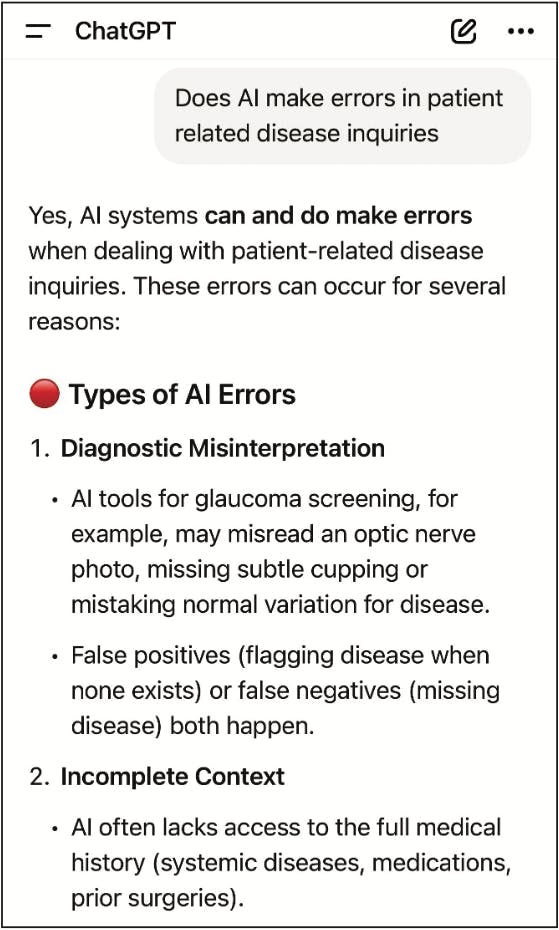
Treating AI as an aid rather than an authority is crucial. Ideally, AI should verify critical claims against trusted sources and maintain disclaimers when appropriate for information that can affect patient outcomes. Patient awareness of the strengths and limitations of AI will develop with time. Individuals can be encouraged to educate themselves about their disease and check original sources while performing AI inquiries.
CONCLUSION
Many patients turn to the internet and AI for education and answers, given the speed and convenience with which information can be acquired. Receiving a diagnosis from a physician can cause anxiety, and a quick online search may provide relief. That said, the internet often provides difficult-to-read, misleading, and poor-quality information. Studies, moreover, have highlighted how glaucoma websites typically exceed recommended readability levels. A lack of health information standards has also led to significant variability in the accuracy of online information. Institutional sources may be more reliable but are still subject to challenges.
Future efforts can focus on improving AI disclaimers and online readability and helping patients to detect misinformation and identify reliable resources. Initiatives by professional societies can help address some of these issues and provide better overall support for patients with glaucoma.
1. Shah R, Mahajan J, Oydanich M, Khouri AS. A comprehensive evaluation of the quality, readability, and technical quality of online information on glaucoma. Ophthalmol Glaucoma. 2023;6(1):93-99.
2. Jia JS, Shukla AG, Lee D, Razeghinejad R, Myers J, Kolomeyer NK. What glaucoma patients are reading on the internet: a systematic analysis of online glaucoma content. Ophthalmol Glaucoma. 2022;5(4):447-451.
3. Tan SSL, Goonawardene N. Internet health information seeking and the patient-physician relationship: a systematic review. J Med Internet Res. 2017;19(1):e9.
4. AlGhamdi KM, Moussa NA. Internet use by the public to search for health-related information. Int J Med Inform. 2012;81(6):363-373.
5. Cohen SA, Fisher AC, Pershing S. Analysis of the readability and accountability of online patient education materials related to glaucoma diagnosis an treatment. Clin Ophthalmol. 2023;17:779-788.
6. WHO releases AI ethics and governance guidance for large multi-modal models. World Health Organization. January 18, 2024. Accessed November 13, 2025. www.who.int/news/item/18-01-2024-who-releases-ai-ethics-and-governance-guidance-for-large-multi-modal-models?utm_source=chatgpt.com