Uveitis-glaucoma-hyphema (UGH) syndrome is a potential complication of cataract surgery and some MIGS procedures. Described by Ellingson in 1978 with anterior chamber IOLs,1 UGH syndrome is characterized by the IOL-mediated mechanical irritation of uveal tissues. This irritation causes inflammation, pigment dispersion, iris transillumination defects, increased IOP, hemorrhage in the anterior chamber with possible spillover into the posterior segment, cystoid macular edema (CME), and, rarely, secondary neovascularization on the iris.1,2
Advances in IOL material and design as well as surgical technique have reduced the incidence of UGH syndrome from 3% to between 0.4% and 1.2%, but it remains a relevant clinical entity, particularly in eyes with a malpositioned IOL optic or haptics, zonular instability,3 and plateau iris configuration.4
The clinical diagnosis of UGH syndrome requires a high index of suspicion based on the patient’s history, slit-lamp findings, and targeted ancillary imaging. A systematic diagnostic approach facilitates early recognition and prompt management with mechanistic-based interventions to minimize long-term ocular complications.
CLINICAL PRESENTATION AND HISTORY
Patients with UGH syndrome may present weeks to years following procedures involving IOLs, iris implants, or glaucoma implants. Chief complaints include intermittent blurry vision, “white out” vision, photophobia, hyperemia, and ocular pain or discomfort that may be out of proportion with examination findings.
Obtaining a detailed ocular surgical history is essential. Although initially observed with rigid anterior chamber IOLs, UGH syndrome has been described with one-piece IOLs placed in the sulcus and malpositioned one-piece IOLs intended for endocapsular placement5 as well as scleral-fixated IOLs, properly positioned one-piece IOLs in eyes with plateau iris and a small interplicata diameter,4,6 and MIGS devices such as the Hydrus Microstent and Ex-Press Glaucoma Filtration Device (both products from Alcon).7
SLIT-LAMP EXAMINATION, GONIOSCOPY, AND POSTERIOR SEGMENT FINDINGS
The cornerstone of diagnosis is the slit-lamp examination, with attention paid to the following signs of uveitis, glaucoma, and hyphema8:
- Anterior chamber cells and flare—indicating a breakdown of the blood-aqueous barrier. These may appear to be mild and, in rare circumstances, can appear as a hypopyon;
- Pigment dispersion from repeated mechanical trauma, which may lead to pigmented keratic precipitates;
- Microhyphema detected by gonioscopy or hyphema in the anterior chamber;
- Iris transillumination defects as evidence of iris contact with the IOL haptic or optic and associated focal iris atrophy (Figure 1);
- Elevated IOP, sometimes with significant fluctuations;
- Gonioscopic observation of blood within the angle, increased trabecular pigmentation secondary to uveal irritation, inflammatory debris, and, in some cases, malpositioned MIGS devices; and
- Vitreous hemorrhage in cases of posterior capsular violation or CME in more severe cases.8
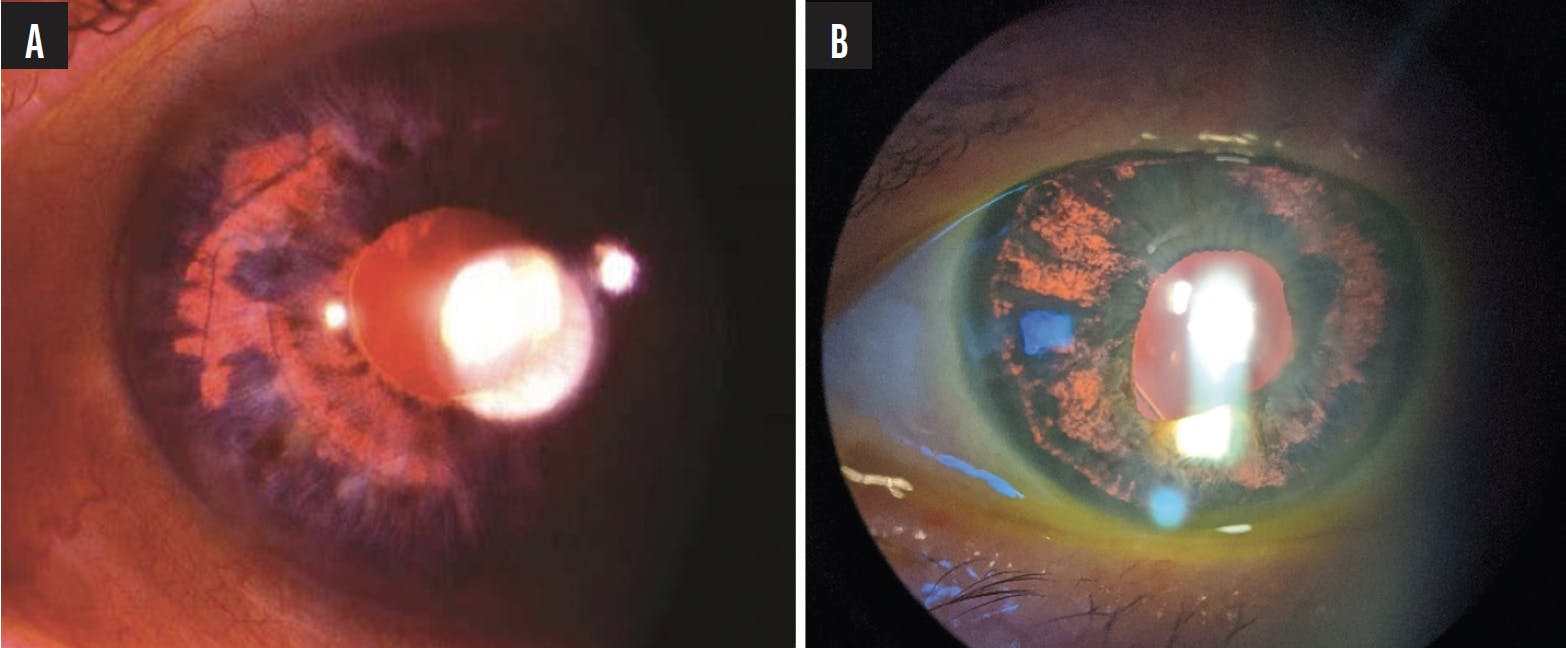
Figure 1. A slit-lamp photograph shows iris transillumination defects from the optic of a one-piece IOL and one haptic in the posterior chamber rather than the endocapsular bag (A). Another shows diffuse iris transillumination defects from a one-piece IOL placed in the ciliary sulcus (B). (Courtesy of Arsham Sheybani, MD © 2025 AAO and Garry Condon, MD)
ANCILLARY DIAGNOSTIC MODALITIES
Ultrasound Biomicroscopy
Ultrasound biomicroscopy (UBM) is the most informative imaging modality for UGH syndrome. If there is a dense hyphema (Figure 2A), UBM allows visualization of the IOL’s position relative to the iris, ciliary body, and angle. UBM can confirm the proper location of an IOL’s haptics and optic (Figure 2B), a tilted optic (Figure 2C), or the haptic of a one-piece IOL improperly placed in the ciliary sulcus.9
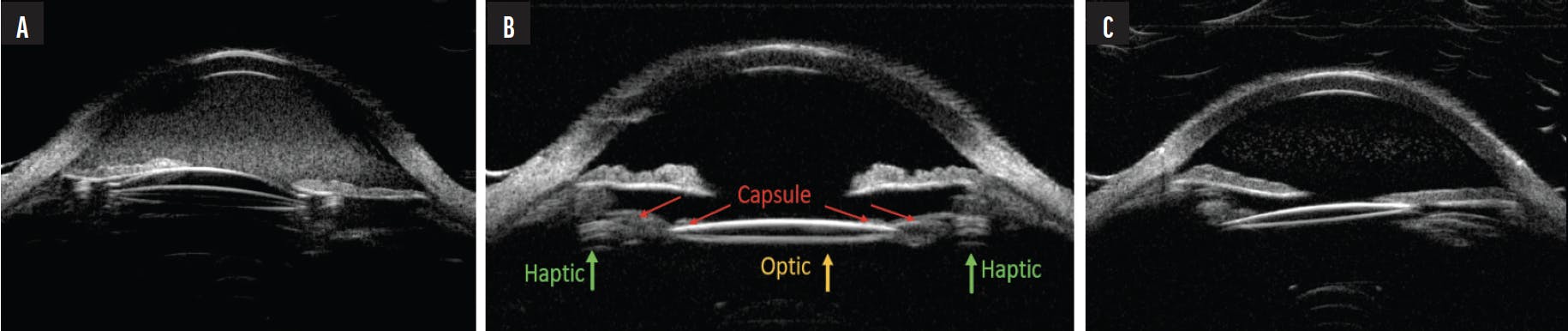
Figure 2. A UBM scan shows a dense echogenic signal consistent with hyphema and two one-piece or piggyback IOLs, with one in the capsular bag and the other in the sulcus, the optic touching the iris, and the haptics touching the iris (A). Another UBM scan shows optimal positioning of a one-piece IOL in the capsular bag (B), and another shows less dense echogenic material in the anterior chamber and a tilted lens optic touching the iris (C). (Courtesy of Sayoko Moroi, MD, PhD; Norma Allemann, MD, PhD; and M. Bernadete Ayres, MD)
Anterior Segment OCT
Although not diagnostic on its own, anterior segment OCT can complement UBM by imaging the angle for recession or peripheral synechiae, the IOL optic’s position through the pupil, iris chafing, or small iris transillumination defects such as the peephole sign.10 The limitations of anterior segment OCT include poor visualization of the ciliary body and ciliary sulcus.
OCT of the Macula
CME may be part of the UGH spectrum due to inflammation. CME can be evaluated objectively with OCT, adding to the clinical spectrum and aiding therapeutic planning and monitoring.8
IOP Monitoring
It is critical to measure IOP at every visit because an acute elevation in the context of inflammation and/or hyphema is part of the clinical spectrum of UGH syndrome.8
OCT of the Optic Nerve and Visual Field Testing
As the visual axis clears, potential damage to the optic nerve and visual field loss should be assessed with OCT imaging and visual field testing.
DIFFERENTIAL DIAGNOSIS
Based on the clinical spectrum of UGH syndrome with inflammation, pigmented keratic precipitates, iris atrophy, intraocular hemorrhage, elevated IOP, and prior intraocular surgery, the differential diagnosis should include the following:
- Unilateral anterior uveitis (such as herpes simplex virus), which can mimic UGH syndrome but typically lacks a history of ocular surgery and IOL-induced mechanical irritation of the uveal tissues11;
- Postoperative inflammation with CME, an IOL within the capsular bag, a lack of iris transillumination defects, plateau iris configuration, and UBM documentation of a haptic touching the ciliary processes and an intact capsular bag (Figure 3)4;
- Secondary glaucoma, including pigmentary, pseudoexfoliative, or angle-recession glaucoma, with elevated IOP, pigmented cells, and radially oriented transillumination defects of the iris but typically no hyphema or IOL-related mechanical elements, as is seen with UGH syndrome11; and
- Pseudoexfoliation, which should be considered in cases of delayed IOL subluxation in the capsule and uveitis.12

Figure 3. A UBM scan shows plateau iris configuration with an open angle, an absent ciliary sulcus, and anterior rotation of the ciliary processes (A). In the same case, the UBM scan also shows a haptic adjacent to the ciliary processes (dashed arrow, B). A transverse UBM scan through the ciliary body region shows where the haptic contacts the ciliary processes (C). Modified from Zhang L et al.⁴
PITFALLS AND CLINICAL PEARLS
IOL Placement
One-piece IOLs should be implanted in the capsular bag and not in the ciliary sulcus due to the risk of UGH syndrome. If capsular support is questionable, a multipiece IOL may be placed in the ciliary sulcus.
UGH syndrome can occur even when the IOL is implanted in the capsular bag. Zonular instability,12 plateau iris configuration,4 and small interplicata diameters have been implicated in these cases.6
Pigment and Precipitates
Pigment dispersion and keratic precipitates are underrecognized clinical signs of UGH syndrome. Their presence in the context of IOL history should raise suspicion for the complication.11
Temporary Symptoms
Transient clinical symptoms often lead to the misclassification of UGH syndrome as recurrent uveitis. A detailed temporal correlation with visual fluctuations, IOP spikes, and examination findings with key ancillary tests can help elucidate the underlying mechanistic etiology.
Anticoagulant Therapy
Surprisingly, anticoagulants are not independently associated with a higher incidence of UGH syndrome, even in patients with hyphema at presentation.13
CONCLUSION
As new glaucoma implants and IOLs are developed, UGH syndrome should remain on the differential for patients who are pseudophakic or have a history of MIGS and are experiencing cyclical inflammation, hemorrhage, or IOP fluctuation. Accurate diagnosis relies on a thorough history, characteristic slit-lamp findings, dynamic gonioscopy, and confirmatory UBM. The combined findings from a slit-lamp examination, gonioscopy, and UBM can determine the mechanism underlying UGH syndrome and guide definitive surgical planning. Timely recognition and intervention are essential to preserve visual function and quality of life in these patients.
This article was supported in part by the OSU Vision Sciences Research Core Program (P30EY032857) and by the Research to Prevent Blindness New Chair Challenge Grant.
1. Ellingson FT. The uveitis-glaucoma-hyphema syndrome associated with the Mark VIII anterior chamber lens implant. J Am Intraocul Implant Soc. 1978;4(2):50-53.
2. Foroozan R, Tabas JG, Moster ML. Recurrent microhyphema despite intracapsular fixation of a posterior chamber intraocular lens. J Cataract Refract Surg. 2003;29(8):1632-1635.
3. Apple DJ, Mamalis N, Loftfield K, et al Complications of intraocular lenses. A historical and histopathological review. Surv Ophthalmol. 1984;29(1):1-54.
4. Zhang L, Hood CT, Vrabec JP, Cullen AL, Parrish EA, Moroi SE. Mechanisms for in-the-bag uveitis-glaucoma-hyphema syndrome. J Cataract Refract Surg. 2014;40(3):490-492.
5. Chang DF, Masket S, Miller KM, et al. Complications of sulcus placement of single-piece acrylic intraocular lenses: recommendations for backup IOL implantation following posterior capsule rupture. J Cataract Refract Surg. 2009;35(8):1445-1458.
6. Garza PS, Man X, Queen JH, et al. Size matters for interplicata diameter: a case-control study of plateau iris. Ophthalmol Glaucoma. 2020;3(6):475-480.
7. Hou A, Hasbrook M, Crandall D. A case of uveitis-hyphema-glaucoma syndrome due to Ex-Press Glaucoma Filtration Device implantation. J Glaucoma. 2019;28(10):e159-e161.
8. Luo JT, Feng ZX, Wang C. Etiology and management of uveitis-glaucoma-hyphema syndrome: a comprehensive review. Int J Ophthalmol. 2025;18(8):1587-1593.
9. Piette S, Canlas OA, Tran HV, Ishikawa H, Liebmann JM, Ritch R. Ultrasound biomicroscopy in uveitis-glaucoma-hyphema syndrome. Am J Ophthalmol. 2002;133(6):839-841.
10. De Simone L, Mautone L, Aldigeri R, et al. Anterior segment optical coherence tomography in uveitis-glaucoma-hyphema syndrome. Ocul Immunol Inflamm. 2024;32(9):2085-2091.
11. Accorinti M, Saturno MC, Paroli MP, De Geronimo D, Gilardi M. Uveitis-glaucoma-hyphema syndrome: clinical features and differential diagnosis. Ocul Immunol Inflamm. 2022;30(6):1408-1413.
12. Durr GM, Ahmed IIK. Intraocular lens complications: decentration, uveitis-glaucoma-hyphema syndrome, opacification, and refractive surprises. Ophthalmology. 2021;128(11):e186-e194.
13. Armonaite L, Behndig A. Seventy-one cases of uveitis-glaucoma-hyphaema syndrome. Acta Ophthalmol. 2021;99(1):69-74.