Trabeculectomy has long been the gold standard of surgical treatment for lowering IOP in patients with glaucoma. The procedure’s ability to reduce IOP remains incomparable; however, outcomes can vary, and the manually created fistula in the subconjunctival space may lead to vision-threatening complications such as hypotony maculopathy, bleb-related infection, and endophthalmitis.1
As safer surgical alternatives such as MIGS have emerged, the preservation of ocular tissue, faster postoperative recovery, and a better safety profile have become priorities.2
Despite these advantages, MIGS often cannot achieve the ideal IOP threshold in eyes with advanced glaucoma. This imbalance between safety and effectiveness has led to the development of a new surgical paradigm known as minimally invasive bleb surgery (MIBS), which aims to combine the controlled subconjunctival filtration of traditional procedures with the less traumatic approach of MIGS.
FROM FIXED TO FLEXIBLE FILTRATION
Early MIBS devices demonstrated that reproducible subconjunctival blebs can be achieved using standardized microlumens as opposed to surgeon-cut fistulas. These procedures shortened recovery time and decreased postoperative variability, but their fixed lumen diameters restricted the surgeon’s control over early postoperative aqueous flow.3
Excessive resistance can lead to sustained elevated IOP, whereas insufficient resistance may result in hypotony. The need for a balance between safety and efficacy continues to influence the design of the next generation of filtration implants.
THE A-STREAM APPROACH
Developed in South Korea, the A-stream Glaucoma Shunt (Microt) introduces adjustability into the MIBS paradigm. The implant consists of a 6-mm silicone tube with a 100-µm lumen—approximately double the inner diameter of conventional MIBS devices. A soft central wing anchors the A-stream within the scleral tunnel, reducing the risk of migration or leakage (Figure 1).
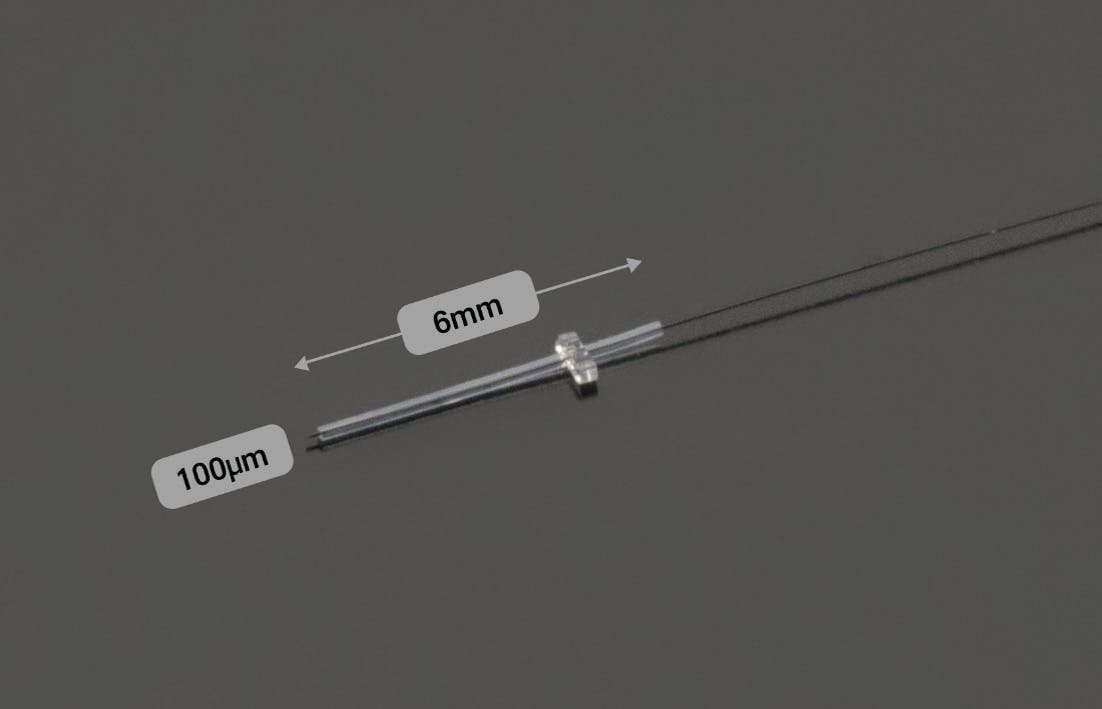
Figure 1. The A-stream Glaucoma Shunt (Microt) consists of a 6-mm silicone tube with a 100-µm lumen. A soft central wing anchors the implant within the scleral tunnel, reducing the risk of migration or leakage.
The notable feature of the device is its removable ripcord: a fine 7-0 nylon filament that temporarily occludes the lumen until the surgeon removes it. Once the bleb stabilizes, the ripcord can be removed to enhance aqueous outflow in a controlled, staged manner, thereby prioritizing stability first and performance next. Unlike a passive implant, this design empowers surgeons with active control during the postoperative healing period.
SURGICAL TECHNIQUE AND CLINICAL PERFORMANCE
The ab externo A-stream procedure is performed through a 30-gauge scleral entry located approximately 2 mm posterior to the limbus. A short conjunctival peritomy allows the direct application of mitomycin C to the target area to support a diffuse bleb morphology. The shunt is then guided into the anterior chamber under the scleral flap, with the ripcord tip retained beneath the conjunctiva for future retrieval (Figure 2).
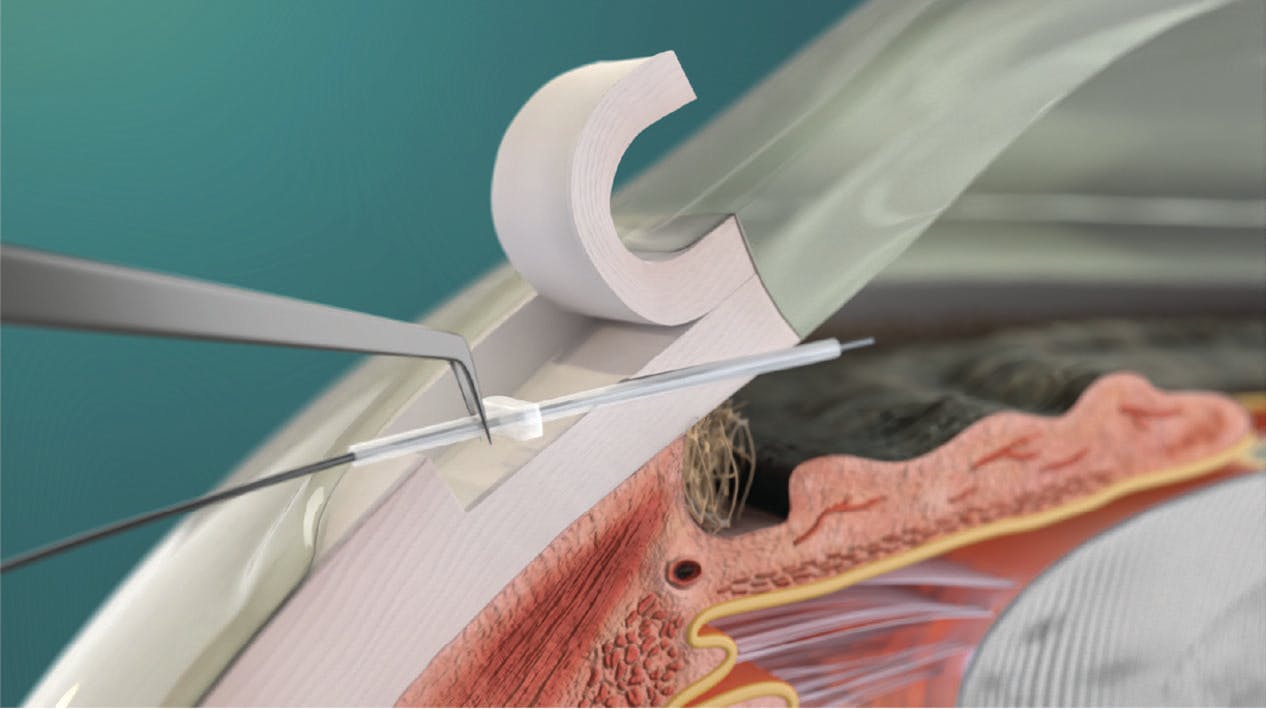
Figure 2. During the A-Stream procedure, the shunt is guided into the anterior chamber under the scleral flap, with the ripcord tip retained beneath the conjunctiva for future retrieval. The ripcord can be removed postoperatively to enhance aqueous outflow.
In a multicenter Korean study of the A-stream in 49 eyes with refractory glaucoma,4 the mean IOP decreased from 26.9 to 11.9 mm Hg (55%) at 6 months. Qualified success was achieved in 94% of cases, and the mean number of topical medications decreased from 3.1 to 0.1. There were no reports of chronic hypotony, a flat chamber, or infection. Nearly three-quarters of patients underwent ripcord removal within 8 weeks to achieve their target pressure.
DISTINCT ADVANTAGES
Similar to a mini-trabeculectomy, the ab externo A-stream procedure allows direct visualization of implant placement and bleb formation. Compared with ab interno techniques, the ab externo approach provides easier antifibrotic delivery and immediate intraoperative control of filtration height. The A-stream’s soft silicone tube, free of any metallic components, minimizes the risk of damage to the corneal endothelium. Upon removal of the ripcord, the wider lumen facilitates a robust yet stable flow of aqueous, potentially making the device suitable for patients with severely compromised conventional outflow pathways or a history of ocular surgery. As with large-plate tube shunts, the ability to adjust aqueous flow via ripcord removal provides surgeons with a degree of postoperative flexibility while also maintaining a microscale, conjunctiva-sparing design.
FUTURE DIRECTIONS
Preliminary outcomes with the A-stream have been promising4,5, but longer-term observation is required to confirm the longevity of blebs, endothelial safety, and consistency across surgical centers. Ongoing clinical programs aim to monitor 1-year results and provide direct comparisons with a similar MIBS device. Should findings remain favorable, the device’s staged-flow mechanism could offer surgeons the option of actively modulating the healing process.
Beyond its clinical metrics, the A-stream represents a shift in surgical philosophy. Filtration surgery is evolving from a static structural modification to an interactive process that can be adjusted as the eye heals. Such adaptability reflects a broader movement in glaucoma treatment toward personalized, titratable surgery that aligns the invasiveness of intervention with each patient’s disease profile and healing response.
CONCLUSION
The evolution of surgical options for glaucoma reflects ongoing efforts to balance efficacy with safety. The A-stream Glaucoma Shunt exemplifies this progression. In an early study, the implant offered trabeculectomy-like levels of IOP reduction through a predictable, less invasive, and finely adjustable design.4,5 Further studies are needed to confirm the device’s clinical outcomes across diverse groups of patients with glaucoma.
1. Wishart PK. Trabeculectomy is not the best surgical option for glaucoma. Eye (Lond). 2008;22(5):603-606.
2. Saheb H, Ahmed, II. Micro-invasive glaucoma surgery: current perspectives and future directions. Curr Opin Ophthalmol. 2012;23(2):96-104.
3. Yu Z, Wu M, Tao Y, et al. Efficacy analysis of microinvasive glaucoma surgery alone or in combination with phacoemulsification in patients with normal tension glaucoma: a systematic review and meta-analysis. BMC Ophthalmol. 2025;25(1):283.
4. Park HM, Lee EJ, Han JC, Rho S, Shin JH, Park DY. Short-term efficacy and safety of A-stream glaucoma shunt: a 6-month study. Eye (Lond). 2025;39(8):1584-1591.
5. Hwang YH, Lee S, Kim M, Choi J. Early clinical experience with the novel A-Stream Glaucoma Shunt combined with mid-posterior Tenon's capsule advancement flap. J Clin Med. 2025;15(1):56.