Key Takeaways
- Hypotony is a significant complication of glaucoma surgery, frequently observed following filtering surgery.
- Identifying the causes and sequelae of hypotony can be a challenge with slit-lamp examinations and indirect ophthalmoscopy alone.
- Imaging modalities such as OCT, A- and B-scan ultrasound, and ultrasound biomicroscopy may be valuable complementary tools for diagnosing and managing hypotony.
Hypotony (IOP < 5–6 mm Hg) may be a significant complication of glaucoma surgery and is most frequently observed during the postoperative period, particularly following filtering surgery. Although the condition is often visually insignificant and/or transient, persistent and visually significant hypotony can lead to adverse outcomes. Clinically significant hypotony may induce neurosensory retinal and structural alterations, potentially resulting in irreversible visual impairment.1,2
Identifying the causes and sequelae of hypotony can be challenging with slit-lamp examinations and indirect ophthalmoscopy alone. Ocular imaging modalities such as OCT and ultrasound are therefore valuable tools for prompt diagnosis and management.
HYPOTONY MACULOPATHY
Hypotony maculopathy from persistently low IOP can create retinal and choroidal folds in the macula, which can reduce or distort patients’ central vision. Peaks and valleys in these folds from severe maculopathy are visible on fundus examination, but subtle cases can be difficult to detect on examination. In subtle hypotony maculopathy, OCT of the macula can show chorioretinal folds involving the retinal pigment epithelium and Bruch membrane and, in advanced cases, more extensive folds in the inner retinal layers (Figure 1).3
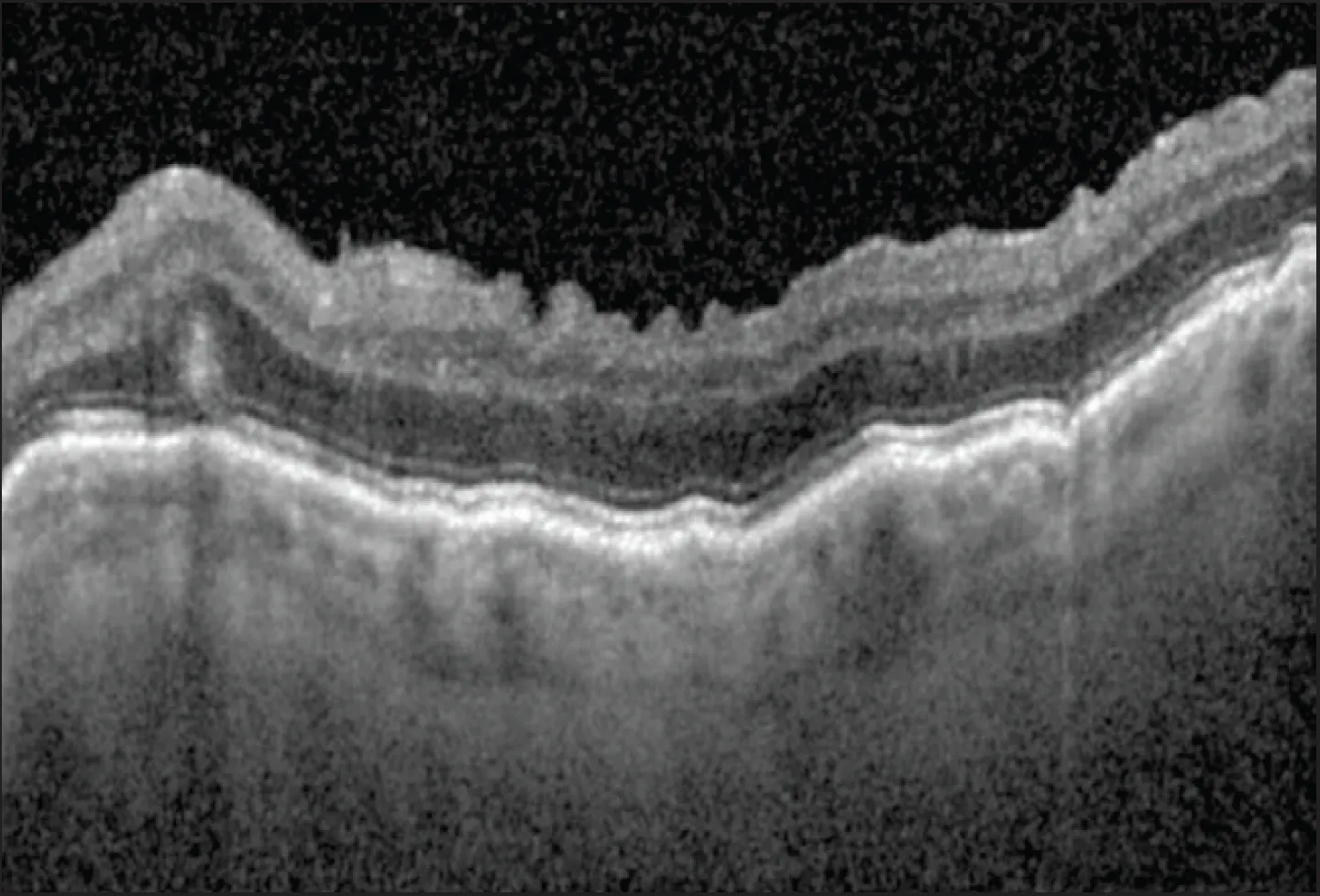
Figure 1. Significant chorioretinal folds consistent with hypotony maculopathy are visualized using OCT of the macula.
REFRACTIVE SHIFT
The surgical reduction of IOP can cause choroidal expansion, which shifts the eye’s focal point more posteriorly relative to the retina and may cause a hyperopic shift.4 Conversely, decreased IOP can create a relative pressure gradient and anterior movement of the lens-iris diaphragm,5 which can temporarily induce a myopic shift, typically in the early postoperative period. Although pre- and postoperative manifest refraction can assist with clinical diagnosis, A-scan ultrasonography and optical biometry may provide more reliable measurements of axial length, anterior chamber depth, and effective lens position.
CHOROIDAL DETACHMENT
In cases of hypotony, choroidal detachments are often accompanied by a shallow anterior chamber. Patients may experience a decrease in vision if the detachments extend over or involve the macula or if shallowing of the anterior chamber causes a refractive shift.
There are two types of choroidal detachments, serous and hemorrhagic, and the former is more common than the latter. Mechanistically, both begin with a decrease in IOP, which results in a pressure gradient between the choroidal space and choroidal capillaries.1,2,6
Serous Choroidal Detachments
In serous choroidal detachments, differences in hydrostatic pressure allow movement of transudative fluid from the choroidal capillaries into the suprachoroidal space, causing a dome-shaped separation of the choroid from the sclera. Risk factors include increased age, extreme axial length (high myopia or nanophthalmos), and chronic uveitis.1,2,6 Symptoms include decreased vision and mild, dull pain that is caused by scleral stretching and rotation of the ciliary body.1,2
Hemorrhagic Choroidal Detachments
Hemorrhagic choroidal detachments can result from an abrupt, substantial drop in IOP, which ruptures short posterior choroidal arteries or choroidal veins. The hemorrhage collects in the suprachoroidal space, separating the choroid from the sclera. For this reason, hemorrhagic choroidal detachments tend to present more suddenly and with more significant pain compared with serous detachments. Risk factors include high preoperative IOP, hypertension, high myopia, postvitrectomy status, and systemic anticoagulation.1,2,6
Diagnosis
Visualization on indirect ophthalmoscopy is possible when choroidal detachments are large, encroaching on the macula or kissing. When the detachment is more anterior, however, diagnosis and classification can be achieved through B-scan ultrasound imaging. A well-circumscribed, smooth, and dome-shaped membrane will be visible rising in a convex shape into the vitreous cavity (Figure 2). Unlike retinal detachments, choroidal detachments are immobile and can extend past the ora serrata on B-scan ultrasound. The space beneath the membrane appears hypoechoic in serous choroidal detachments (Figure 2) and hyperechoic in hemorrhagic choroidal detachments—a distinction that can be crucial for management.1,2,6,7
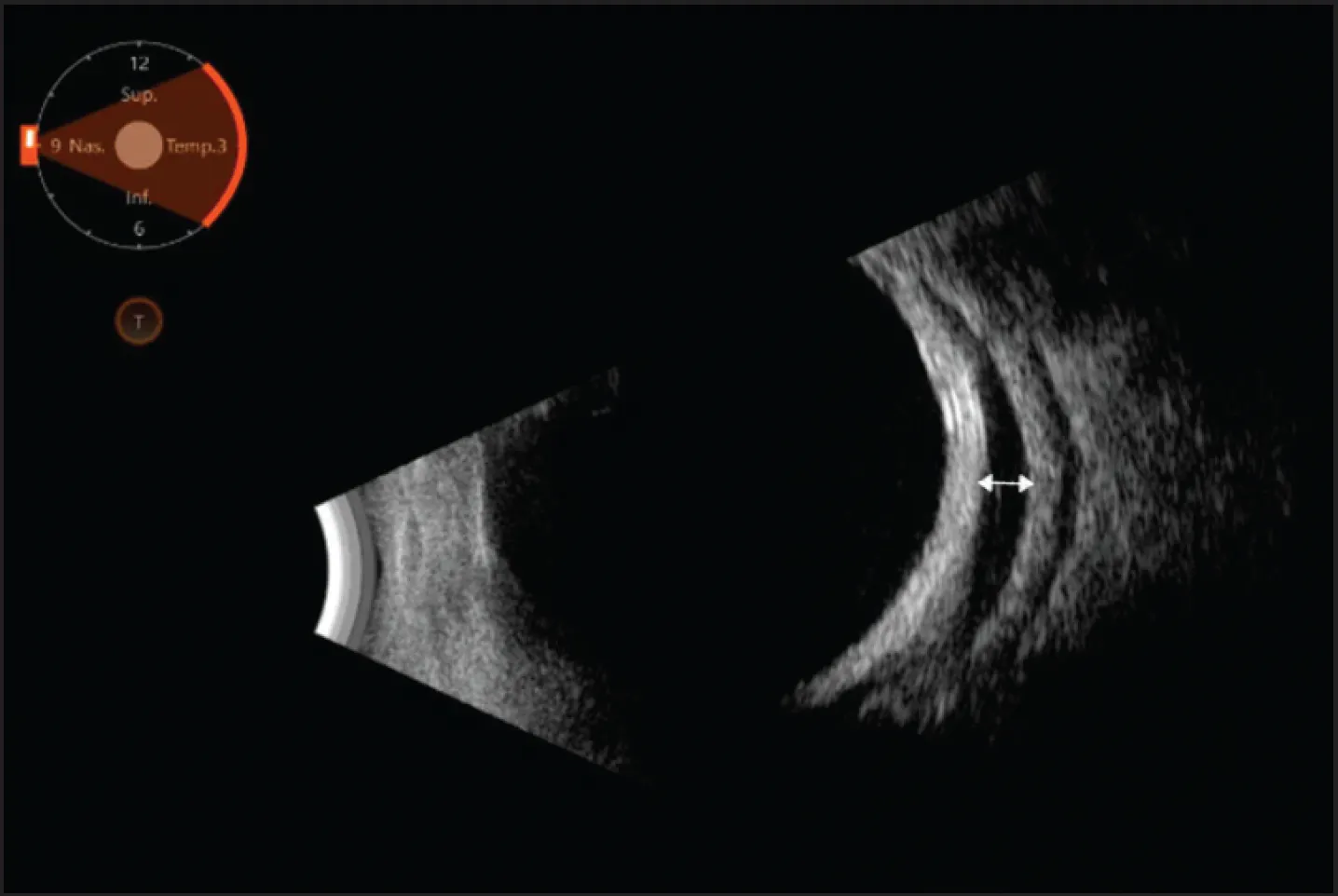
Figure 2. Serous choroidal detachment is demonstrated with a shallow hyperechoic membrane overlying the hypoechoic transudative fluid (white arrow) on B-scan ultrasound.
PHTHISIS BULBI
Chronic and severe hypotony can cause the globe to shrink, accompanied by a complete loss of vision and eye function. Diagnosis typically relies on the clinical history and examination, including pseudo-enophthalmos and dystrophic changes of the cornea and lens.1,2,8 B-scan ultrasound can help confirm a reduction in axial length, internal disorganization of anatomic structures, and an absence of retinal or choroidal detachments. B-scan imaging can also identify dystrophic tissues, which may demonstrate posterior shadowing and hyperechogenicity due to calcification.1,2,8
CYCLODIALYSIS CLEFT
Hypotony may result from a cyclodialysis cleft caused by blunt ocular trauma or iatrogenic issues, including after MIGS. The cleft occurs due to a physical disinsertion of the longitudinal ciliary muscles from the scleral spur.
Gonioscopy is the gold standard for diagnosis. Usually, the extent of the anatomic separation between the ciliary body and scleral spur is indicated by a white sheen, reflecting the bare scleral wall and abnormal posterior displacement of the iris root. Gonioscopy can be difficult, however, when hypotony, corneal edema, or hyphema is present—all of which are common after a cyclodialysis cleft.
Ultrasound biomicroscopy (UBM) is an important complementary method for diagnosing and evaluating the circumferential extent of a cyclodialysis cleft. On imaging, the cleft appears as a distinct, hypoechoic space between the anterior chamber and the suprachoroidal space (Figure 3). UBM can be crucial for preoperative planning and the postoperative management of large clefts as well as for monitoring the resolution of small clefts.
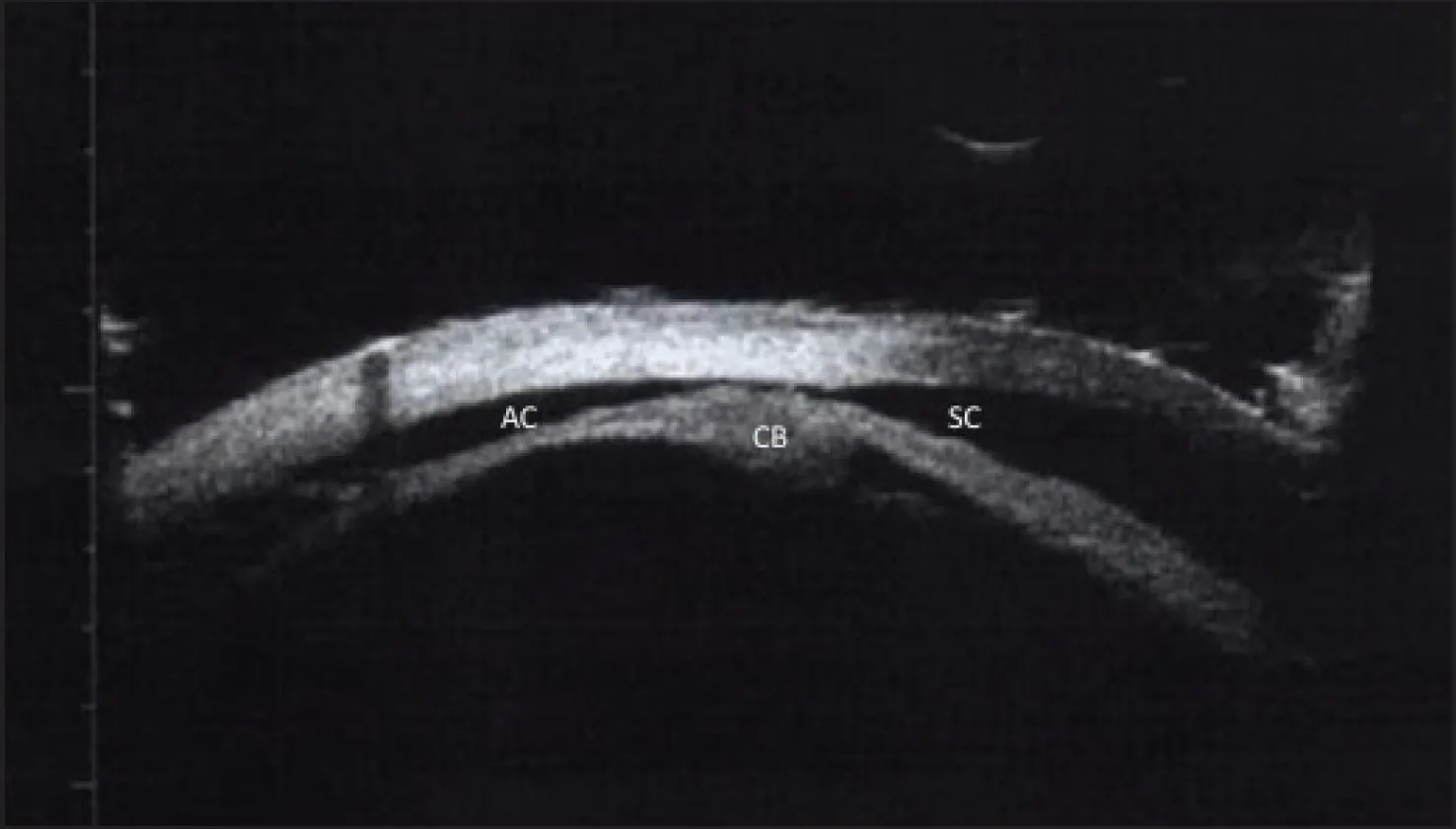
Figure 3. UBM is used to visualize a hypoechoic cyclodialysis cleft, superior to the ciliary body (CB) and a conduit between the anterior chamber (AC) and suprachoroidal space (SC), in relation to anterior segment structures.
1. Ghobashy HM, Elmaria AF, Ghoneim AM, Eid TEM. Ocular hypotony after glaucoma surgery. Ophthalmology Research: An International Journal. 2022;17(3):8-15.
2. Siegfried CJ, Rosenberg LF, Krupin T, Jampol LM. Hypotony after glaucoma filtration surgery: mechanisms and incidence. J Glaucoma. 1995;4(1):63-69.
3. Budenz DL, Schwartz K, Gedde SJ. Occult hypotony maculopathy diagnosed with optical coherence tomography. Arch Ophthalmol. 2005;123(1):113-114.
4. Francis BA, Wang M, Lei H, et al. Changes in axial length following trabeculectomy and glaucoma drainage device surgery. Br J Ophthalmol. 2005;89(1):17-20.
5. Fechtner RD, Khouri AS. Early vision loss after trabeculectomy. In: Feldman RM, Bell NP, eds. Complications of Glaucoma Surgery. Oxford University Press; 2013:113-120.
6. Waheed NK, Mendonça LSM, Young LH. Choroidal effusions and detachments. In: Albert DM, Miller JW, Azar DT, Young LH, eds. Albert and Jakobiec’s Principles and Practice of Ophthalmology. Springer; 2020:3857-3874.
7. Bhatt VD, Bhatt DC, Bhatt KD, et al. The “triangle” sign: a novel ultrasound marker for diagnosing total choroidal detachment and total suprachoroidal hemorrhage. Clin Ophthalmol. 2025;19:261-268.
8. Tripathy K, Chawla R, Temkar S, et al. Phthisis bulbi-a clinicopathological perspective. Semin Ophthalmol. 2018;33(6):788-803.
9. Ormerod LD, Baerveldt G, Sunalp MA, Riekhof FT. Management of the hypotonous cyclodialysis cleft. Ophthalmology. 1991;98(9):1384-1393.