KEY TAKEAWAYS
- Steroid response is thought to develop secondary to the buildup of glycosaminoglycans in the trabecular meshwork, which increases resistance to aqueous outflow.
- In patients with steroid-response glaucoma, minimally invasive angle-based surgeries can be remarkably effective.
- Gonioscopy-assisted transluminal trabeculotomy merits consideration in these cases because the procedure is likely to lower IOP significantly and minimize the medication burden.
A 68-year-old woman with an IOP of 42 mm Hg OS was referred to me emergently by her retina specialist. The patient’s IOP had begun to rise after uneventful bilateral cataract surgery a few months ago. She had developed refractory cystoid macular edema (CME) in her left eye that required prolonged treatment with topical steroids. One month before her presentation to my office, she had received intravitreal and sub-Tenon injections of triamcinolone acetonide in her left eye.
At the time of presentation, the therapeutic regimen for her left eye consisted of brimonidine and a fixed combination of dorzolamide and timolol dosed twice daily, but the patient was having difficult with adherence. Her ocular history was not significant apart from CME, but her family history was notable for primary open-angle glaucoma in her mother. On examination, the patient’s right eye had a visual acuity of 20/20 and an IOP of 13 mm Hg, and her affected left eye had a visual acuity of 20/200 and an IOP of 42 mm Hg.
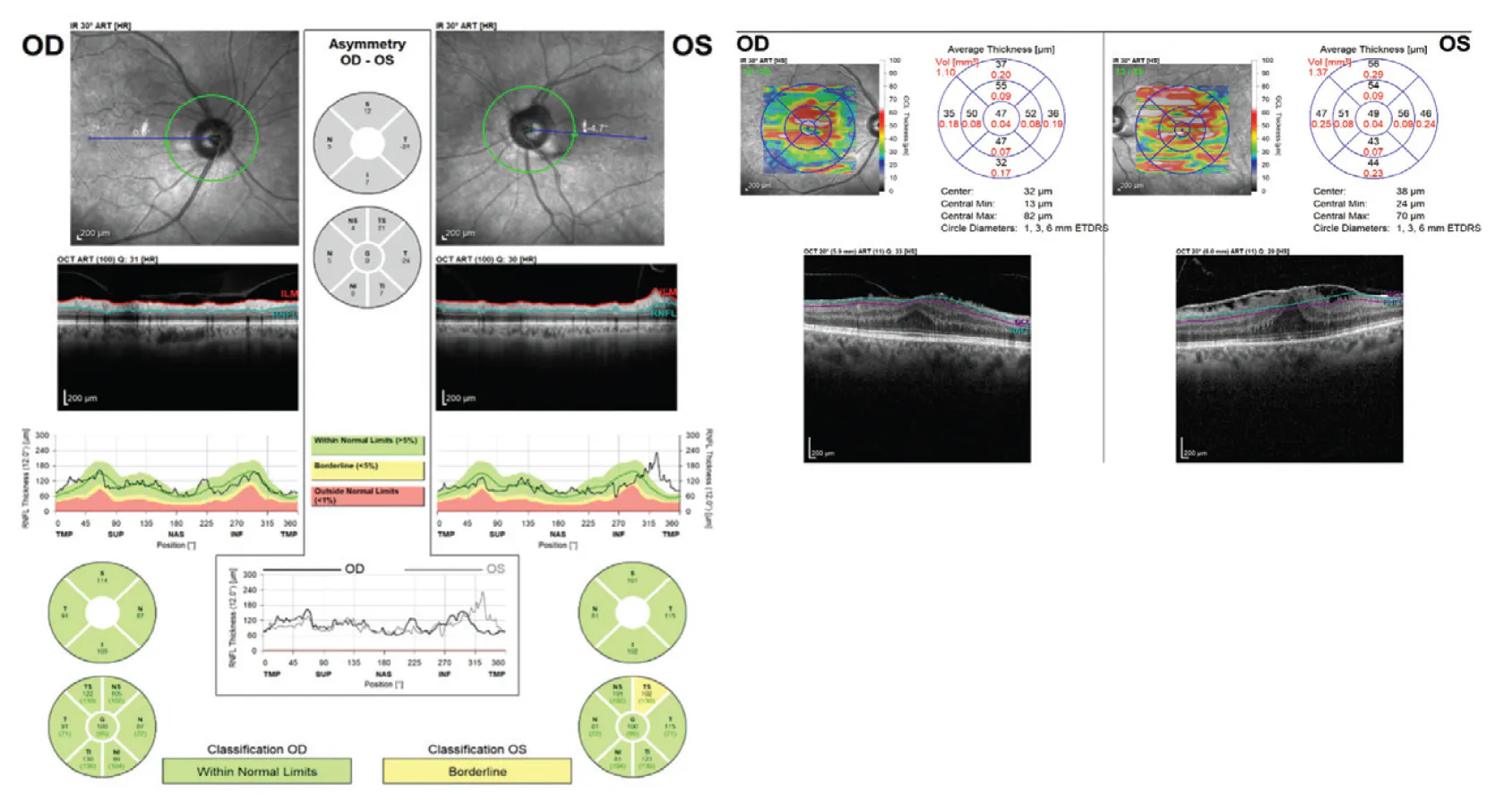
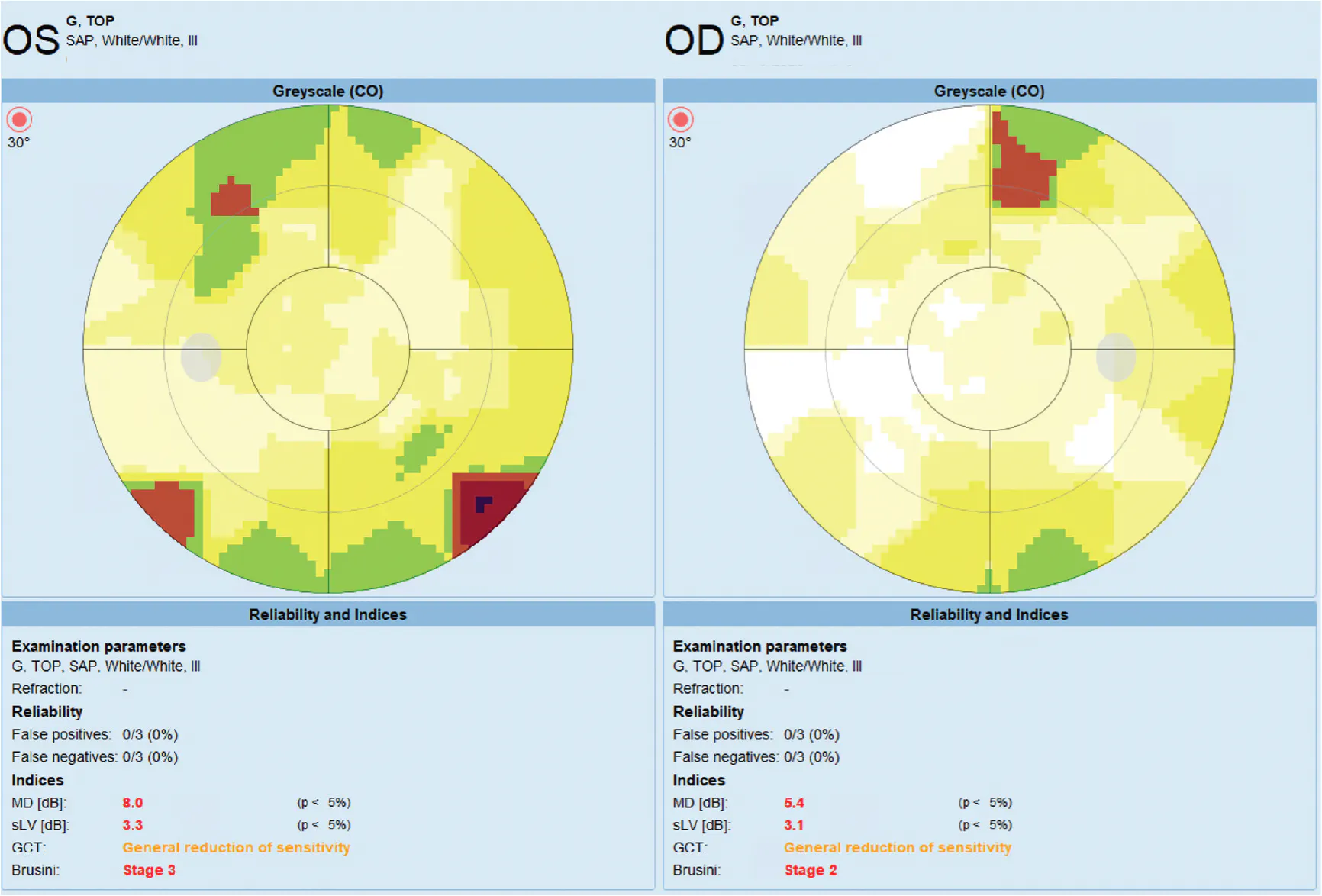
An examination of the anterior segment of the left eye showed a clear cornea, an IOL that was well positioned in the bag, and no signs of anterior uveitis. Gonioscopy revealed a deep and open angle to the ciliary body band in four quadrants without peripheral anterior synechiae. A posterior segment examination showed CME and vitreomacular traction. The optic nerve appeared to be healthy, with an intact rim and a cup-to-disc ratio of 0.3. OCT imaging of the right eye was normal. OCT imaging of the left eye showed borderline retinal nerve fiber layer thinning but was confounded by an epiretinal membrane and macular thickening (Figure 1). Visual field testing (Octopus, Haag-Streit) showed nonspecific general depression in both eyes, with possible early arcuate changes in the left eye (Figure 2).
UPDATING THE PHARMACEUTICAL REGIMEN
Given the examination findings and the temporal relationship between the patient’s IOP elevation and treatment for CME, I suspected steroid-response glaucoma. She initially favored a noninterventional approach, so a fixed combination of netarsudil and latanoprost (Rocklatan, Alcon) dosed every night was added to her existing drug regimen, and the importance of adherence was emphasized.
The patient’s IOP decreased to 16 mm Hg, and the fixed combination of netarsudil and latanoprost was eventually discontinued to prevent exacerbation of the CME. The IOP in the left eye was maintained at 13 mm Hg for 3 months, at which time she presented with an IOP of 35 mm Hg after having recently discontinued all drops due to ocular irritation. An examination showed significant periocular erythema, conjunctival injection, and a papillary reaction. I suspected that the glaucoma drops had caused ocular surface medicamentosa. Over the next few weeks, various preservative-free drop regimens were trialed, but they exacerbated her symptoms. Oral acetazolamide was contraindicated owing to her allergy to sulfa drugs. Ultimately, the only drop that the patient could tolerate was latanoprost, which carried a risk of exacerbating her CME.
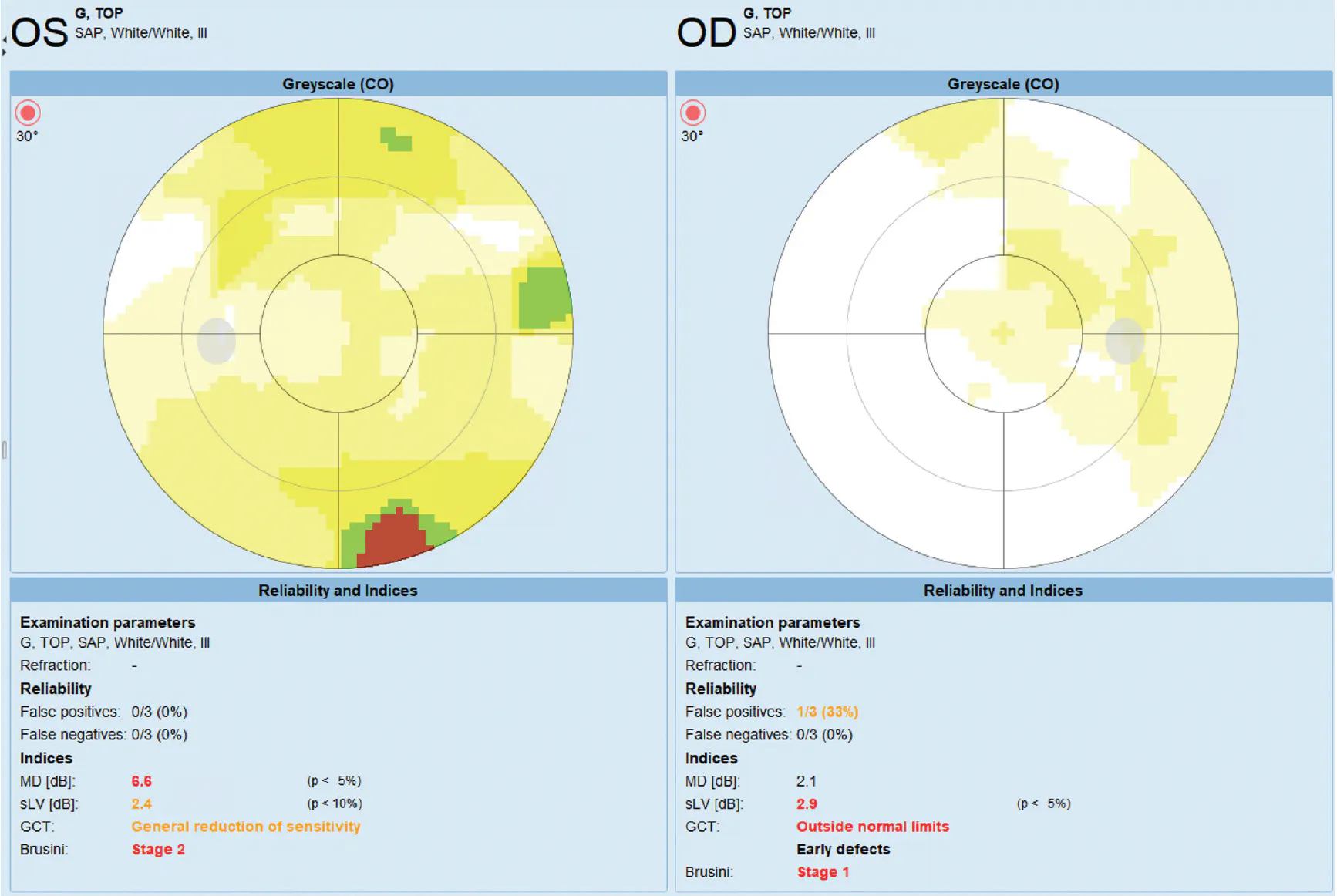
Her IOP was controlled on latanoprost, and the ocular surface disease resolved. Several months later, however, the patient received a vitrectomy and membrane peel in her left eye, and the IOP climbed to 35 mm Hg postoperatively. Her CME worsened around this time, and a need for higher doses of steroids was anticipated. OCT was unreliable secondary to CME, and a visual field test showed nonspecific general depression and signs of a possible early superonasal defect in the left eye (Figure 3).
OPTING FOR A MINIMALLY INVASIVE SURGICAL APPROACH
With the alternatives for topical medical therapy exhausted, I revisited the option of surgical intervention with the patient. Unmedicated IOP control was the goal, given her allergies and concern about worsening CME with latanoprost treatment. Although tube shunt surgery or a trabeculectomy would have been most likely to lower the IOP sufficiently, she was disinclined to undergo those procedures because of their prolonged postoperative recovery and risk of complications. She also worried that filtering surgery could limit her active lifestyle.
Given her current IOP level, I felt that selective laser trabeculoplasty was unlikely to lower her IOP sufficiently, and the procedure carried the risk of an IOP spike. We discussed the option of goniotomy-assisted transluminal trabeculotomy (GATT). Because a component of her IOP elevation was likely related to a steroid response, I reasoned that GATT could be effective. I counseled her, however, that it might not free her from topical therapy and filtering surgery might later be needed.
The patient elected to proceed with 360º GATT, which was performed without complication. At postoperative week 1, her unmedicated IOP was 18 mm Hg. By postoperative month 1, her IOP was 16 mm Hg off glaucoma drops, although she was instilling prednisolone acetate four times daily for the treatment of CME. At postoperative month 6, her IOP was 16 mm Hg, and at 1 year postoperatively, her IOP was 18 mm Hg off all glaucoma drops and on prednisolone acetate once daily for CME. Although OCT was still confounded by CME, visual field testing at this time had improved reliably and showed no further damage.
CONCLUSION
In patients with steroid-response glaucoma, minimally invasive angle-based surgeries such as GATT can be remarkably effective. Steroid response is thought to develop secondary to the buildup of glycosaminoglycans in the trabecular meshwork, which increases resistance to aqueous outflow.1 During GATT, the trabecular meshwork is incised for 360º, and the distal collector channels are dilated, which can disrupt resistance and improve outflow. In a retrospective case series of 13 patients with steroid response who underwent GATT, all patients achieved an IOP reduction greater than 20% at 24 months postoperatively and experienced a significant reduction in the number of IOP-lowering medications required.2
GATT merits consideration in patients with uncontrolled IOP and steroid-response glaucoma, because the procedure is likely to lower IOP significantly and minimize their medication burden. It may even offer them drop independence.
1. Johnson D, Gottanka J, Flugel C, et al. Ultrastructural changes in the trabecular meshwork of human eyes treated with corticosteroids. Arch Ophthalmol. 1997;115:375-383.
2. Boese EA, Shah M. Gonioscopy-assisted transluminal trabeculotomy (GATT) is an effective procedure for steroid-induced glaucoma. J Glaucoma. 2019;28(9):803-807.