KEY TAKEAWAYS
- Expanding options are allowing surgeons to tailor glaucoma treatment more precisely.
- In this case, combining sustained drug delivery with suprachoroidal outflow enhancement provided a physiologic method of lowering IOP after prior trabecular surgery.
A 75-year-old pseudophakic woman with primary open-angle glaucoma (POAG) was referred for a surgical consultation.
Two years ago, the patient underwent selective laser trabeculoplasty (SLT), followed by placement of a bimatoprost implant (Durysta, AbbVie) in each eye. SLT was repeated 5 months later in both eyes with little success. The patient subsequently underwent angle surgery with iStent Infinite (Glaukos) implantation plus viscodilation in both eyes. Despite this stepwise, layered approach targeting the trabecular outflow pathway, her IOP rose again after approximately 1 year of control.
Upon evaluation, the patient’s visual acuity was 20/20 OD and 20/30 OS. Goldmann applanation tonometry revealed unmedicated IOPs of 28 mm Hg OD and 25 mm Hg OS. An optic nerve examination demonstrated cup-to-disc ratios of approximately 0.7, with superior and inferior retinal nerve fiber layer thinning in both eyes on OCT (Figure 1). The visual field of the right eye was full, but progression was noted in the left eye (Figure 2). Based on these findings, the patient was classified as having mild POAG in the right eye and moderate POAG in the left eye. Her target IOP was set below the high teens in the right eye and below the middle teens in the left eye.
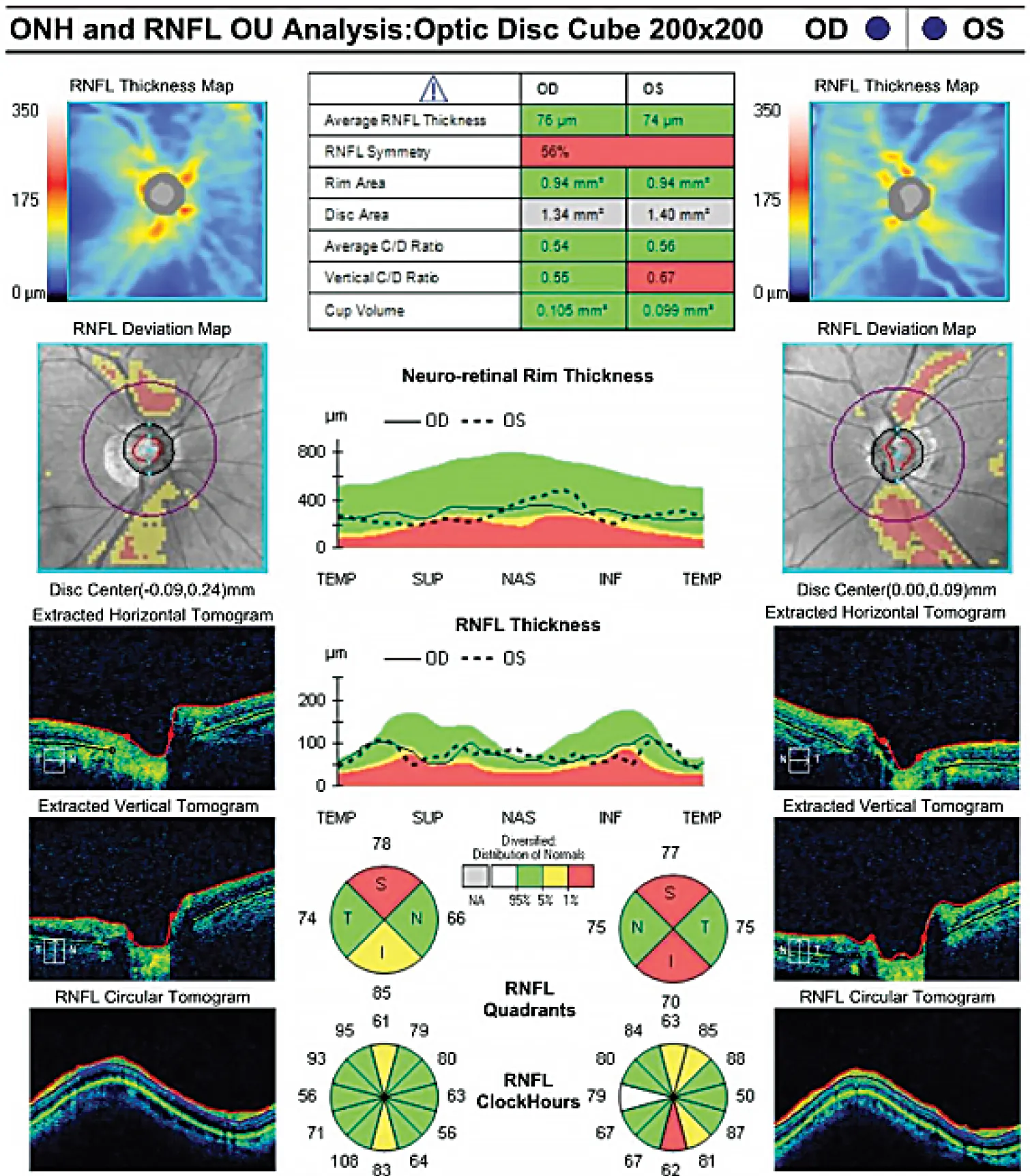
Figure 1. OCT demonstrated thinning of the retinal nerve fiber layer in the superior and inferior quadrants of both eyes.
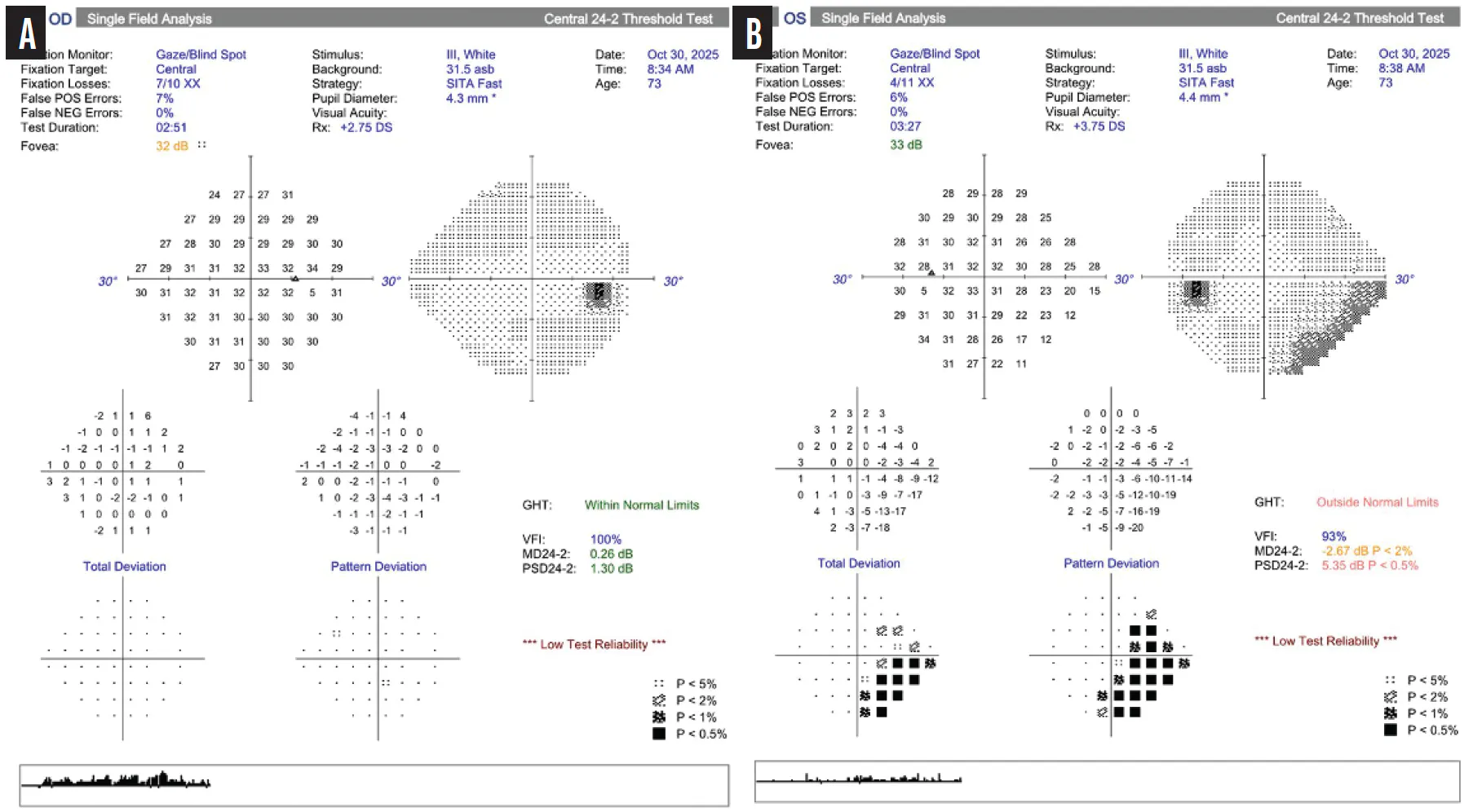
Figure 2. A full visual field was observed in the right eye (A). An early superior arcuate defect and a moderate inferior arcuate defect were seen in the left eye that had progressed from previous visual field testing (B).
Of note, the patient has a limited tolerance of topical glaucoma medications, particularly prostaglandin analogues (PGAs) and Rho kinase inhibitors, which have caused significant ocular surface irritation in the past. Given her elevated IOP, poor tolerance of topical therapy, and the evidence of disease progression in the left eye, surgical escalation was recommended.
MANAGEMENT OF THE LEFT EYE
The patient’s left eye demonstrated moderate POAG with documented progression despite prior laser and angle procedures. With a target IOP in the middle teens and her intolerance of topical therapy, a Xen Gel Stent (AbbVie) was implanted using an open-conjunctiva ab externo technique with the application of 40 µg of mitomycin C.
The surgery created a functioning filtering bleb; however, as is common with subconjunctival filtration procedures, postoperative management required clinic-based interventions and frequent follow-up. During the early postoperative period, three subconjunctival injections of 5-fluorouracil were performed to improve bleb function and control subconjunctival fibrosis. At 3 months postoperatively, the IOP measured 15 mm Hg OS on a single aqueous suppressant.
RECONSIDERING THE STRATEGY FOR THE RIGHT EYE
The patient’s right eye presented a different clinical scenario. Although the IOP remained elevated despite prior interventions (two SLT treatments, intracameral PGA therapy, and trabecular bypass with viscodilation), the disease stage remained mild.
A subconjunctival filtering procedure similar to that performed in the fellow eye was an option but several factors recommended against this approach:
- The right eye had less advanced disease and a higher IOP target than the left eye;
- The experience with the left eye highlighted the postoperative management burden and intensity of bleb-forming surgery;
- The patient was eager to try a less invasive option if available; and
- A repeat trabecular meshwork–based procedure was unlikely to meaningfully lower the IOP.
The treatment strategy therefore shifted toward engaging a different physiologic outflow pathway while simultaneously reducing the patient’s reliance on topical medication.
MANAGEMENT OF THE RIGHT EYE
An intracameral travoprost implant (iDose, Glaukos) was placed, a cyclodialysis cleft was created, and scleral allograft reinforcement (AlloFlo, Iantrek) was performed. This combined strategy was selected for several reasons.
First, the intracameral travoprost implant provides sustained PGA therapy without requiring daily topical administration. Intracameral drug delivery offered a more reliable and better tolerated means of lowering the IOP.
Second, PGAs and suprachoroidal implants may provide physiologic synergy. PGAs increase uveoscleral outflow. Suprachoroidal implants enhance access to this same uveoscleral drainage pathway. By combining these approaches, both therapies act on the same outflow system and may produce additive IOP-lowering effects.
Third, the uveoscleral pathway can be an important option for patients who have undergone trabecular bypass procedures. Once the trabecular meshwork has been surgically addressed, targeting a different outflow pathway may provide a minimally invasive way to regain IOP control without immediately escalating to filtration surgery.
Finally, the combined strategy preserved the conjunctiva without the formation of a filtering bleb.
POSTOPERATIVE COURSE
Surgery on the right eye was uneventful. One day postoperatively, an anterior segment examination confirmed appropriate placement of the implants, the IOP was 12 mm Hg, and the patient’s visual acuity was 20/40 OD.
Her visual acuity improved to 20/30 OD at week 1 and 20/20 OD at month 1, and her IOP stabilized in the high teens on a single aqueous suppressant (brimonidine), which the patient could tolerate.
She reported improved visual clarity and no significant postoperative discomfort. Importantly, this approach avoided a bleb surgery, reducing the long-term management burden associated with subconjunctival filtration procedures.
CONCLUSION
Expanding options are allowing surgeons to tailor glaucoma treatment more precisely. In this case, combining sustained PGA delivery with suprachoroidal outflow enhancement provided a physiologic method of lowering IOP after prior trabecular surgery.
For patients with mild to moderate disease and a history of trabecular outflow surgery, targeting the uveoscleral pathway can provide a valuable minimally invasive alternative to filtration surgery while preserving future options.
Author’s AI disclosure: An AI language model (Gemini 3, Google) was used to assist with language editing. All content was reviewed, verified, and revised by the author, who assumes full responsibility for the accuracy and integrity of the manuscript. The AI tool was not used for data analysis, interpretation, or drawing scientific conclusions.