KEY TAKEAWAYS
- A stepwise, tailored approach is crucial to balancing the safety and efficacy of IOP management, particularly in young patients with a goal of vision preservation.
- Individualized therapy based on glaucoma etiology, age, life expectancy, inflammatory status, angle anatomy, medication tolerance and adherence, and rate of disease progression can help to minimize risk and improve outcomes.
- Compared to traditional filtering surgeries, gonioscopy-assisted transluminal trabeculotomy offers a favorable safety profile, with fewer long-term complications.
A 27-year-old phakic woman with a history of chronic, recurrent anterior uveitis in both eyes was referred for management of uveitic glaucoma and steroid-induced IOP elevation. Her uveitis was being treated with topical corticosteroid drops in both eyes. One sub-Tenon triamcinolone acetonide injection had been administered in the left eye 6 months prior. Her past uveitis workup did not reveal any infectious (syphilis, tuberculosis, HIV), inflammatory (angiotensin converting enzyme, lysozyme), or autoimmune (human leukocyte antigen B27, antinuclear antibodies) laboratory markers. Her medical glaucoma regimen consisted of four eye drops, including a prostaglandin analogue, a beta-blocker, a carbonic anhydrase inhibitor, and an alpha agonist, as well as oral acetazolamide.
When I first evaluated the patient, her BCVA was 20/20 OD and 20/25 OS. Her IOP measured 18 mm Hg OD and 29 mm Hg OS with Goldmann applanation tonometry on maximally tolerated medical therapy. Her IOP measurements had been in the 40s mm Hg OS before oral acetazolamide was added.
A slit-lamp examination revealed a quiet anterior chamber in the right eye and trace anterior chamber cell in the left eye. The crystalline lenses were mostly clear, with a few areas of posterior synechiae. The cup-to-disc ratio was 0.5 in both eyes. Gonioscopy demonstrated open angles with mild, fine scattered peripheral anterior synechiae. OCT showed inferior thinning of the retinal nerve fiber layer (RNFL) in the left eye and a grossly full RNFL in the right eye (Figure 1). Humphrey visual field testing (Carl Zeiss Meditec) revealed superior arcuate and nasal defects in the left eye and early superior and nasal changes in the right eye (Figure 2).
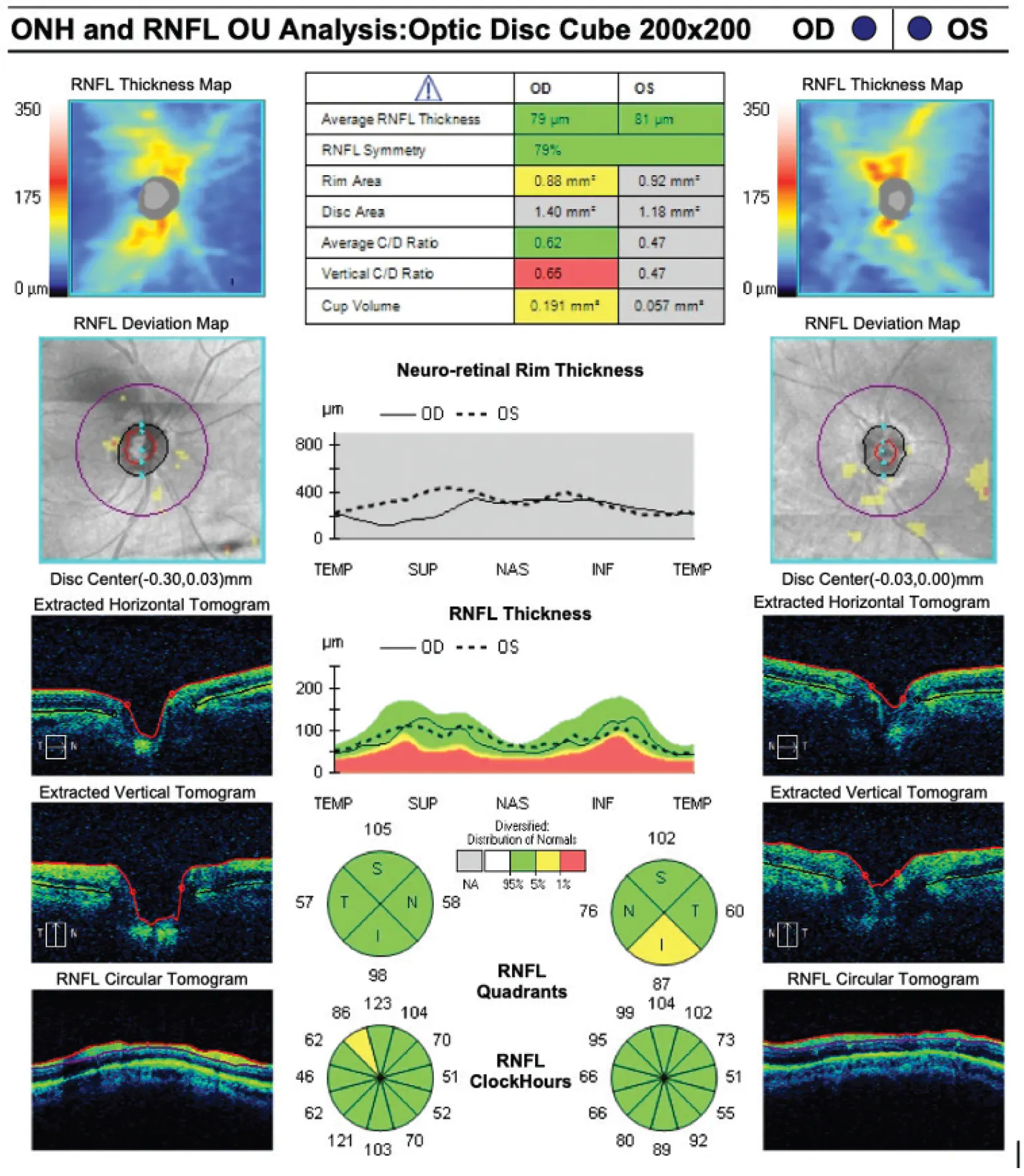
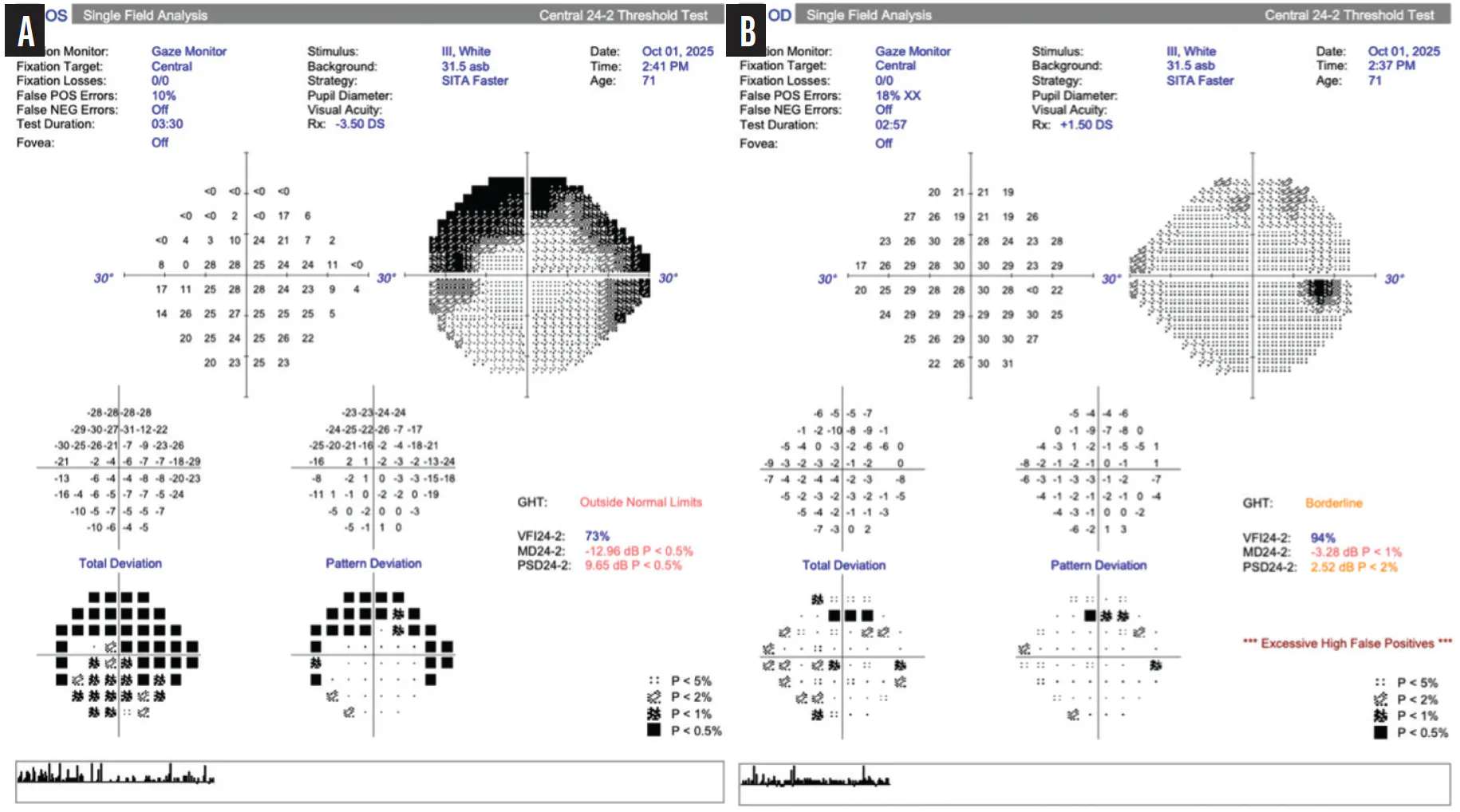
Figure 2. Humphrey visual field testing reveals superior arcuate and nasal defects in the left eye (A) and early superior and nasal changes in the right eye (B).
Given the elevated IOP and visual field defects in the left eye, the patient’s dependence on long-term steroid therapy, and her use of oral acetazolamide, which she was having difficulty tolerating, I recommended gonioscopy-assisted transluminal trabeculotomy (GATT) with goniotomy for the left eye.
PATHOPHYSIOLOGY AND RATIONALE FOR GATT
Management of uveitic glaucoma requires treating intraocular inflammation while controlling IOP fluctuation. Mechanisms of elevated IOP in uveitic glaucoma consist of inflammatory cells, fibrin, and an accumulation of proteinaceous debris within the trabecular meshwork that physically obstructs aqueous outflow. Chronic inflammation can lead to structural remodeling, including trabecular endothelial cell dysfunction, extracellular matrix deposition, and sclerosis of Schlemm canal. Additionally, corticosteroid therapy induces extracellular matrix deposition in the trabecular meshwork, increasing outflow resistance and decreasing aqueous outflow.
Although traditional surgical approaches such as trabeculectomy or glaucoma drainage device implantation can be effective, they are also associated with higher complication and failure rates than GATT, especially in inflamed eyes. GATT is a conjunctiva-sparing, angle-based surgery that directly addresses trabecular meshwork remodeling, debris deposition, and increased outflow resistance, which is particularly beneficial in eyes with uveitic glaucoma and steroid-induced ocular hypertension. Additional advantages of MIGS in a young patient with uveitic glaucoma include preservation of the conjunctiva and elimination of possible complications related to bleb leak, tube erosion, or infection.
POSTOPERATIVE COURSE
The patient underwent 360º GATT and 180º goniotomy in the left eye. On postoperative day 1, the IOP was 16 mm Hg, and her visual acuity was 20/80 due to a microhyphema. At 1 week, the patient had an IOP of 14 mm Hg off all ocular antihypertensive agents and 1+ pigmented anterior chamber cell off oral acetazolamide. Her visual acuity had returned to baseline at 20/25 OS. By postoperative month 3, the IOP was 16 mm Hg on one ocular antihypertensive drug plus a maintenance dose of one drop of prednisolone in each eye. The patient was pleased to have reduced her topical medication load and discontinued the oral acetazolamide.
CONCLUSION
A stepwise, tailored approach is crucial to balancing the safety and efficacy of IOP management, particularly in young patients with a goal of vision preservation. Individualized therapy based on their glaucoma etiology, age, life expectancy, inflammatory status, angle anatomy, medication tolerance and adherence, and rate of disease progression can help to minimize risk and improve outcomes. Compared to traditional filtering surgeries, GATT offers a favorable safety profile, with fewer long-term complications. Preservation of the conjunctiva is particularly important in uveitic patients, who may require future surgical interventions.