


Gonioscopy is an examination technique with a variety of grading systems dedicated to describing its findings. Yet, in many ophthalmology settings, gonioscopy has become somewhat of a lost art. Its use can leave some eye care providers not only scrambling through drawers to find the elusive goniolens but also wondering about the meanings and associations of the pathologies it helps to detect.
Gonioscopy is time-consuming and difficult for both the clinician and the patient. As a result, in many settings the technique has fallen by the wayside in favor of other diagnostic modalities, such as anterior segment OCT. Only recently has gonioscopy experienced a resurgence in utility among ophthalmologists who perform MIGS. However, the applications of gonioscopy are farther reaching than possibly assumed: Treasures are hidden away in the angle, waiting to be found by those willing to pursue them.
THE HISTORY IS IN THE PHYSICAL
From the first day of medical school, physicians in training are told that the answers to a patient’s diagnosis lie in the history of present illness. Although true for some ophthalmic conditions, a paradigm shift has occurred in ophthalmology: Examination skills have taken center stage in identifying the presence or absence of pertinent findings that point toward the underlying etiologies of disease. In fact, the most essential part of most case presentations is the examination. Whereas the patient history portion of a case presentation may be received by a less-than-enthusiastic audience, complete and undivided attention is typically given when examination findings are reported.
However, in this scenario, the presence of corneal deposits or ulcers, anterior chamber hyphema or hypopyon, vitreous debris or hemorrhage, and retinal tears or chorioretinal lesions get all the glory. Rarely, if ever, are gonioscopic findings presented, and, when they are, the presenter is often admired for taking that extra diagnostic step. Yet, gonioscopy should be considered an essential part of the ophthalmic examination because its findings often elucidate the etiology of disease, as evidenced by the following clinical examples:
- A patient who had not been previously diagnosed with ocular sequelae of diabetes presented with acute vision loss and elevated IOP. Gonioscopy revealed neovascularization of the angle without evidence of rubeosis, securing the diagnosis of proliferative diabetic retinopathy and confirming the appropriate treatment of anti-VEGF therapy and panretinal photocoagulation.
- A patient presented with photopsias but had an otherwise normal anterior and posterior segment examination. Gonioscopy revealed a darkly pigmented ciliary mass, which was later confirmed to be melanoma.
- A patient presented with a painful injected eye and reported no significant medical or ocular history. Gonioscopy revealed peripheral anterior synechiae and increased pigment in the inferior trabecular meshwork, confirming a history of anterior uveitis.
These gonioscopic findings were essential to determining the underlying etiologies of each patient’s presentation and subsequently selecting the appropriate management approach.
FROM BUBBLES TO BLOOD
In medical school, most of the procedures we observe in the OR are performed with the naked eye, with the surgeon using macroscopic techniques and the occasional robot or laparoscopy. In ophthalmology, however, the surgeon undergoes a complete metamorphosis into a microscopic specialist. Couple that with learning to use a scope or loupes, and it can be an uphill battle for a new surgeon. Although we may make a foray into using an indirect goniolens during clinic for examination or for laser trabeculoplasty and iridoplasty, the surgical use of a goniolens adds another layer of complexity. Intraoperative use is particularly daunting because it is direct and requires specific positioning of the patient’s head for optimal visualization.
But, from the OR to the laser room, the ability to identify angle structures is essential in a variety of settings and scenarios. Without adequate identification of the angle’s landmarks, the application of laser energy or the placement of a MIGS device can be a futile endeavor. For a new ophthalmology resident, it is validating to see the tiny air bubbles form after melding the trabecular meshwork with the laser. Taking that skill gained in clinic and building on it in the OR is an accomplishment. Placing a MIGS device under the scope while holding the lens with one hand and the injector in the other requires not only manual dexterity but also confidence in one’s ability to identify anatomic structures. Witnessing the blood reflux, particularly the first time, is satisfying and invigorating. Years of practicing gonioscopy can lead not only to surgical success but also to proficiency in the various utilities of the technique.
VIDEO RESOURCES FOR GONIOSCOPY
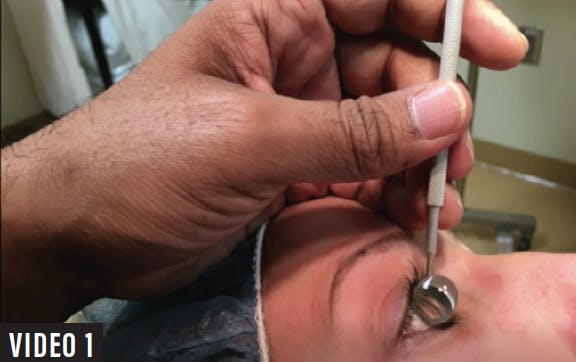
Intraoperative Gonioscopy
By Shakeel Shareef, MD
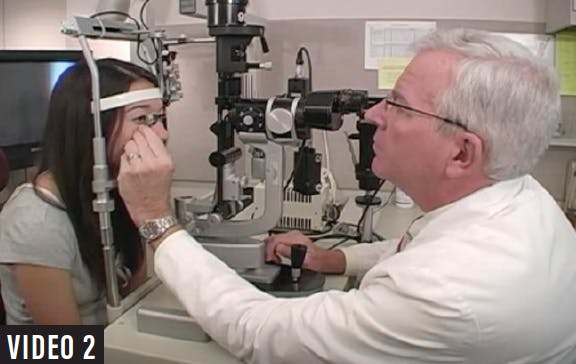
General Gonioscopy Exam Technique
By Wallace L.M. Alward, MD
CONCLUSION
Regardless of whether you plan to pursue a glaucoma fellowship, there is no denying the value of learning to use gonioscopy during ophthalmology training. Broad application of the technique in both ophthalmic examinations and procedures underscores the importance of its mastery. There are secrets hidden in the angle and a wealth of information to be extrapolated!


