Childhood glaucoma is a rare disease that, if left untreated, can lead to irreversible visual impairment. This, in turn, may affect a child’s development, education, and ability to perform the activities of daily living. Childhood glaucoma may also result in cosmetic changes, such as enlarged eyes and corneal clouding, which can adversely affect their emotional welfare and self-esteem. Other burdens, including financial strain, caregiver stress, and a reduced quality of life, are substantial but difficult to quantify.1-3 For these reasons, timely and appropriate treatment with MIGS is crucial to preserve patients’ vision and minimize glaucoma’s impact on their well-being.
To understand the role of MIGS in the treatment of childhood glaucoma, it is important to consider the defining characteristics and advantages of these procedures compared with traditional glaucoma surgeries, such as trabeculectomy and glaucoma drainage device implantation. MIGS, as defined by Ahmed et al, represents a group of procedures characterized by an ab interno microincisional approach, minimal tissue trauma, effective IOP reduction, a strong safety profile, and rapid postoperative recovery.4 These features make MIGS a safer and less invasive alternative to traditional glaucoma surgery. Although conventional filtering surgeries are effective for lowering IOP, they carry a higher risk of long-term complications, including hypotony, bleb-related issues, and tube-related problems. Consequently, filtering surgeries are generally reserved for specific subtypes of childhood glaucoma or cases in which angle surgery has failed.5 By definition, MIGS procedures preserve the conjunctiva, thus offering a critical advantage in pediatric patients who face a lifelong disease course and often require multiple surgical interventions.
This article builds on previous reviews of the use of MIGS in pediatric patients by incorporating recent clinical data and newer devices.6,7
MICROCATHETER-BASED TECHNIQUES
Interest in MIGS techniques has grown significantly,8,9 with traditional angle surgeries such as goniotomy and trabeculotomy remaining the mainstay initial treatments for primary congenital glaucoma.5
Shi et al investigated the use of the iTrack 250A microcatheter (Nova Eye Medical) for ab interno trabeculotomy in patients with primary congenital glaucoma. The researchers reported a 12-month success rate of 87.9%, which exceeded the 82.2% success rate achieved with the ab externo approach while also preserving the conjunctiva.10 A second version of this device, the iTrack Advance (Nova Eye Medical), was designed primarily for ab interno canaloplasty and has demonstrated good clinical outcomes in adults.11 Its benefits may also extend to the pediatric population, with newer applications such as trabeculotomy being explored.12,13 The iTrack Advance builds on the iTrack 250A by incorporating a preloaded handheld injector that enables precise ab interno delivery of the illuminated microcatheter. This design eliminates the need for frequent manipulation of intraocular forceps and potentially improves surgical efficiency during Schlemm canal cannulation.
Both iTrack devices offer the advantage of continuous catheter tip visualization via the use of an illuminated beacon (Figure); this helps minimize the risk of undetected subretinal or suprachoroidal misdirection, a potentially serious complication. If the catheter becomes lodged within the canal or diverted into collector channels, the illuminated tip facilitates accurate localization and retrieval via a targeted cut-down approach.14
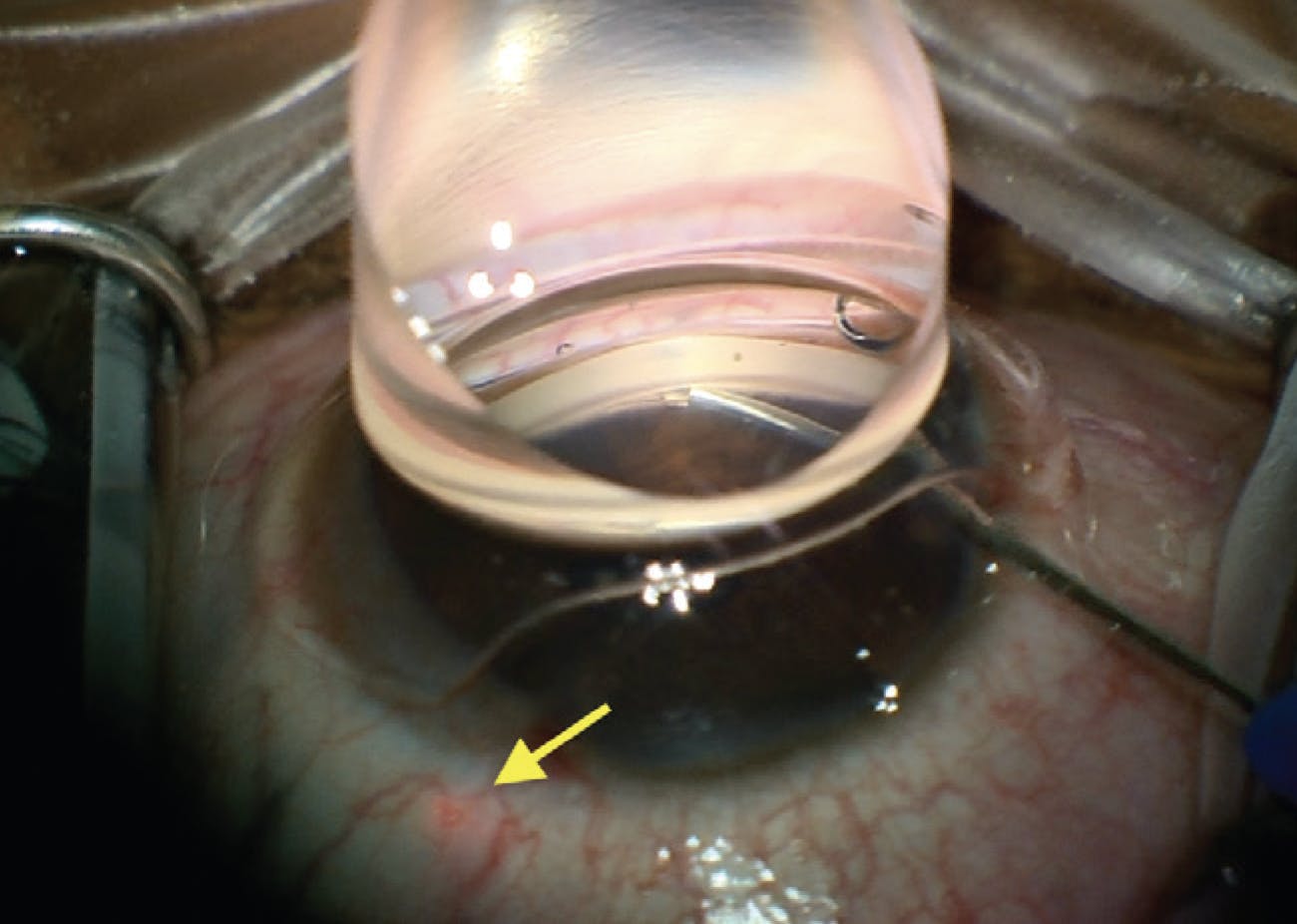
Figure. Canaloplasty using the iTrack Advance, performed without the assistance of intraocular forceps to advance the microcatheter through Schlemm canal. The yellow arrow indicates the position of the catheter’s tip within the canal.
EXCISIONAL GONIOTOMY AND SUBCONJUNCTIVAL IMPLANTS
The use of other MIGS approaches, such as excisional goniotomy and subconjunctival implants, has also been reported recently in the pediatric glaucoma literature. The Kahook Dual Blade (New World Medical), an excisional goniotomy device designed to remove a portion of the trabecular meshwork, features two parallel blades and a ramp that lifts, stretches, and excises the trabecular meshwork. In a study of 21 eyes of patients with a median age of 6 months, ab interno trabeculectomy with the Kahook Dual Blade, targeting 100° to 120° of the nasal iridocorneal angle, yielded a significant reduction in IOP at all follow-up visits.15 No serious complications occurred. However, only 12 eyes (57.1%) met the study’s success criteria, defined as an IOP of 21 mm Hg or less at the 1-year follow-up visit with no evidence of glaucomatous progression.15
A pseudo-MIGS device, the Preserflo MicroShunt (Santen/Glaukos), deserves mention, even though its implantation requires conjunctival incision/dissection. The Preserflo is a small tube-like implant designed to drain aqueous humor from the anterior chamber to the subconjunctival space via an ab externo approach. Its use was evaluated in a prospective case series of 12 patients aged 15 months to 14 years who had refractory childhood glaucoma. The investigators found that Preserflo implantation resulted in successful IOP control in 75% of eyes at 1 year, with an average 45% reduction in IOP and a significant decrease in medications.16 In a retrospective multicenter observational study, Preserflo implantation significantly reduced IOP and the medication burden in patients with pediatric glaucoma at 2 years postoperatively. A 45% success rate was noted at the final follow-up visit, with no sight-threatening complications reported.17 Although implantation of the Preserflo involves conjunctival dissection, requires an ab externo approach, and results in the formation of a small bleb, the procedure is still considered substantially safer than traditional trabeculectomy and tube shunt surgery because it avoids scleral dissection, sclerostomy, iridectomy, and tensioning sutures and meets the other defining characteristics of MIGS.18,19
Shifting focus from outflow to aqueous suppression, the use of endoscopic cyclophotocoagulation for pediatric glaucoma was explored in a 2024 meta-analysis of 159 patients. Over a median follow-up period of nearly 3 years, a significant reduction in mean IOP was observed, from 32.9 ±8 mm Hg on 1.7 ±0.7 medications to 22.6 ±9.8 mm Hg on 1.2 ± 1.1 medications, with patients requiring an average of 1.3 treatment sessions.20
CONCLUSION
Although newer MIGS devices have emerged and additional data on existing technologies have been published, high-quality pediatric evidence remains limited for many of these procedures. Nonetheless, MIGS should be considered an important part of the surgical armamentarium for the treatment of childhood glaucoma, and the careful adoption of new techniques, alongside ongoing research, is essential. Until robust long-term safety and efficacy data become available, the focus must remain on the judicious monitoring of long-term complications through a cautious and evidence-based approach.
1. Barke M, Dhoot R, Feldman R. Pediatric glaucoma: diagnosis, management, treatment. Int Ophthalmol Clin. 2022;62(1):95-109.
2. McLaughlin DE, Semrov A, Munshi H, et al. The impact of childhood glaucoma on psychosocial functioning and quality of life: a review of the literature. Eye. 2023;37(15):3157-3173.
3. El Sayed YM, Elhusseiny AM, eds. Childhood Glaucoma: Current Trends and Future Prospects. Springer Nature; 2024.
4. Saheb H, Ahmed IIK. Micro-invasive glaucoma surgery: current perspectives and future directions. Curr Opin Ophthalmol. 2012;23(2):96-104.
5. Aktas Z, Gulpinar Ikiz GD. Current surgical techniques for the management of pediatric glaucoma: a literature review. Front Ophthalmol (Lausanne). 2023;3:1101281.
6. Chang TCP. MIGS in kids. Glaucoma Today. September/October 2016. Accessed July 20, 2025. https://glaucomatoday.com/articles/2016-sept-oct/migs-in-kids
7. Coulon SJ, Chang TCP. Microinvasive glaucoma surgery in children. Glaucoma Physician. December 1, 2021. Accessed July 20, 2025. https://glaucomaphysician.net/issues/2021/december/microinvasive-glaucoma-surgery-in-children/
8. Li R, Liu H, Zhang K, Lu Z, Wang N. Global tendency and research trends of minimally invasive surgery for glaucoma from 1992 to 2023: a visual bibliometric analysis. Heliyon. 2024;10(16):e36591.
9. Minimally Invasive Glaucoma Surgery (MIGS) Devices Global Market Report 2025. The Business Research Company. January 2025. Accessed July 24, 2025. www.thebusinessresearchcompany.com/report/minimally-invasive-glaucoma-surgery-migs-devices-global-market-report
10. Shi Y, Wang H, Oatts J, et al. Ab interno vs ab externo microcatheter-assisted trabeculotomy for primary congenital glaucoma with clear cornea. Clin Exp Ophthalmol. 2020;48(9):1201-1209.
11. Khaimi MA, Koerber N, Ondrejka S, Gallardo MJ. Consistency in standalone canaloplasty outcomes using the iTrack microcatheter. Clin Ophthalmol. 2024:173-183.
12. Smith S, Wang J, Kamat S, Sheybani A, Patterson I, Qiu M. Three techniques for 360-degree gonioscopy-assisted transluminal trabeculotomy with iTrack advance. Am J Ophthalmol Case Rep. 2024;36:102192.
13. Elhilali HM, Aboalazayem F. Ab-interno angle surgery. In: El Sayed YM, Elhusseiny AM, eds. Childhood Glaucoma: Current Trends and Future Prospects. Springer Nature; 2024:225-238.
14. Meshksar A, Razeghinejhad MR, Azimi A. Ab-interno trabeculotomy procedures: a review. J Curr Ophthalmol. 2023;35(2):110-124.
15. Elhilali HM, El Sayed YM, Elhusseiny AM, Gawdat GI. Kahook Dual Blade ab-interno trabeculectomy compared with conventional goniotomy in the treatment of primary congenital glaucoma: 1-year results. J Glaucoma. 2021;30(6):526-531.
16. Brandt JD. Use of a novel microshunt in refractory childhood glaucoma: initial experience in a compassionate use/early access cohort. Am J Ophthalmol. 2022;239:223-229.
17. Duarte SR, Lima-Cabrita A, Barão RC, et al. Efficacy and safety of the Preserflo MicroShunt in pediatric glaucoma. J Glaucoma. 2025;34(6):455-461.
18. Balas M, Mathew DJ. Minimally invasive glaucoma surgery: a review of the literature. Vision. 2023;7(3):54.
19. Saeed E, Gołaszewska K, Dmuchowska DA, Zalewska R, Konopińska J. The PreserFlo MicroShunt in the context of minimally invasive glaucoma surgery: a narrative review. Int J Environ Res Public Health. 2023;20(4):2904.
20. Elhusseiny AM, Hassan AK, Elsaman AS, et al. Continuous wave transscleral cyclophotocoagulation and endoscopic cyclophotocoagulation in childhood glaucoma: a meta-analysis. J Glaucoma. 2024;33(6):456-463.